6mm AI vs. 6x284

Verminator2

Active member
To all those that answered my other post, http://www.predatormastersforums.com/ubb...page=1#52882244 , thanks. I'm now down to two cartridges for my build, the 6mm Ackley Improved and the 6mm/.284. I'm starting to lean toward the idea of the Ackley because A. brass is cheaper B. I can have fun while fire forming C. It achieves almost the same velocities with out as much powder according to my Sierra manual D. I can use powders like IMR-4895 and Varget, which I already use. Well now that I put it like that I think I just talked myself into one, but what do you guys think? 6mm AI or 6/.284.
 
I had a 243AI and now shoot a 6/284. I agree with Dan, the 243 is inheritly more accurate then the the two you mention. Also the 6mm/284 is better built on a long action, I know because mine is on a short action.
 
Quote:
"... I agree with Dan, the 243 is inheritly more accurate then the the two you mention."


I read Dan's comment 12 times, and I keep missing the part where he said, "the 243 is "inheritly" more accurate then the the two you mention".

Could you please point out that part to these old eyes - I still can't find it?

There is NO difference in accuracy between the three rounds... accuracy is dependent on the quality of the rifle and barrel work.


.
 
The 6mm AI would be the best choice or just the plain 6mm Rem . The 6mm-284 is one round i haven't been impressed with ,a lot more powder with very little gain.
 
Quote:
The 6mm AI would be the best choice or just the plain 6mm Rem . The 6mm-284 is one round i haven't been impressed with ,a lot more powder with very little gain.


Bea175...

I just put together a 6mm Rem on a Rem 40-XB action - not the BR but the plain ol' 6mm/244 Rem.

The rifle was built for long (LONG) range chuck shooting.

I had thought long and hard about whether to cut an Ackley chamber for 6 or 7 months, and finely decided on the standard chamber, and here's why.

I bought about 700 pieces of Winchester's limited run brass - it's really good stuff.

The idea of fireforming 700 pieces of brass, even using COW was not appealing, whatsoever!

Plus, the 6mm Rem and the 243 Win are already pretty hot cartridges out of the box, and the extra ~100 fps just wasn't worth the headaches of fireforming and spending over $200 in Redding comp dies, when I already had a full set in 6mm Rem.

Now someone starting from scratch won't already have dies, but there is another downside to Ackley chambers.

Most 'smiths are using 0.004" shoulder/neck setback to cut Ackley chambers, and frankly, that ain't enough to hold the case in place when fireforming.

RagnCagn on this site just got two 25-06 AIs built by one of the most respected 'smiths in the country - the setback is ~0.004", and he is loosing 30% of his cases to head separation on the first fireforming (factory ammo), and the cases that didn't separate, are clearly weakened in front of the web... now, that's a BADD THING!!

When I was a "grasshopper" doing my apprenticeship in gunsmithing, I was taught that for an Ackley setback, it should be ~0.02" to 0.03" - that's five to eight times what is now current - we were taught that you had to really "lean" on the bolt for fireforming the first shot on a case.

Now, RagnCajin will have to oil his cases for the first firing in order for them to form without badly stretching or separating at the web.

My point here (in case I have wandered too far) is that the Ackley chamber does NOT come without it's own set of problems, headspace, and it's management, being one of them.


.

 
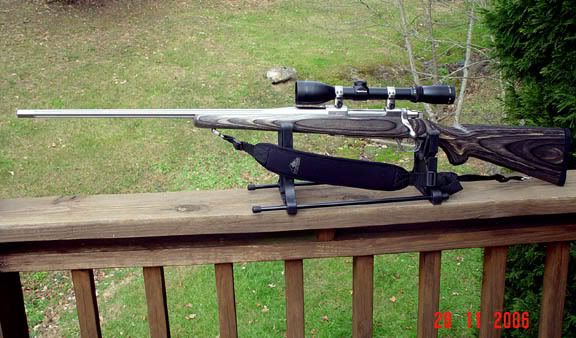
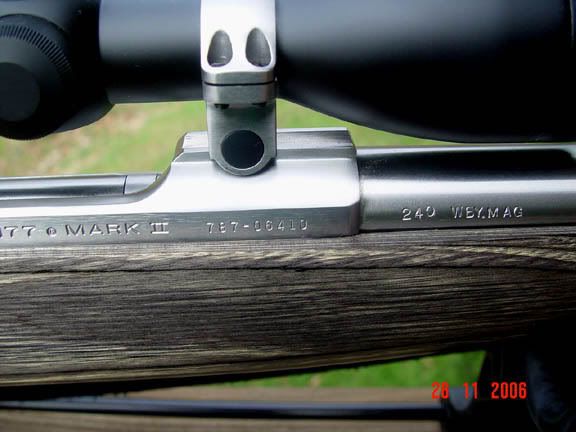
Two other choices is the 6mm-06 or the 240 Wby which is my favorite. The draw back with the 6mm-06 is the cost of a set of dies but you can use 25-05 brass and just run them through the dies and you have your cases. The 240 Wby chamber can vary a little based on the reamer that you use to cut the chamber but after firing the case in your rifle just adjust your sizing die to size to the base of the neck to head-space and not off the belt . I built my 240 Wby with a 1&10 twist 26 inch barrel on a Ruger 77 LH action . My rifle grouped the first load i tried with a new barrel just under 1/2 inch Hornady 95 gr SST and Rel 22 and WBY Brass.The 240 Wby is my favorite 6mm round with the 243 and 6mm running second and third.

240WBY1.jpg

240WBY2.jpg
 
Quote:
"When I was a "grasshopper" doing my apprenticeship in gunsmithing, I was taught that for an Ackley setback, it should be ~0.02" to 0.03" - that's five to eight times what is now current - we were taught that you had to really "lean" on the bolt for fireforming the first shot on a case"

What is the current thinking on crush fit?


"What is the current thinking on crush fit?"

From what I see - it's all over the place - My last stuff from PTG (243 AI) was a 0.004" setback at the shoulder/neck junction - and when you consider that there is 0.007" allowable variation in brass headspace, that means it's all over the place.

I think 4 thou is now the agreed setback - and it's not enough (IMNSHO).

When Ackley started this whole thing, Fred Huntington was still running RCBS, and they were the ONLY shop that would make wildcat dies (for the same price as standard dies!!).

So when you had an Ackley built, you sent 3 cases to RCBS, and they made your dies to fit the chamber, so 30 thou setback was not usual - and NOBODY ever had head separations when fireforming.


.
 
I usually set the headspace on an AI to .000" as compared to a standard set at .0015" That with my custom reamers and gages sets the HS for the AI at -.006" of the standard parent case size. Customers complain about the pressure needed to close the bolt on the standard case. Also, I always advise the new guys to use moly lube on the locking lugs every 2 shots to keep metal galling down. I've never had many issues with AI's that I've built. I personally own a few, love em..
 
Quote:
Quote:
"... I agree with Dan, the 243 is inherently more accurate then the the two you mention."


I read Dan's comment 12 times, and I keep missing the part where he said, "the 243 is "inherently" more accurate then the the two you mention".

Could you please point out that part to these old eyes - I still can't find it?

There is NO difference in accuracy between the three rounds... accuracy is dependent on the quality of the rifle and barrel work.


.


Are just looking for an argument? You seem to have the opinion that you are the resident expert here but some of us have been around the block a few times also...

I agreed with Dan on the 243AI as another option. The comment on inherently accurate is my own!

In my experience there is a big difference in the three calibers ability to find an accurate load, the end result is the same but the 243AI seems to shoot any load combination you throw at it.
 
I have 3 ackleys and don't have any case stretch issues when forming. I have a slight resistance when closing the bolt, and they form just fine. I also jamm seat the bullets to get a firm rearward pressure against the boltface.

If he is losing cases on fireforming, I would have to say that others factors are at play.
 
The past two coyote season with my 257 AI was a hoot, with that I decided to try the 244 AI for this fall \ winter. I’ve done a lot of load development since early April here is one of my recent targets off the bench at 100 yards. In the picture my seating depth I have noted as .000, this is a note to myself that I have the bullet just touching the lands. The barrel is a Shilen 1-10 @ 26” with brake, on a TC Encore frame. Is it a shooter? I think so..

Good luck with your project

B..

244AI100Y-1.jpg
 
Quote:
If .004" didn't work.
What is the current thinking on crush fit?


It should be whatever the shooter and the gunsmith decide they want. Crush is just the neck/shoulder of a chamber pushing the neck/shoulder radius of the case. It's a very small contact point and the .004" crush number that gets tossed around isn't nearly enough.

For instance, I measured a bunch of .243 cases....PMC, Win, and Lapua..... from casehead to neck/shoulder junction, which is where an AI case headspaces during fireforming. Within EACH headstamp there was .004-.005" variation. And between the longest of one headstamp and the shortest of another there was .009" difference, just within the samples measured. I don't know how these measurements would've corresponded to go- no go gauges, but it did show me that .004" isn't a good number. You want a good tight seal and with a chamber that's only .004" short, there can easily be excess headspace.

My AI chambers are all short. Only the .223AI at .006" crush is close to what people consider normal for an AI cartridge. The 22-250AI has .025" crush, the .243AI has .020" crush., the .257AI has .010", and the 6mmAI has .012". Felt bolt pressure varies from a little to an occasional pretty good push. And these are average/approximate numbers because if you measure any bunch of new brass, they can vary by a little or they can be all over the place.

These measurements are all taken with a window gauge. This is made when the new barrel is chambered. It's about a 1" section of barrel cut with the throat, neck, and part of the shoulder. The "window" part is a cutaway so that the whole neck and throat is visible. Use this gauge to determine seating depth, throat wear, and to see exactly how long your brass is compared to the chamber. It's a very handy thing to have. Every rebarrel job should include one of these.
 
Quote:
Quote:
If .004" didn't work.
What is the current thinking on crush fit?


It should be whatever the shooter and the gunsmith decide they want. Crush is just the neck/shoulder of a chamber pushing the neck/shoulder radius of the case. It's a very small contact point and the .004" crush number that gets tossed around isn't nearly enough.

For instance, I measured a bunch of .243 cases....PMC, Win, and Lapua..... from casehead to neck/shoulder junction, which is where an AI case headspaces during fireforming. Within EACH headstamp there was .004-.005" variation. And between the longest of one headstamp and the shortest of another there was .009" difference, just within the samples measured. I don't know how these measurements would've corresponded to go- no go gauges, but it did show me that .004" isn't a good number. You want a good tight seal and with a chamber that's only .004" short, there can easily be excess headspace.

My AI chambers are all short. Only the .223AI at .006" crush is close to what people consider normal for an AI cartridge. The 22-250AI has .025" crush, the .243AI has .020" crush., the .257AI has .010", and the 6mmAI has .012". Felt bolt pressure varies from a little to an occasional pretty good push. And these are average/approximate numbers because if you measure any bunch of new brass, they can vary by a little or they can be all over the place.

These measurements are all taken with a window gauge. This is made when the new barrel is chambered. It's about a 1" section of barrel cut with the throat, neck, and part of the shoulder. The "window" part is a cutaway so that the whole neck and throat is visible. Use this gauge to determine seating depth, throat wear, and to see exactly how long your brass is compared to the chamber. It's a very handy thing to have. Every rebarrel job should include one of these.


Good post with good information... that's why he's "The Ackman" /ubbthreads/images/graemlins/smile.gif

Dan.

I think the crush thing has been made very short so gunsmith's won't get complaints from customers about "My gun is too hard to close!"

And customers want the best of both worlds - they want improved cases and performance, but they want it smooth and slick too.


.

.
 
Quote:
So I assume 6mm AI? This got a little off track.


Well, sorta.

For powders, the classic powders for the 243 and 6mm Rem are H-4350 and H-414, or powders that are in that burning range - Varget and H-4895 might be OK with 60gr bullets, but even with the little 60 grainers, you will loose 200 to 300 fps because the those powders just burn too fast.

But it would be a shame to cripple a good long range cartridge with those itty bitty boolets.

Load 75 or87 V-Maxs and H-4350 and really reach out and touch something... /ubbthreads/images/graemlins/wink.gif


.
 
Quote:
Quote:
Quote:
"... I agree with Dan, the 243 is inherently more accurate then the the two you mention."


I read Dan's comment 12 times, and I keep missing the part where he said, "the 243 is "inherently" more accurate then the the two you mention".

Could you please point out that part to these old eyes - I still can't find it?

There is NO difference in accuracy between the three rounds... accuracy is dependent on the quality of the rifle and barrel work.


.


Are just looking for an argument? You seem to have the opinion that you are the resident expert here but some of us have been around the block a few times also...

I agreed with Dan on the 243AI as another option. The comment on inherently accurate is my own!

In my experience there is a big difference in the three calibers ability to find an accurate load, the end result is the same but the 243AI seems to shoot any load combination you throw at it.


Well it seems if you follow long range shooting much the last few years that theres always a .284 something setting a new record so say a .243 or 6MM Remington case is more inherently accurate doesn't cut much with me.

New 1000 yard record from a what?
 
Back
Top