Coyotes east and west

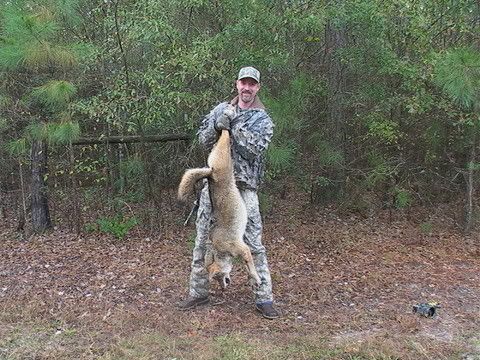
As far as size goes. We kill one or two here in East Texas every year that will go over 50#s. I have a picture of one on my website we killed last year that weighed 52. I do subscibe somewhat to the Burgman theory but not entirely. The coyotes I've hunted in Idaho average about 10 pounds less than these dogs here, as do the coyotes from west Texas.

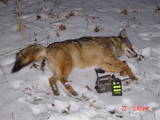
Here is a picture of one we called in couple of weeks ago that weighed 45. This is not uncommon for a mature male from here.

DSC00268.jpg


We called in a female last week that weighed over 40. They have plenty to eat here year round, but still come to the call. They can't help it. (tip)You just have to make it easy for them.

Byron /ubbthreads/images/graemlins/laugh.gif
 
It almost looks to me like we could use a new forum here.How 'bout"Calling in the Northeast"or "New England-Maritime Provinces Tactics".I live about 4 miles from the Atlantic Ocean,in a province roughly the size of TN or KY?I Think?10,000 sq. miles or so,give or take?Population...700,000??How many people live in KY?TN?..80+% of the land here is "Crown Land",or public,meaning anyone can hunt there during any open season.NOBODY DOES AFTER DEER SEASON!Coyote hunting pressure is non-existent.I don't buy this argument at all that eastern yotes are more nocturnal because of humans/hunting pressure,or this that and the other thing.I would bet my last dollar that the human population/sq.mile is less here than ANYWHERE in the Lower 48. :eek: (hope i"m Right).Point is,it has nothing to do with "Calling In The Overcrowded East"where alot of you guys hunt.It's just a whole diffrent ballgame here.They are a different animal here.I respect that alot of you guys are knowledgeable and successful in your home states or wherever,but where da hell is Ohio?Kentucky?Michigan?Missouri???...'Bout 1000-1500 miles inland from here,that's where.That's "out west" from where I sit.Comparing hunting the Mississippi Flyway to hunting the Atlantic is like apples/oranges.
 
I hold Byron's comments on proximity very valid. In my valley to hill, field to forest layouts, I have driven myself to a new level of multiple mental phobias running scenarios through my mind on setups. When I think my setup plan of the day will work, the wind changes, etc, etc.

I quit worrying about big and little coyotes. It is much like fly fishing. If God wants you to have a 50 pound coyote, like a 30" brown trout, he'll give you one when you earn it. I just concentrate and hunt the animal now. I'll weigh it when I shoot it.

I don't think the question is how big or smart an eastern coyote is. The question is how dumb I am. All we can do is hunt - and that ain't all that bad.
 
Same coyote different conditions. If you pick your stands with care get within ear shot and call he will respond, most of the time. This is how they make a living. They are coyotes. They respond to distress calls. Now if there are no people to educate them then you got it made. Find where he is hanging out, set him up with everything you can in your favor (wind,terrain), blow the call, when he responds kill him. This is a little over simplified but my point is. I could care less what predator your hunting and on what continent it is. They will respond under the right conditions, most of the time. Murry Burnham told me one time "hell this stuff don't work every time". Sometimes they won't come regardless of the best efforts that particular day for what ever reason. All you can do as hunter/caller is to be in control of as many of the variables as possible. They are creatures of habit and do what they do as results of certain conditions.

Byron /ubbthreads/images/graemlins/laugh.gif
 
Grinr, I can show you 400 square miles of " Crown Land " where no one lives. All public domain. The majority of the winter I will be one of the very few in there. Coyote population is one for every 8/10 of a mile. I've been getting my fanny kicked in a major way for three years now hunting in there. Why do I keep working it?

I got a total of four of the 30 coyote's I called in up there last winter. Each one of those thirty animals taught me something. They have a lot more to teach and I'm going to be the best pupil I can.Jimmie
 
Never said Eastern coyotes were smarter, in fact I said:
just not a bunch of coyotes here in New England, but the ones that are here are fairly easy to kill (until I educate a few). They just require a different approach, or they will seem very smart. Hunt them right, and they die good.
and
But no, when you set up on a coyote that is not call shy, and do not make the mistake of trying to call him into the open, he will respond just like a dog on one of Byrons videos.
Its just the populations we will have to agree to disagree on! /ubbthreads/images/graemlins/smile.gif Also, our coyotes are not nocturnal, they just live in the woods, where very few Eastern hunters have thought to hunt them. I don't hunt at night, so all my kills are daytime. We are limited to 22lr, NO LIGHT, or shotgun, so I do not even bother.

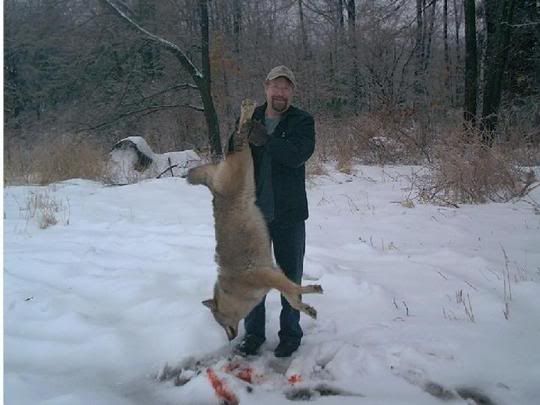
As far as size, goes Byron, I'll see you that coyote, and raise you this one /ubbthreads/images/graemlins/laugh.gif You seem like a good dude Byron, and if you ever make it to Granville, Ma., drinks are on me!!
im000669.jpg
 
Thanks Sleddog, I may take you up on that offer, and for what its worth I don't disagree with a word you have said. Thats a huge coyote. I sure wish our coyote were fured up that good. Eastern callers have all kinds of odds stacked against them compared to the Western callers. Our margin for error with lower numbers, and tighter spaces we can't afford to make many mistakes and expect to kill coyotes. Out west you can get by with a whole lot more. We just have to work with what we've got.

Byron /ubbthreads/images/graemlins/laugh.gif
 
Reading this great thread on east vs. west, smartness, size etc. I found the part about interbreeding with wolves curious. Since they are two seperate species I would think this would be a one time thing. Similar to breeding a horse to a an ass and getting a mule. The mule can't breed. The same goes for coyote to dogs. Two different species, not the same breed. Sure it would throw off pups but these offspring would be sterile.
Being a newbie I'm finding this forum to be one heck of a place for some great reading and learning. Thought I'd add my 2 cents on this.
 
I appreciate Byron's no-nonsense opinion on this topic. I live in SC. In my area it's hard to find large pieces of ground with no homes on it, or at least very nearby. The large public lands are "rimfire only" outside of deer season. There's no night hunting allowed for predators anytime. We just have to hunt hard and be patient. Sometimes I wonder if watching all these videos of western hunts is our biggest problem. /ubbthreads/images/graemlins/wink.gif

The best years of hunting I have had were a result of really getting serious about obtaining permission for private lands, and having the time available. The more ground I have, the better I do. The more time I spend out there also seems to help the numbers.

JB
 
From what I have read biologist consider the Mississippi river to be the dividing line between Eastern and Western Coyotes. I haven't found or read anything so far that places or considers placing Northeastern or New England Coyotes into a biological category of their own.

As far as calling in the East goes, we are all East of somewhere.
 
Riccu,

Wolves and Coyotes are canines, like Beagles and Walkers. If you bred dog breed "A" with dog breed "B" you would get "AB" pups and they would not be sterile. If this was not true most of todays dog breeds would not be here.
 
Byron said:
One more thing You will never be a good predator caller, until your a good predator hunter.
I've refrained from posting and read this thread with interest until now. The quote above is maybe the most important single statement made in this entire discussion, IMHO. Read through Byron's original post again and think about it.

If you waded through that big story of mine about "Good Day Calling..." think about the coyote I called last Saturday. I saw that coyote approaching on the lope, he was hot to the call. He was about 125 yards in big open woods when I first spotted him. Guys, where I hunt, seeing a coyote at over 100 yards is a pure rarity, usually the range is closer to 70-80 yards or less when first spotted. I wanted him closer and moving slower for a shot in the timber. There was one little detour that coyote could take to get the drop on me and bust the stand. And it did so. From the time I saw the coyote until I fired the shot that didn't connect and it was gone from sight, total elasped time was probably less than six seconds. From where I first saw the coyote to where it dissapeared was only 150-175 yards total, how fast can a coyote on the lope, then running hard cover 175 yards? Dang fast let me tell ya! And this was a long encounter for me in my woods.

You might wonder why I didn't have my Dad on that little side ridge instead of where he was posted. If you read the story you know that I was aware that could be a problem for me. Here's why...the critters weren't "supposed" to come from that direction (left - right). They were expected to come from the thick cover of the lake and brushy creeks on the right, that'd put the wind totally in my favor. An approaching critter coming from that direction would have to make a long wide loop to get into the scent cone behind me, offering a lot of time and visability for a shot opportunity. And that's part of the problem we face in thick cover. Responding coyotes may come from dang near anywhere. Yeah, the best cover was to the right. The coyote on the other hand was on the left and there's no way to control that in tight cover. When you get out on a fresh snow, make a long circle around your calling stands and I think you'll be surprised how many animals you actually do call that circle wide and downwind that you never see.

The tight cover and quick reactions and instincts of the coyote work against us, more than any supposed IQ ratio. My coyotes are mostly virgins with little human contact. There are no farms, few scattered houses, and zero predator hunting pressure over hundreds of thousands of acres. It's area, not brain power that makes coyote hunting in the thick stuff so tough. George Brint of Predator Supreme and Decoy Heart told me that I hunt the toughest way he knows of, RIGHT IN THEIR BEDROOMS! His advise? Find another place to hunt them with some open areas! There are no such places in the National Forest I hunt so you learn to be a hunter first and foremost.
 
GC - you and I are in the same boat, as I hunt mostly woods also. Can't hunt in the open even if its available, as Eastern coyotes don't do the "charging into an open field" thing too often. I gave up hunting conventional after one year of doing exactly what you said. Walking downwind after a stand in the snow. I was horrified when I saw how far off they winded me. They just wrapped around my stand location time after time and slipped out. They winded me way out, over 100 yards. So thick I never even got a glimpse. I got tired of that fast, and don't hunt them conventionaly now. Call in to shot ratio is very acceptable now.

I hate being winded. But a bad day being winded by a coyote still beats a good day at work /ubbthreads/images/graemlins/laugh.gif
 
I tell ya what, I learn more and more on here every time I stop by. I try to read everything I can and apply it to my hunt in order to see what works for me and what you two are saying kinda hit home today.

I went out to a piece last night for a short hunt before the snow came in today. I was just trying to see what was there, never hunted it before then.

I got out of the truck and got my stuff then just sat there for a few minutes listening. They were howling on their own in several locations, the closest one to me was about 300 yards away across open field in another piece of woods I'm allowed to hunt. Instead of going to that woodlot I decided to stand on a fence row where I was at.

I let out a few howls and they responded. Waited a minute or so then started with the rabbit call. Called off and on for a while with no response. Let out a few more howls and they would respond. I went through my calling sequence 3 times and they never came in but always howled back. The wind was in my face and they were howling from upwind of me. I even put away my e-call and went with a longrange rabbit call thinking that the wind was cutting down my range.

Another guy on here "KeeKeeYelp" suggested that they were not coming in due to territorial issues and they very well may not be. After reading you guys posts I am questioning my stand locations. I try to hunt the edges of fields in an attempt to get them in the open or get them to use the fence rows. Do you think that maybe they are hugging the woodlots for some reason?
 
I have enjoyed reading this thread so much that I got way off the original question. My answer as to where the dividing line is between Eastern coyotes and Western coyotes has to be where the terrain features change from mostly rolling hills and low brush into larger timber and river bottoms. This line, down South, starts about the Eastern third of Texas an goes almost directly North into Canada. The bioligist often refer to the Mississippi river as the dividing line I believe because in recent history, 20 years or so back there were hardly any coyotes East of that line. This has drastically changed. Now there are coyote in the intire lower 48 and in sustainable numbers. Guys that live in Eastern Texas, Eastern Oklahoma, Arkansas, Lousiana or any other state West of the Mississippi, but East of the line I mentioned earlier are hunting the same coyote and habitat as most of the guys hunting East of the Mississippi with few exceptions. For me the term Eastern Coyote should be changed to woodland coyotes as opposed to desert, or prarrie coyotes. Ask a guy that is confined to hunting the coyotes in the thick mountonous terrain of Washington state (West) how easy his Western coyotes are to kill.

I believe that guys that have hunted coyotes there intire lives in the thick stuff can benifit from either going out West or into more open terrain where they can get a visual, mental picture on how coyotes react to there calls and use the terain and wind to their advantage. This can also done by watching how they respond in the videos that are filmed in more open country. Guys can then go back and aply this knowledge to calling in the thick stuff. Hunting the woodland coyote is much the same as hunting more open ground coyotes with blinders on. The major difference in woodland coyotes vs open land coyotes is that they have a distict advantage in the thick stuff. They can smell you long before you can see them. You can't kill them unless you can see them before they do this, hence the word set-up. If you can hunt the edges of the thick stuff it will make it easier to set him up. If there are no edges then look for terrain feature such as rivers, bluffs or something that will help deture him into you and your set-up. Woodland coyotes hunters then have to be better hunters and pay closer attention to the details to be consistantly successful in getting a coyote where you can see him. Most of us would be amazed, includeing me, at the number of critters we have called in and never seen. Guys like GC and Sleddog and others that have been calling for years and have figured it out, and have developed and eye for what a good a set-up looks like. There are so many variable to this equation It would take a book to cover. I have got off topic again, so I will stop. Thanks for all the post. this is a very interesting topic.

I hope this doesn't sound like a shameless plug for my videos, but much of this is covered in both of my videos. There is plenty of footage on both videos from both woodland, and more open, Western habitat.

Happy Holidays and Good Hunting

Byron /ubbthreads/images/graemlins/laugh.gif

 
Issues /ubbthreads/images/graemlins/tongue.gif The coyote is born with them! Anything can and often will go wrong when calling them. Territory, terrain, cover and numerous other things go into the mix when calling them.

A for instance, Last year I was working a group I had heard howl at 2:30 in the afternoon. I couldn't have asked for a better setup[ than the one I found. Long sloping point with wind in my face. Plenty of large trees for me to prop against and hide my silhoette. I set up my e-caller at about thirty yards in front of me and sat against a huge white oak. In five minutes I had not just one but four coyotes coming up that slope . The last in line stopped about eighty yards out staring right at me.When it turned I took the pup standing at the decoy and questioned why the other stopped and turned. Let the caller run it's course for the thirty minutes. Right at the end of the tape a coyote aproached that I never even saw though it aproached from the same general direction. It too stopped and turned away outside of my shotguns effective range as soon as it was seen.

I couldn't figure out why these animals behaved this way. I had good cover, large white oak tree with a little brush in front to hide me. What the heck went wrong?

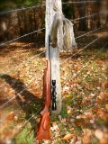
When I went to collect my one coyote and my caller I looked uphill where I had left my ghillie and shotgun propped against the tree. I now knew why. My ghillie matches the woods floor quite well, what it didn't match was the bark of that big white oak. My gear stood out like a neon sign against the white of the bark. I had used this same type of setup for years in the farm areas around here and had no problems getting picked off. But in an area where for nine months of the year they see a lot of people, it was almost worthless.

I don't get picked off by sight there anymore. I made just one simple change. I now use the large red oaks when I have to use the trees for cover. I blend real well and have had no more spot me at even thirty yards or less.

Always question what might have gone wrong. It may be something real simple once you examine it.

Now I have to get it through my thick skull to examine all possible aproaches to a setup in there before calling . Terrain is a big factor .I hunt this place because it is teaching me things about coyote behavior that I hadn't seen so far. Terrain is diferent from what I have always hunted and they use it to every advantage. When you continue to extend yourself beyond what you already know, you improve your abilities. Jimmie
 
all I know, which isnt much cuz im an idiot, is I could sit in my truck every day of the year in every part of my area and call and NEVER have one jump into my lap like the one did on Jay's video.

I dont know if that Coyote was so smart he knew he could get in or too stupid to know not too.... /ubbthreads/images/graemlins/smile.gif
 
Back
Top