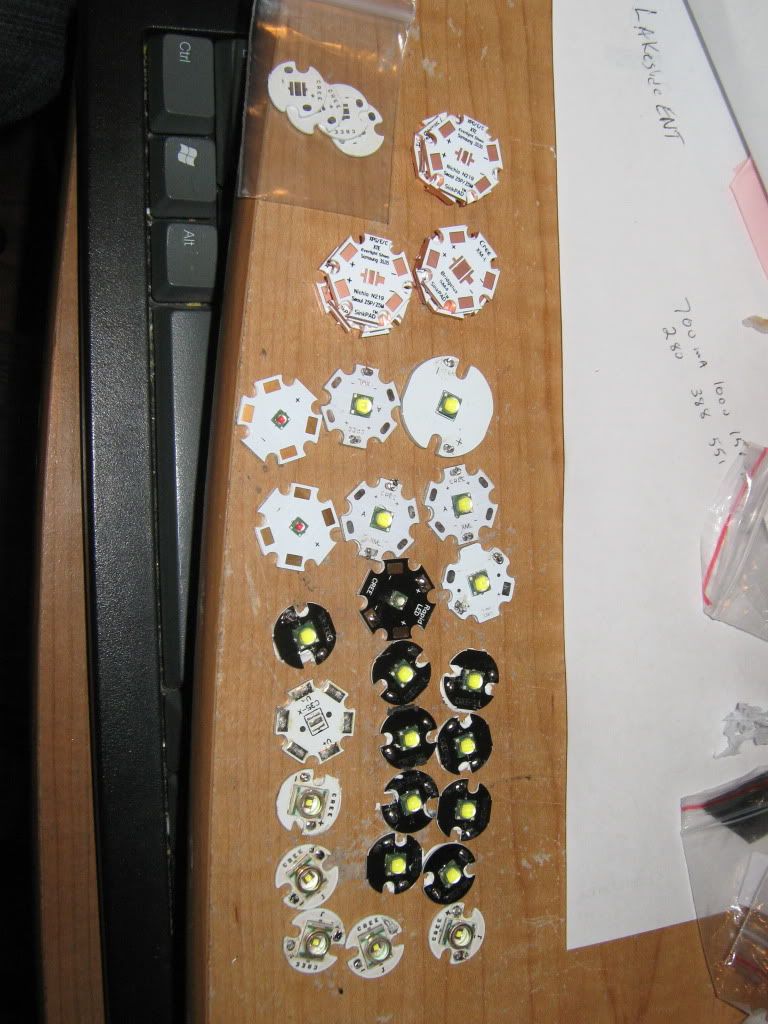
the cree XM-L t6 emitter that is in that light you linked according to cree data sheets put out 280 lumens at 700 milliamps, 388 lumens @ 1000 mA, 551 lm @ 1500 mA, 692 lm @ 2000 mA. those advertised lumens are what we call chinese lumens. these chinese light are almost always underdriven(cicuitry not matched to emitter) and have wildly exaggerated lumen claims. lux and more specifically candela(cd) is a good measure of how far a light will"throw".see link in pmack's post. here is some good info from Dr. jones
quote..
Often one can read about "lux" or "lux@1m" to describe 'spot brightness' or throw.
lux is the unit of illuminance E, that is the luminous flux F (lumens) per area A falling onto a surface. It's more a unit for a whole lighting setup onto a target than for a light source itself.
With a single light source like a flashlight, the illuminance E drops with increasing distance d, described by the inverse square law: E is proportional to 1/d² (actually that's an approximation which gets more accurate with increasing distance). If one now multiplies that illuminance E by the squared distance, E*d² gives a constant value, which is independent of the distance and only depends on the flashlight itself. This is another physical quantity, the luminous intensity I, or, measured at the spot, the spot luminous intensity I, or peak luminous intensity I. It's unit is candela (cd; candlepower (cp) is an obsolete unit equivalent to candela): I = E * d²
Of course, one lux in d=1m distance gives one candela, which is why "10000 lux@1m" is somewhat the same as 10000 cd (or better 10 kcd), however the latter is the proper unit. ANSI/NEMA FL1 uses it, too.
Most of you already know that measuring the spot intensity at only 1m distance is not a good idea, as the beam often has not settled to it's 'final beam pattern' in that short distance. Even ANSI/NEMA FL1 demands a minimum distance of 2m; for throwers that is still much too near (I suggest a distance where the spot size is at least 10 times as big as the reflector/lens diameter). Doing so and calculating that back to "lux@1m" sometimes leads to strange units like "31736 lux @1m (calculated)" - just write 31.7 kcd instead.
I just would like to suggest
not using lux when you mean candela
using the "k" for big numbers
not denoting more than three significant digits; typical lux-meters have an accuracy of 5%, a number like 31736 seems to imply a dubious precision of less than 0.1%
While being at it, throw (in meters) is usually defined as the distance at which the illuminance on a (perpendicular) target falls below a certain level; if you follow ANSI/NEMA, that level is 0.25 lx. Throw can be calculated from the spot intensity I using the above formula rearranged to
d = sqrt ( I / E0 )
with E0 = 0.25 lx for NEMA throw. (Some consider that value of 0.25 lx quite low, resulting in relatively high throw values; practical throw values might be lower, depending on the situation.) (more info on throw)
You might find this a bit nitpicking; but I think proper terminology is a good thing, it was developed for a reason.
end quote.