

You are using an out of date browser. It may not display this or other websites correctly.
You should upgrade or use an alternative browser.
You should upgrade or use an alternative browser.
Ladder test - Help
- Thread starter DavidW
- Start date

Ridge Runner
New member
as small as the case capacity of the 223 is I would go up in .1 or .2 max, grains at a time
RR
RR
Longcruise
New member
Quote:
as small as the case capacity of the 223 is I would go up in .1 or .2 max, grains at a time
RR
RR is right, you should probably stay with .1 increments for the load you suggested. 400 yards is probably more range than you need to test the load. 300 or even 200 will probably work fine. You will need an fine spotting scope to see the holes at 400. OTOH, if you have the scope for the job and conditions are right there is no reason not to shoot it at 400.
Here are some tips on the ladder test: http://www.mikeswillowlake.com/ladder%20test.htm
Also, the OCW test seems to give good results for some people, although I've not tried it personally.
as small as the case capacity of the 223 is I would go up in .1 or .2 max, grains at a time
RR
RR is right, you should probably stay with .1 increments for the load you suggested. 400 yards is probably more range than you need to test the load. 300 or even 200 will probably work fine. You will need an fine spotting scope to see the holes at 400. OTOH, if you have the scope for the job and conditions are right there is no reason not to shoot it at 400.
Here are some tips on the ladder test: http://www.mikeswillowlake.com/ladder%20test.htm
Also, the OCW test seems to give good results for some people, although I've not tried it personally.
Jay Johnson
New member
I do my loading in increments of .2 Grains. The shooting at 200 yards. It will tell you what you need to know. It's to hard for me to find a close range that will let you shoot over 200.
Longcruise
New member
Your increments should reflect the powder capacity of the case. In a .223 even a .1 increment will have you starting your charge very low when spread over 20 rounds.
.1gr will take forever and waste powder. When running the ladder, you will notice harmonic nodes that will stretch over up to as much as 1gr, and in the middle of that range will be a very consistent load. I use .2gr charges for 222/223 volumes, and .3gr for larger cases.
I basicly use the OCW method of running the creighton audette ladder, and find the round robin style of running the strings makes for very consistent data.
I basicly use the OCW method of running the creighton audette ladder, and find the round robin style of running the strings makes for very consistent data.
Longcruise
New member
Quote:
.1gr will take forever and waste powder.
It's a 20 round course regardless of powder charge. .2 grain increments will have you starting at a very low powder charge for a .223. For example, if you were running a ladder with varget you would be starting at 23.3 grain charge for a powder that maxes at 27.5 with a 55 grain bullet. The rounds loaded at the very low end, even if they show an accuracy node, will not be of practical use. Use .1 increments and start this powder at 25.4 grains or even 25 grains leaving the max end some slack.
Same is applicable with most powders for the .223 given that most max around 27 grains for a 55 grain bullet and many max at 25 grains or less.
.1gr will take forever and waste powder.
It's a 20 round course regardless of powder charge. .2 grain increments will have you starting at a very low powder charge for a .223. For example, if you were running a ladder with varget you would be starting at 23.3 grain charge for a powder that maxes at 27.5 with a 55 grain bullet. The rounds loaded at the very low end, even if they show an accuracy node, will not be of practical use. Use .1 increments and start this powder at 25.4 grains or even 25 grains leaving the max end some slack.
Same is applicable with most powders for the .223 given that most max around 27 grains for a 55 grain bullet and many max at 25 grains or less.
I never start at the bottom of the load data, that is also a waste of powder (IMHO). I start mid-range and work to max. Cases that contain a lot of room after the charge is thrown, are not the text book example of how to load for max accuracy. I prefer slower powders, so mid range is the best starting point for my work,...low end is not where I want to be,..too little MV.
after running a few ladders round robin style, I easily determined that accuracy nodes can cover a fair amount of range (like a .4-.6gr range) and therefore, the .2gr increments save time and powder.
also, we had a guy at one of the 1000yd matches who actually counted the sticks of powder in a charge, and then determined the energy produced by each stick of powder, then determined the energy of .1gr of powder, and even running the balistic tables next to each other, the .1gr charge variance was determined to be sooo small of a change, that shooter error and wind drift as well as mirage effect were all far greater variables. I think the charge variance made for something like 8-10fps, which even at 1000yds won't show up in any amount that can be pin-pointed to the powder charge.
YMMV, but I can usually have 2 nodes inside of 10-12 charges, and can pick my velocity at that point, then test the same load several times over at 300yds to check for vertical dispersion. If the vertical is acceptable, you are done, if not, test the charge on either side of that load at 300yds and one will prove to be the best load over distance.
after running a few ladders round robin style, I easily determined that accuracy nodes can cover a fair amount of range (like a .4-.6gr range) and therefore, the .2gr increments save time and powder.
also, we had a guy at one of the 1000yd matches who actually counted the sticks of powder in a charge, and then determined the energy produced by each stick of powder, then determined the energy of .1gr of powder, and even running the balistic tables next to each other, the .1gr charge variance was determined to be sooo small of a change, that shooter error and wind drift as well as mirage effect were all far greater variables. I think the charge variance made for something like 8-10fps, which even at 1000yds won't show up in any amount that can be pin-pointed to the powder charge.
YMMV, but I can usually have 2 nodes inside of 10-12 charges, and can pick my velocity at that point, then test the same load several times over at 300yds to check for vertical dispersion. If the vertical is acceptable, you are done, if not, test the charge on either side of that load at 300yds and one will prove to be the best load over distance.
Longcruise
New member
JustC,
You are mixing terminology here. What you appear to be doing is testing with Dan's OCW method and referring to it as a "ladder" test. They are not the same thing.
You are mixing terminology here. What you appear to be doing is testing with Dan's OCW method and referring to it as a "ladder" test. They are not the same thing.
they are the same thing as a ladder test,..the ONLY real change from Creighton to the OCW is that the ladder is run X number of times. I run the ladder round robin,..and therefore have run the ladder 5 (5 rounds each charge weight) times when my targets are pulled. Trying to track bullet holes on 1 target is kind of tough to say the least.
I set a new bullseye for each load (3 per sheet of paper). Then I shoot across the paper ( 1 hole per bullseye). Then after cooling, I run the targets again. This method of running the ladder 5x (in my case), I have a definitive answer to the accuracy nodes. It is a creighton ladder, only run across the paper 5x rather than up the paper 1 time. 5x gives a better idea of shooter error and allows the elimination of flyers that would otherwise be used as hard data in the standard creighton audette ladder. With the OCW method,..1 flyer in 5 can be eliminated as shooter error. This way of load testing has been the fastest and most accurate method of runnning a load ladder that I have ever used.
Not that other methods don't work,..but I have found the round robin OCW method to be accurate for me every time I use it. The most important factor,is how well is distributes human error across the data set. YMMV
here is a ladder from last year.
I set a new bullseye for each load (3 per sheet of paper). Then I shoot across the paper ( 1 hole per bullseye). Then after cooling, I run the targets again. This method of running the ladder 5x (in my case), I have a definitive answer to the accuracy nodes. It is a creighton ladder, only run across the paper 5x rather than up the paper 1 time. 5x gives a better idea of shooter error and allows the elimination of flyers that would otherwise be used as hard data in the standard creighton audette ladder. With the OCW method,..1 flyer in 5 can be eliminated as shooter error. This way of load testing has been the fastest and most accurate method of runnning a load ladder that I have ever used.
Not that other methods don't work,..but I have found the round robin OCW method to be accurate for me every time I use it. The most important factor,is how well is distributes human error across the data set. YMMV
here is a ladder from last year.
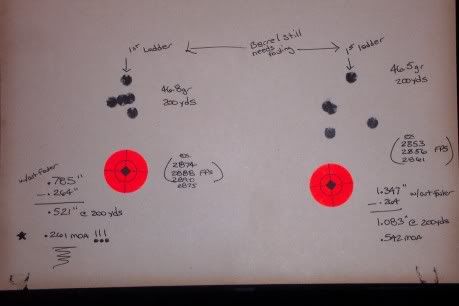
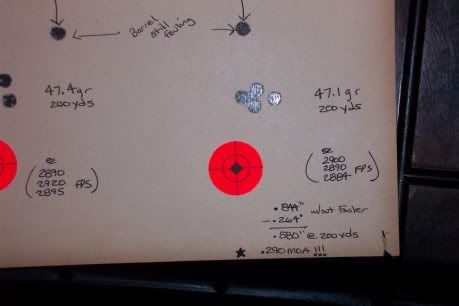
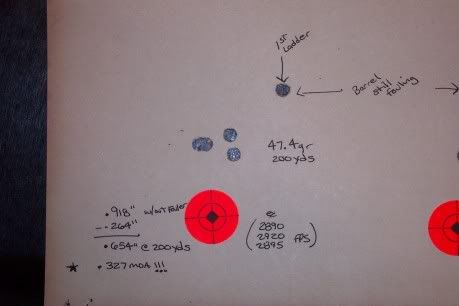
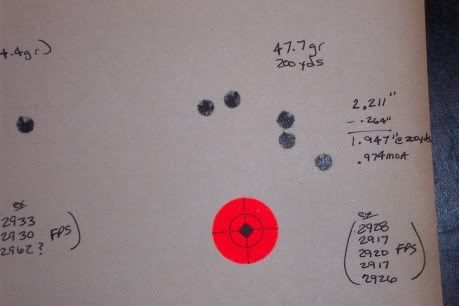
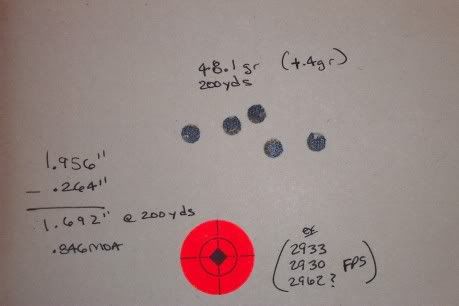
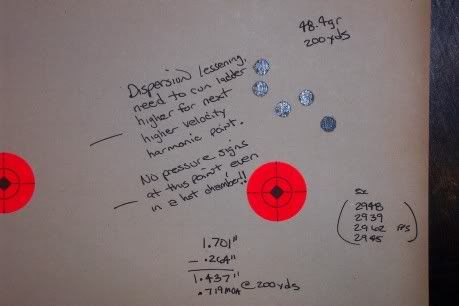
dan newberry
New member
The primary differences between the traditional ladder test and the OCW method are...
With the ladder test, the entire string of shots is fired at a single bullseye, and it is expected that the shots will climb up the target, pausing to form clusters at two or three points along the way. One shot at each charge weight is fired.
With OCW, you use a seperate bullseye for each charge weight being tested, and you fire three shots of each charge, rather than the single charge in the ladder test.
Normally, the Audette ladder test was/is fired at 300 yards. In order for the results to be truly meaningful, there must be either no wind at all, or a perfectly steady wind. Neither condition is generally the case for a long enough period of time to get all twenty shots fired in a ladder test.
The OCW test should be fired at 100 yards. This will largely negate minor wind effects on the groups.
Here are a couple of links where I compare the validity of ladder test results to those of the OCW method. Pay particular attention to the "scatter group" information. The scatter group occurs when the main shock wave (as identified by my friend engineer Chris Long) is at the muzzle. In at least one of three instances, the bullet emerging during this period of time will fall right into a cluster on a ladder test, confusing the interpreter.
http://home.earthlink.net/~dannewberry/dannewberrysoptimalchargeweightloaddevelopment/id1.html
http://practicalrifler.6.forumer.com/viewtopic.php?t=157
Dan
With the ladder test, the entire string of shots is fired at a single bullseye, and it is expected that the shots will climb up the target, pausing to form clusters at two or three points along the way. One shot at each charge weight is fired.
With OCW, you use a seperate bullseye for each charge weight being tested, and you fire three shots of each charge, rather than the single charge in the ladder test.
Normally, the Audette ladder test was/is fired at 300 yards. In order for the results to be truly meaningful, there must be either no wind at all, or a perfectly steady wind. Neither condition is generally the case for a long enough period of time to get all twenty shots fired in a ladder test.
The OCW test should be fired at 100 yards. This will largely negate minor wind effects on the groups.
Here are a couple of links where I compare the validity of ladder test results to those of the OCW method. Pay particular attention to the "scatter group" information. The scatter group occurs when the main shock wave (as identified by my friend engineer Chris Long) is at the muzzle. In at least one of three instances, the bullet emerging during this period of time will fall right into a cluster on a ladder test, confusing the interpreter.
http://home.earthlink.net/~dannewberry/dannewberrysoptimalchargeweightloaddevelopment/id1.html
http://practicalrifler.6.forumer.com/viewtopic.php?t=157
Dan
dan newberry
New member
Here is one of the more recent OCW tests I did. I went straight from the 100 yard OCW test range to 1060 yards, and you can see the results farther down the thread.
http://practicalrifler.6.forumer.com/viewtopic.php?t=215
Dan
http://practicalrifler.6.forumer.com/viewtopic.php?t=215
Dan
Longcruise
New member
Quote:
they are the same thing as a ladder test,..the ONLY real change from Creighton to the OCW is that the ladder is run X number of times. I run the ladder round robin,..and therefore have run the ladder 5 (5 rounds each charge weight) times when my targets are pulled. Trying to track bullet holes on 1 target is kind of tough to say the least.
Actually, they are quite different as Dan has pointed out above. A ladder test is shot with 20 rounds. Thats it unless you want to repeat it for some reason or other.
As Dan points out, the weather must be consistent during the test, and those holes are hard to see at 300 yards.
To keep track of the holes and the shot number you would have a duplicate target in a 1/2 or 1/4 scale next to you on the bench and would mark your shots and shot numbers at the bench as you fire each round. Pretty much the same way a Scheutzen spotter does for the shooter.
Here is a link to an explanation of how the test is run.
http://www.mikeswillowlake.com/ladder%20test.htm
they are the same thing as a ladder test,..the ONLY real change from Creighton to the OCW is that the ladder is run X number of times. I run the ladder round robin,..and therefore have run the ladder 5 (5 rounds each charge weight) times when my targets are pulled. Trying to track bullet holes on 1 target is kind of tough to say the least.
Actually, they are quite different as Dan has pointed out above. A ladder test is shot with 20 rounds. Thats it unless you want to repeat it for some reason or other.
As Dan points out, the weather must be consistent during the test, and those holes are hard to see at 300 yards.
To keep track of the holes and the shot number you would have a duplicate target in a 1/2 or 1/4 scale next to you on the bench and would mark your shots and shot numbers at the bench as you fire each round. Pretty much the same way a Scheutzen spotter does for the shooter.
Here is a link to an explanation of how the test is run.
http://www.mikeswillowlake.com/ladder%20test.htm