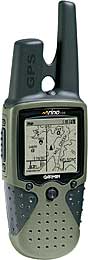
First and foremost, my advice to anyone looking to get a GPS, is get one with a "joystick" button on the front. Otherwise you'll be pushing a 5 buttons to do the work of that one button.
Second, you must get a topo map program for it (if you're using it for outdoors). I did without the program for a year, and I had no idea what I missing for $100.
I've got a Garmin E-trex legend. Great unit. I bought it for over $200, but they can be had for about $150 now. I also got the US Topo map CD's for it a few months ago. The maps themselves are somewhat lame as far as topo features go (it's equivelant to a 1 to 100k map they say) but it will show darn near every dirt road, creak, tanks, topo features, etc.
My unit has 8mb storage space on it. With all of AZ topo maps downloaded, and over 200 waypoints, I'm using about 8% of available space I think.
The map program adds tons of versatality to the unit. I now only keep waypoints on the unit for the area I'm going to. The rest are downloaded and stored in the computer. So now I only have to sort through 20 or 30 waypoints when I'm out, instead of over 200.
Last week, I had my brother meet me out a hunting site I'd not been to in 20 years, and he'd not been to ever. Using the map program, and measuring tool, I was able to give him directions in miles (10.3 miles, turn left, etc). I was amazed that I could go 13 miles down a very bad and winding primitive road, and have the directions be accurate to 1/10th of a mile!!! Amazing.
The garmins have a "base map" already on them, which will show most large roads. They will show cities (and even tiny towns) rest stops, and exits. They'll tell you what's available at the exit (exxon, McDonalds, propane, etc.)
It has a hunt / fish times calendar on it. Area calculations. Trip computer (total time, moving time, speed, highest speed.) Sunrise and sunset times, which is a nice feature when hunting. I know if I am on my last stand at the time it tells me it is sunset, I've got enough time left for a complete stand.
When using one, I would HIGHLY recommend using "UTM" coordinates with a "NAD 27" datum (if you've done time in the military, that system will be familiar to you). Stay away from Latitude and Longitude. Those who know what they're doing will usually use UTM coordinates when using maps or GPS for ground use. Easy to convert to paces for walking, and milage for driving. Lat and Lon is a pain in the ass.
Lastly, if you want the latest and greatest info on GPS, try a "Geocache" message board. They're the "techno-geeks" of the industry I guess you could say. Geocache is a game where people hide things, and find them, using GPS. They're usually very "up" and informed on the latest GPS info.
Good Luck!