17remhunter
Active member
Other than using a Hornady OAL gauge what other method can you use to accurately measure how far to seat a bullet so its touching the rifling ?




What is the speedy methodI use either speedy method or wheeler method. Both give me the same results. If I can’t tell by the wheeler for some reason then the speedy works everytime
Speedy method is where you pull the barrel off and have it sitting vertical chamber side up. You take a piece brass fired and drop it in the chamber and you’ll see it sit proud. You can push it with force and it will seat but then you won’t be able to remove it with just your nail or freely. If you size the brass and bump the shoulder back .001-.002 thou you’ll be able to drop the brass in and it will free fall and 0 resistance on removal or if you flipped the barrel it will then 100% free fall out.What is the speedy method
Another plus one on AWS's post. Used the same exact procedure for years, and still do.
As well as some others, the only difference I'll interject is a small amount of die wax (case lube) on the ogive of the bullet to assist in keeping the ogive and lands from sticking. On extraction with a bolt go slow don't rack the bolt like when shooting which AWS covered above. For some reason when I've done (racking the bolt) it in the past I wound up sticking more in the throat vs going slow as he advised.
I like this method as it requires the least amount of tools.
The other method of using a cleaning rod with a jag and tip on the jag removed works, However one can have more errors than with method AWS advocates. While it will work I would highly suggest what AWS propose to you.
Whether your measuring COAL with just a caliper, or using the caliper and a bullet comparator to get CBTO(such as the now Hornady offering) you will get your desired measurement. Use the same method to seat don't mix the two method.
If using just the COAL method with calipers be sure to use the same bullet when setting up the dies. only because of ever so slight irregularities in each bullet. The comparator is a bit more precise. Yet the other method works extremely well. One doesn't "have" to have the bullet comparator but it sure is nice (not sure if the hornady set has a 17 cal insert I don't recall one in my set, they may have).
Every time i attempt to find where the bullet touches the lands. Its far enough out that its past the case neck I was watching ultimate reloader on COAL or CBTO. They said that the Hornady AOL gauge is not that accurate. Im just trying to understand what everyone is saying in regards to me trying to find the maximum CBTO. Its supposed to be there. But what if it isn’t. What if the leade is such that you cant seat a 25 gr or a 30 gr into the neck so that the bullet touches the lands.OK, bear with me, now how to word this to not be a peeing match or anything outside the fact is you asked for help and we as a group have attempted to help. My point is not to slam your endeavors into reloading or be negative.
You found a post via google AI discussing the long throat in the 17 Remington cartridge. I don't doubt what you found and posted is a fact. The same was done to the 5.56mm NATO vs the .223 Remington cartridge as chamberings. Throated long (5.56mm NATO) to reduce the pressure curve to allow it to achieve a higher muzzle velocity. Simply put the .223 Remington is throated shorter.
The whole reason for those of us responding was to show how to find the point that the bullet make contact with the bore. In order to keep pressure down.
Now with the 17 Rem if you can't make contact with the bullet seated out. Then your simply not going to have the bore contact making contact to drive the pressure up. NO problem.
You had posted asking us to share loads with a 6mm CM. Well you will find out that depending on bullet, you will make contact with the bore in that cartridge, even though it's throated longer than most other 6mm cartridges designed before /after it.
I'm in the process of redoing /rebarreling a rifle into that cartridge (6mm CM). I've several differing types of bullets all differing weight and differing bullet profiles. Only one of them doesn't make contact it's the Barnes 58gr Varminator they offer. The take away is I can just seat that bullet to barely go into the neck. And that I don't have to worry about jamming into the lands. The others well yeah I need to find the point they make contact and set them back a little to keep pressures in a controllable state. While is considered bad JU-JU to seat again the lands it's also bad JU-JU to seat too deep it will have the same effect, excessive pressure early. Unless loads are worked up. Can you make contact with the lands and start low and work up safely? sure you can bench rest shooter do it all the time, but also understand they have a tendancy to keep their ammo in a cooler to control temperatures, reducing pressure spikes. But key word is locate accurate data from bullet /powder manufacturers.
Within one of the other three threads that you are seeking answers to the same question as this thread. I asked a simple question in lieu of simply answering it you double posted the same thing as above from google AI. The question was a yes or no answer.
Do you have a set of calipers?
If you don't, I would highly suggest that you at some point obtain a set. If so (as in you do own a set) great use them.
No need to respond as I've stated my response to the question had you answered it.
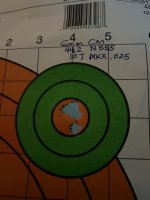
I do have a set of calipers. This is all new stuff to me. Im in the 1st grade just learning. I bought a 6 cm. Heard that N 555 was a creedmoor powder. Didn’t know much about H4350. Got some 107 sierra Match Kings. I hear lots about 1/2 MOA?? All touching?? One hole?? A guy at the Range said all his rifles are 1/4”. Is that .250? Here is my last 5 shots. With my new 6 CM. Guy next to me said I need to tighten that up. So much information seems like in different directions. Then the guy that works at the range said that if you plan on taking 500 yard shots at Marmots you should be shooting .5 MOA at 200yds. What's the difference between.5 moa at 100 and .5 moa at 200?OK, bear with me, now how to word this to not be a peeing match or anything outside the fact is you asked for help and we as a group have attempted to help. My point is not to slam your endeavors into reloading or be negative.
You found a post via google AI discussing the long throat in the 17 Remington cartridge. I don't doubt what you found and posted is a fact. The same was done to the 5.56mm NATO vs the .223 Remington cartridge as chamberings. Throated long (5.56mm NATO) to reduce the pressure curve to allow it to achieve a higher muzzle velocity. Simply put the .223 Remington is throated shorter.
The whole reason for those of us responding was to show how to find the point that the bullet make contact with the bore. In order to keep pressure down.
Now with the 17 Rem if you can't make contact with the bullet seated out. Then your simply not going to have the bore contact making contact to drive the pressure up. NO problem.
You had posted asking us to share loads with a 6mm CM. Well you will find out that depending on bullet, you will make contact with the bore in that cartridge, even though it's throated longer than most other 6mm cartridges designed before /after it.
I'm in the process of redoing /rebarreling a rifle into that cartridge (6mm CM). I've several differing types of bullets all differing weight and differing bullet profiles. Only one of them doesn't make contact it's the Barnes 58gr Varminator they offer. The take away is I can just seat that bullet to barely go into the neck. And that I don't have to worry about jamming into the lands. The others well yeah I need to find the point they make contact and set them back a little to keep pressures in a controllable state. While is considered bad JU-JU to seat again the lands it's also bad JU-JU to seat too deep it will have the same effect, excessive pressure early. Unless loads are worked up. Can you make contact with the lands and start low and work up safely? sure you can bench rest shooter do it all the time, but also understand they have a tendancy to keep their ammo in a cooler to control temperatures, reducing pressure spikes. But key word is locate accurate data from bullet /powder manufacturers.
Within one of the other three threads that you are seeking answers to the same question as this thread. I asked a simple question in lieu of simply answering it you double posted the same thing as above from google AI. The question was a yes or no answer.
Do you have a set of calipers?
If you don't, I would highly suggest that you at some point obtain a set. If so (as in you do own a set) great use them.
No need to respond as I've stated my response to the question had you answered it.
I saw where you can put lock tight in the cartridge neck insert a bullet chamber it and wait until it dries and that will give you an accurate CBTO measurement???Seat your bullet long, blacken the bullet and keep seating the bullet deeper and deeper until the bullet no longer has has land marks in the blackening. I used to smoke bullets but now use a magic marker. Work gently so you don't stick the in the lands, I keep a cleaning rod handy with a jag with the center post ground off to tap the bullet loose if I stick one.
believe it or not I actually answered...... It's a NON issue for your 17 Rem if the bullet does it touch. Just seat it into the neck. At what length? the length that the bullet and chambering likes. Although I used the 6mm CM I'm just waiting on the stock to get in for as a guide.Only one of them doesn't make contact it's the Barnes 58gr Varminator they offer. The take away is I can just seat that bullet to barely go into the neck. And that I don't have to worry about jamming into the lands.
The demonstrators had the locctite only in the neck No chance it leaked out. Seems very affective and very accuratebelieve it or not I actually answered...... It's a NON issue for your 17 Rem if the bullet does it touch. Just seat it into the neck. At what length? the length that the bullet and chambering likes. Although I used the 6mm CM I'm just waiting on the stock to get in for as a guide.
In my case I'll probably seat that bullet 0.040"to 0.050" into the neck. Go to the lowest powder setting in data and shoot a ground.
Looking at Hodgdon's website for the 6mm CM at a 60grs I'll be looking for the slowest listed velocity (ONLY because of the constraints of that Barnes bullets and it's design).
Looks like Winchester StaBALL Match will get the nod for that Bullet. Balancing the velocity and pressure listed, Plus I have that powder on hand
WAit WHAt??? Loctite OH heck NOOOOOOOO
(while bullet sealant have been used in the past, they dang sure didn't use today's loc-tite, I can just vision if it leaked / or was pushed out. and when they did use a sealant for Military purposes, weather proofing, it dang sure wasn't put in a chamber to dry. )