

You are using an out of date browser. It may not display this or other websites correctly.
You should upgrade or use an alternative browser.
You should upgrade or use an alternative browser.
Acrylic Calls???
- Thread starter ScottD
- Start date
TheHuntedOne
New member
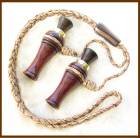
You mean like this one?
Colors avaliable are Copper (shown) Amber, Red, Blue, Black, Ivory, Grey(smoke), and I have green and bronze on the way in.
I sell them for 24.99 at www.THOGameCalls.com and PM members get 10% off and free 1st class mail shipping if you e mail me and let me know you want the call.

Al
THO Game Calls
Colors avaliable are Copper (shown) Amber, Red, Blue, Black, Ivory, Grey(smoke), and I have green and bronze on the way in.
I sell them for 24.99 at www.THOGameCalls.com and PM members get 10% off and free 1st class mail shipping if you e mail me and let me know you want the call.
Al
THO Game Calls

TheHuntedOne
New member
Once the call is on the lathe, it takes me about 50 minutes to turn and sand the outside of one.
Once it comes off the lathe, it's another hour and a half minimum to finish the ends, sand the insides and then polish the calls. They are labor intensive.
I am working on a way to speed the polishing process up some, but I am not sure it will work. I should know in about 3 or 4 hours though LOL.
Al
THO Game Calls
Once it comes off the lathe, it's another hour and a half minimum to finish the ends, sand the insides and then polish the calls. They are labor intensive.
I am working on a way to speed the polishing process up some, but I am not sure it will work. I should know in about 3 or 4 hours though LOL.
Al
THO Game Calls

trappertodd
New member
check out KO predator solutions in the promotional forums,they have a new acrylic call called the Kenai Killer thats just about to come out and it looks real sharp. /ubbthreads/images/graemlins/grinning-smiley-003.gif
berettaman
New member
I really like the looks of the acrylic calls, but was wondering how do they sound? Have heard that they are very loud...would they be good for using in the East? Thanks!
TheHuntedOne
New member
From my personal experiance with acrylic calls, I would agree with you that they can be very loud. They can also be played softly. The tone board plays a large role, but you will find that the material, hard as it is, tends to transmit sound very smoothly from the toneboard through the barrel of the call.
This is also true of calls made from Dymondwood if they are sanded and finished inside. It can also be true of any wood call that is given a smooth bore and a hard finish on the inside, though not quite to the extent of acrylic.
Keep in mind that a custom call is much different from a mass produced call. The call maker has the ability to tune a toneboard to the way you want the call to sound, and to the volume you want the call to produce.
If you want a custom acrylic call that blows raspy at low volumes, that can be accomplished. If you want one that is going to reach out there and pull them in from 5 miles away, that too can be accomplished. Be aware that there is always a trade off. A call that blows raspy at low volumes may tend to lock up when you try to get on it. One that is made to reach way out there may not do so well when blown softly.
Now all calls will make sound, usually, at different volumes, but they will preform best when played the way they are designed, and that is one of the big advantages of working with a custom call maker over mass produced calls.
It's also why most of us carry more than one call in the field.
To bear this out, the standard commercial call by which all other commercial calls are judged is the Crittr Call. If you explore the Crittr Call line, you wil see that they have 4 different calls - at least from my book anyway. Each for different purposes.
So don't despair if you want an acrylic call that is going to work the way you want it, because you can have your cake and eat it too.
Al
THO Game Calls
This is also true of calls made from Dymondwood if they are sanded and finished inside. It can also be true of any wood call that is given a smooth bore and a hard finish on the inside, though not quite to the extent of acrylic.
Keep in mind that a custom call is much different from a mass produced call. The call maker has the ability to tune a toneboard to the way you want the call to sound, and to the volume you want the call to produce.
If you want a custom acrylic call that blows raspy at low volumes, that can be accomplished. If you want one that is going to reach out there and pull them in from 5 miles away, that too can be accomplished. Be aware that there is always a trade off. A call that blows raspy at low volumes may tend to lock up when you try to get on it. One that is made to reach way out there may not do so well when blown softly.
Now all calls will make sound, usually, at different volumes, but they will preform best when played the way they are designed, and that is one of the big advantages of working with a custom call maker over mass produced calls.
It's also why most of us carry more than one call in the field.
To bear this out, the standard commercial call by which all other commercial calls are judged is the Crittr Call. If you explore the Crittr Call line, you wil see that they have 4 different calls - at least from my book anyway. Each for different purposes.
So don't despair if you want an acrylic call that is going to work the way you want it, because you can have your cake and eat it too.
Al
THO Game Calls

River Runner
New member
Al, Quit it

Al
The color of that copper makes me thirsty for a shot of Jack Daniels and I don't even drink the stuff! At least very often. /ubbthreads/images/graemlins/grin.gif
I wonder if the amber will have the color of a glass of beer. /ubbthreads/images/graemlins/grin.gif
I am afraid I am going to either learn how to turn acrylic, or I am going to have to get a couple more from you. /ubbthreads/images/graemlins/grinning-smiley-003.gif
Steve
Yep I need a glass of beer now! /ubbthreads/images/graemlins/smile.gif

The color of that copper makes me thirsty for a shot of Jack Daniels and I don't even drink the stuff! At least very often. /ubbthreads/images/graemlins/grin.gif
I wonder if the amber will have the color of a glass of beer. /ubbthreads/images/graemlins/grin.gif
I am afraid I am going to either learn how to turn acrylic, or I am going to have to get a couple more from you. /ubbthreads/images/graemlins/grinning-smiley-003.gif
Steve
Yep I need a glass of beer now! /ubbthreads/images/graemlins/smile.gif
Last edited:
berettaman
New member
Thanks for the good reply Al!
TheHuntedOne
New member
Ya know, I have some white delrin that I could make the toneboard from. Sort of look like foam. We could call it the "Draft" LOL.
Al
THO Game Calls
Al
THO Game Calls
TheHuntedOne
New member
Now there's another idea.
I just might go up into the shop and play around a bit tonight.
You guys are responsable for what ever happens /ubbthreads/images/graemlins/smile.gif
AL
THO Game Calls
I just might go up into the shop and play around a bit tonight.
You guys are responsable for what ever happens /ubbthreads/images/graemlins/smile.gif
AL
THO Game Calls


BUCKWHEAT
New member
AL
That is a very nice piece of workmanship; I just went out and purchased stock in a polishing compound company. Seemed like a good move to me. I think you will be using a lot, and I am getting in before this stock takes off. LOL
Al that was great information about call sounds, People need to understand some of this information and look at predator calls almost like one would look a turkey diaphragm reed call tube yelper or any call that takes air to make a noise. They all can be tuned to sound a certain way buy each call maker. Also remember, each new caller person has to be able to get good enough to blow the call how it was tuned correctly. I am sure if some one heard Al or any other call maker blow one of there own calls people would realize just how great a call should sound. I have hunted with other call makers, and when you hear the sounds the maker of there own call can make them sound, you will realize just how much effort each call makers puts in to tuning there call for sound. I would also think the first words out of your mouth would be. Can you make me a call that would sound just like that one you just used, at least from the call makers I have seen and heard? So when some one asks what a call should sound like, I would say just like the one the call maker him self uses. He has already tuned his call to get the most affective and different sounds out of the calls he carries. Then go from there if one would feel the need.
Anyhow AL, very nice call and I bet it sounds GREAT!
acrylic calls are extremely loud. i'd advise against blowing them in confined spaces.
the best advice you can get is from the custom call makers. they are not afraid to share their "secrets" and you yourself can fiddle around with reeds and get the sound you prefer. enclosed reeds are pretty cheap and you can teach yourself how to blade them and other ways of changing sound. consistency is the key. then from there you can make your production calls "custom", if you are not into turning wood or acrylic.
most of the guys that are making calls learned from other call makers what works and what doesn't. then explored on their own from there and found what works best for them. experimentation is the mother of invention. oh no, it's necessity is the mother of invention. sorry.
the best advice you can get is from the custom call makers. they are not afraid to share their "secrets" and you yourself can fiddle around with reeds and get the sound you prefer. enclosed reeds are pretty cheap and you can teach yourself how to blade them and other ways of changing sound. consistency is the key. then from there you can make your production calls "custom", if you are not into turning wood or acrylic.
most of the guys that are making calls learned from other call makers what works and what doesn't. then explored on their own from there and found what works best for them. experimentation is the mother of invention. oh no, it's necessity is the mother of invention. sorry.