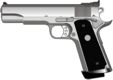
Continuiong the 9 vs 45 thread with real world experience (very long)

As an IDPA member and shooter I think it offers one of the better civilian training excersizes available.

And as silly as it may seem.
Paintball gave me a healthy respect for someone shooting back, how easy it can be to miss someone so close and how terrible it can be to run out of ammo or have equipment malfunctions in the middle of the action. Granted it's not life or death but paintballs don't tickle either so there's an inherent level of stress.
 
Originally Posted By: NdIndyThe hollywood shootout is a great training tool, but I think the odds having the best handgun round in the world would not have changed the final outcome. You just can't take a 25 yard weapon to a 300 yard fight. Persistence may win, but it's not going to win right now. A scoped .308 in the right hands and the right place would have made a tremendous difference.

Having said that, math is great and energy is fantastic. But how the energy is delivered is king. I can work up a round that dumps X ft/lbs into a body and unless I hit something that will result in an immediate drop it's only going to cause one through psychological effect. However I can take the exact same amount of energy and deliver it through a baseball bat, and odds are I win in 1 swing.

Given the choice, I'll take the bat. So .45 instead of the 9. In real life I carried a .40, decent compromise between thump and capacity. But I also carried a 12ga loaded with slugs (I don't do buckshot) in the pass rack, and an AR in the trunk. I did carry buck and beanbags in the trunk as well along with a few other *items* but they are a decision and not a regular load in my book.

My personal credo, any sidearm exists only to let me fight my way to my trunk. If you're in a gunfight, I highly suggest you fight your way to *MY* trunk as well
laugh.gif


I know it's easy to Monday morning quarterback situations, but every time I watch video of the North Hollywood cluster #@$%, I can't help but wonder where the 12 gauges with slugs were at? Might not have killed the SOB's with the armor and all, but I'm guessing a 1 oz slug would've knocked the fight out of them long before officers had to commandeer AR's from a gun shop.

I spent a lot of time with my rifle sighted 1187 before we got AR's and was amazed how accurate slugs could be @ 100 yards. Good enough that a head shot at that distance wouldn't be out of the question.

 
Makes sense to me wdchuckhuntr.
I think the point I was trying to make, was that the needs for the `average joe` are somewhat different than someone who on a regular basis puts their life on the line. IMO
 
Originally Posted By: wdchuckhuntrPaintball gave me a healthy respect for someone shooting back, how easy it can be to miss someone so close and how terrible it can be to run out of ammo or have equipment malfunctions in the middle of the action. Granted it's not life or death but paintballs don't tickle either so there's an inherent level of stress.

Was watching True TV a couple of days ago and they showed a clip of officers responding to a bank robbery back east somewhere where a female officers drove into an intersection and was ambushed by the bad guy with a rifle. His first shot hit the officer, who was able to make it out of her patrol vehicle and returned fire, but her gun jammed from being limp-wristed due to her being shot in the shoulder. She was basically left helpless while tying to retreat in front of her now rolling vehicle while the bad guy continued to shoot at her. The whole thing made me sick to my stomach thinking how helpless she must have felt. Luckily back-up got there quick and killed the guy, but it was a good reminder of just how quickly chit can hit the fan and how Murphy rears his ugly head.

I hope and pray I can make it through the rest of my career and never have to find out what it's like to have some shooting at me or having to shoot back.
 
Buster,
LAPD did not issue slugs for their shotguns at the time of the North Hollywood Shootout.

In general discussion, regarding the 1986 FBI/Miami shootout, the FBI had both shotguns and H&K MP5's... locked away in their car trunks! Arrogance and poor tactics lead them to disaster that day.
 
Quote:Anyway, I would never advise someone to choose a 9mm if I know they can use a .45. Pretty good advice. Still, today I pack a 9mm because a .45 is just too much to handle in the size of package I choose to carry. FWIW, I shoot IPSC/IDPA with a couple of retired Illinois State Troopers. Both would no doubt agree with you. But all three of us have migrated to the 9mm with age...
 
Carrying a gun doesn't mean you are a gun person.

Lots of militarty and LE folks have proven that to me on several ranges.

IIRC the Miami incident was full of errors and 1st gen WW silvertips were notoriously bad (remember reading about a large biker guy that fired at two cops who made hits on his leather jacketed torso.....badguy died while trying to start his bike after he emotied his pistol).

Never shot a person, or even at one. So I may not know crap according to some people, but I'll still disregard the proponents of smaller caliber/higher round count handguns.

One of my favorite sayings..........a handgun is for fighting your way to a rifle or shotgun.
 
Last edited:
I think its kinda funny we are still arguing over the merits of two cartridges that were developed over 100 years ago.

How about something new, like .357sig vs 10mm?
tongue.gif
 
Last edited:
Originally Posted By: YotecallrThe 9mm has been killing people for over 100 years. One day an officer went on a domestic and the male came at the officer with a weapon, the officer put 1 9mm round in the guys chest and he was dead when he hit the ground. After that day, I decided the 9mm would be my choice for defense. And I know the 45acp kills just as dead. I shoot a Ruger SR9 now.


Statistically the 38 special accounts for more 1 shot kills than all other calibers combined according to one study I read. Conclusion was that this caliber was carried as a backup, (also read ankle gun), by more law enforcement officers than other calibers because of it's size. The theory was that 1.) the officers were better trained to deal with the heat of the moment emotionally, and 2.) by the time the situation digressed to the point of pulling the ankle gun, the suspects were virtually point blank range.

That study was a couple years old when I read it, and I would suspect the 380 autos are probably closing if not eclipsing those numbers these days.

Regardless, that doesn't mean I'm going to start carrying a 38 special because it effects 1 shot kills. The 9 mm has its points, and it does definitely account for a great many kills, but I've seen several handguns in action hunting, and I was not impressed with the 9 mm; the 357 mag was only marginally better. When you get into 40 caliber rounds, things start dying. It all goes back to the age old theory of a 9 mm might expand, but a 45 isn't going to shrink! 40 caliber rounds leave a huge wound channel, whether they mushroom or not. And, there is no argument that 9 mm and 357 rounds have advanced over the years, because the same advancements have been made in 40 cal rounds as well. They have always been, and will always be, superior to the 9 mm and other 30 cal rounds.

As far as double stack mags... If you make your shots count, you don't need 15 shots. If you watch too much television and have a tendency to stick your gun up over whatever you're hiding behind and launch lead at targets you aren't even looking at, then yeah, you probably need a double stack mag, and a few spare magazines. If you make your shots count, the standard 8 round 45 ACP mag is more than enough. It all depends upon how proficient you are, under pressure.
 
Originally Posted By: Rocky1 It all depends upon how proficient you are, under pressure.


This is a good reason why this is somewhat of a silly point to argue. No citizen CCW is going to get this real kind of training. Pick your tool, practice and pray you attacker didnt.
 
Quote:True for the Military, but not for police Officers.

My experience of the almost complete difference between combat and police gunfights leads me to the comment that I make. There is no way to achieve and maintain the level of vigilance or "anticipation" of combat operations, patrols etc. while conducting routine police patrols/duties...

I'm a little confused, you advocate a LOWER capacity weapon because typical "first time" gunfight LEOs (and civilians) WON'T react as well as "first time" firefight soldiers?


Quote:Good training can give "first timers" the ability to react effectively.

That's kind of the point of the Field Manual I quoted isn't it, which says (in part) "Poor showing on first exposure to real battle can be reduced by providing tough, realistic training (especially battle drills under high stress), but it cannot be totally prevented."

Unfortunately that "good training" is pretty scarce. How many departments, much less civilians, can afford (very effective) simunition training so that if they ever do get in that first gunfight it will not be a completely new experience.

As you said "The "trick" (if you want to call it that) is to ignore or supress the natural tendency and recover with an application of training, experience or tactics". Hands down and far and away, the most effective of those three (training, experience, and tactics) is experience. Our brain recovers from being startled much more quickly, and deals with fear more effectively, if it's not a completely new experience. Human beings rarely do well at first time experiences, especially ones they are afraid of, whether it's riding a bike, pushing off of a ski jump, jumping out of a perfectly good airplane, whatever. Once you have even one personal experience and your brain knows what to expect (more or less), it may still be a scary experience, but our brains will typically handle it far better.

Unfortunately almost all gunfights, civilian and LEO are first time gunfights and big city police department "hit rate" statistics for gunfights are generally in the mid teens to close to 30% (depending on the year). That's "hit" rate, not "mortal hit" rate.

And of course that's the reason so many organizations have gone to HIGH capacity weapons.
 
Interesting thread. Tactics should matter as much as, or more, than equipment. Something tells me that if your tactics and behavior are sound, and you can shoot very well under pressure and put rounds where they need to go, the caliber won't matter so much.

For a start, living by Cooper's color-code mindset will probably be more important in saving your life than how many and how big your cartridges are.

Thanks for all the info.
 
I'll just stick to my 45 with 13rds of hot loaded 200gr XTP's. If that doesnt put them down then its my time to go and meet the good Lord. If we don't continue to fight for our rights, we wont have to worry about whether its a 9mm or 45 as we'll only be limited to throwing rocks and sticks like other parts of the world.
smile.gif
 
"My experience of the almost complete difference between combat and police gunfights leads me to the comment that I make. There is no way to achieve and maintain the level of vigilance or "anticipation" of combat operations, patrols etc. while conducting routine police patrols/duties..."

There is very little common characteristics between military combat operations that repeat or are likely to happen again on a fairly short turn around time betweeen the first and the next incident. It is certainly more likely to happen again much sooner in a military combat situation than in routine police work. In fact it is actually more likely to never happen in routine police work. So, the parallels just aren't there to say that the first incident will "settle" an LEO so that the second won't be as frightning/startling. Rather than experience, training is key. Proven tactics and realistic training for those tactics are possible.

Jeff Cooper's ideas about situational awareness are sound concepts. Unfortrunately, except for high risk operations (SWAT, Narcotics raids, warrant service teams, etc.) routine police work becomes all too soon, "routine". Therefore, some almost automated response, "muscle memory" needs to be in place.

Fortunately, the training does not need to be "sophisticated" and can be modeled into low cost "competitive drills for necessary "qualification". ( I will be happy to elaborate for anyone interested in the details privately). In fact we always tried to make it fun as well as effective. Over time, it can be achieved and maintained.
 
Last edited:
Our department just recently upgraded their laser weaponed video training facility to work with all the street officers and their individual weapons that measures judgment, shooting skill, and give some pretty realistic situations that go from routine to really bad, quickly and each can be modified so that no two are alike or have the same outcome...Unfortunately, most civilians will never have the opportunity to participate in that level of training...

I agree that severe and realistic training is the initial key to successfully surviving an attack where weapons are involved, but it's also a known fact that experience under fire, is as important as an individuals mindset should he/she be wounded in the confrontation...Most 'uninitiated' tend to freeze and go into shock when they realize they have been cut or shot and that allows the attacker the time needed to finish the job he initiated...

I'm a firm believer in the IDPA concepts of training for civilians and feel that anyone that has a concealed weapon permit should be required to attend those type of matches for at least one shooting season to maintain their permits..

A handgun is a purely defensive weapon, for reasonably close range situations....and while it's hard to accomplish, the person that can keep their cool while receiving incoming fire and still take the tactical perspective and accurately engage their target, will usually survive the encounter...but that takes a lot of stress training and polished motor skills...as well as the ability to move and shoot at the same time, until effective cover can be obtained...

Most 'bad guys' can't hit their intended target, especially a moving one, except by dumb luck...The same holds true for most CCW permit holders...as well as a sizable percentage of street officers...

There are many lessons to be learned by studying past shoot outs, whether the one in Miami/FBI, the North Hollywood Robbery, or the Newhall massacre in the desert of California...fortunately, the training lessons learned have resulted in better training and less on established practices that are usually taught at most firing ranges...

 
I would disagree about the need for experience to be recent. I had the normal "scared worthless" experience in S.E. Asia the first time I was in a firefight, and then in subsequent firefights settled in to business (as the FM predicts).

The first time we were ambushed in Iraq, 30 plus years later, there was no "new" learning curve, it was like old home week, and I did exactly what needed to be done in a reasoned and rational manner. That was true of the other "old guys" who had been in combat in their youth as well.

Muscle memory will degrade over time if you don't reinforce it regularly, but the subconcious recognition of a particular type of danger doesn't. That mental recognition will keep you thinking rationally, which will probably do more to keep you alive than any training.

Having done Lord knows how many (hundreds of) hours of them, I would certainly not argue against repetitive "muscle memory" drills. Though less (mentally) effective than experience, it's certainly very important.

For those without actual gunfight experience, live fire simunition training (which is very close to the real thing) AND repetitive muscle memory drills, would be the best deal.

Unfortunately most "routine" LEOs (and civilians) don't even target practice at the range regularly, much less "drill", and (once again) that's the reason so many have gone to high cap pistols.

High cap is certainly not the BEST solution to the "lack of experience or training" problem, but it's the most common one, and it HAS "saved the bacon" of a number of "first timers".
 
High capacity is a band aid for poor shooting performance. I'll say it again, you cannot miss fast enough to make up for good shot placement from the other guy. Second place is a cold comfort in this situation. Hi-cap doesn't hurt anything as long as you don't view those extra rounds in the gun as a crutch and continue to maintain the mindset that only hits count.
 
No one can guaruntee their perfomance in a gunfight. Even a spray and pray assailant can get a lucky break as easily as a trained individual. That's why I strongly believe tactics are more valuable than firepower.
 
Back
Top