

AWS
Custom Accessory Maker & Retired PM Staff
As I peruse the internet, I see a lot of people building "Coyote Hunting Rifles" most are big 6mm of some sort, heavy barrels, chassis with scope more suited to prairie dogs. So what is the fascination with long range rifles for coyotes. I'll admit I have two rifles I have set up for what I call open country, I rarely take them and the few coyotes I've killed with them have been under 50 yards.
What causes a coyote to hang up at longer ranges? If a coyote is willing to commit to 500 yards why doesn't it keep coming to 400, 300, 200, or less.
So what are your thoughts. I'm going to share some of mine, some your going to think I'm a crackpot. I really want to hear your thoughts and you can't offend me.
Conditioned coyotes, they've had experiences that modify their responses.
1. I hunted a place in WA where I ran into coyotes would sneak into to the stand keeping in any available cover and scan the surrounding high ground. Another time three stopped and started milling around not panicked but I think that the road was just 300 yards away and they would have to expose themselves any closer.
2. They see things. We hunted a canyon in NV , hid the truck and hiked in. We expected the coyotes to come up out of the valley into the canyon draining into the valley, it had been a tactic that had been working well. One coyote responded up on the opposite plateau when he reached the edge to drop down into the canyon he turned and headed off. My nephew dropped him at 275 yards. We went over to find him and walked the top of the canyon and could see the truck from almost the exact spot he turned. From the valley and the bottom of the canyon the truck was invisible and if we hadn't had to go find him would never have known he could see the truck.
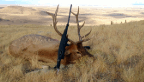
He turned at the left high spot on the edge of the plateau and Jon killed him crossing the notch on the top on the right side of the picture.

3. Sounds, I have this theory that coyotes can hear things we can't. A hunter buys a new caller, a different brand than he's been using and his response increase and he attributes it to the brand. I find if I go into a slump I change brands of callers and boom coyotes. Or the hunter buys somebodies sounds and they really start producing for them. Here's my theory, companies have their sounds, Lightning Jack is the same sound that came out on the FX-3 as the latest and greatest FP, they've cleaned it and change the frequencies but it is the same sound from the original recording.
Same with JS sounds, they are all from the original recordings. I don't think the coyotes are reaction to the sound but ambient sounds that carry through the process of adding sounds to a caller. That's why adding sounds from different sources and using different brands can trigger responses. There are no ambient sounds that trigger caution.
4. Sight and hearing, coyotes have both in excess. Lifting your rifle or binos to scan are movements that focus a coyote's vision same with reaching down to change volume or sounds. Another is reaching to dial power, paralax or dial range. Sound is pretty self explanatory noisy safeties, shuffling your feet, coughing etc.
Your thoughts.
What causes a coyote to hang up at longer ranges? If a coyote is willing to commit to 500 yards why doesn't it keep coming to 400, 300, 200, or less.
So what are your thoughts. I'm going to share some of mine, some your going to think I'm a crackpot. I really want to hear your thoughts and you can't offend me.
Conditioned coyotes, they've had experiences that modify their responses.
1. I hunted a place in WA where I ran into coyotes would sneak into to the stand keeping in any available cover and scan the surrounding high ground. Another time three stopped and started milling around not panicked but I think that the road was just 300 yards away and they would have to expose themselves any closer.
2. They see things. We hunted a canyon in NV , hid the truck and hiked in. We expected the coyotes to come up out of the valley into the canyon draining into the valley, it had been a tactic that had been working well. One coyote responded up on the opposite plateau when he reached the edge to drop down into the canyon he turned and headed off. My nephew dropped him at 275 yards. We went over to find him and walked the top of the canyon and could see the truck from almost the exact spot he turned. From the valley and the bottom of the canyon the truck was invisible and if we hadn't had to go find him would never have known he could see the truck.
He turned at the left high spot on the edge of the plateau and Jon killed him crossing the notch on the top on the right side of the picture.
3. Sounds, I have this theory that coyotes can hear things we can't. A hunter buys a new caller, a different brand than he's been using and his response increase and he attributes it to the brand. I find if I go into a slump I change brands of callers and boom coyotes. Or the hunter buys somebodies sounds and they really start producing for them. Here's my theory, companies have their sounds, Lightning Jack is the same sound that came out on the FX-3 as the latest and greatest FP, they've cleaned it and change the frequencies but it is the same sound from the original recording.
Same with JS sounds, they are all from the original recordings. I don't think the coyotes are reaction to the sound but ambient sounds that carry through the process of adding sounds to a caller. That's why adding sounds from different sources and using different brands can trigger responses. There are no ambient sounds that trigger caution.
4. Sight and hearing, coyotes have both in excess. Lifting your rifle or binos to scan are movements that focus a coyote's vision same with reaching down to change volume or sounds. Another is reaching to dial power, paralax or dial range. Sound is pretty self explanatory noisy safeties, shuffling your feet, coughing etc.
Your thoughts.