
Coyote population

dale06

Active member
It seems to me that the coyote population in the middle half of the USA is down quite a bit from the past several years. That’s based on my success this year so far and also the success of several friends that hunt different states than I hunt.
Does that match what you are seeing, or is my opinion off base?
 
I have been saying this for the last 3 years in my area. I am shooting about the same numbers but seeing and hearing far less as are all my landowners as they go about chores and winter feeding. Area trappers are catching WAY fewer. Same with sightings of coons. Still lots of 'silver mink' (possums), but i think they are like cockroaches and will be here when all other life is gone.
After I contracted Lymes in 2023-even though I took all precautions EXCEPT I did not permethrin my bowhunting clothes which is when I got sick, I got to thinking that maybe that is what is killing off the pups. They don't have vets. Most dogs in our area are being infected and treated with many dying or becoming crippled. Just this old coal miner's thoughts.
 
I agree with fewer around here as well. I think a large part is due to everyone in this area that has a hunting license now owns a thermal. Its became the thing. I know several guys that have never even attempted to call one in the daytime. And that’s fine. Coyotes around here even hear a rabbit distress they run to the next county. lol
 
I agree as well. Early season before we got hammered and buried with snow it was the quietest I’ve experienced. Landowners weren’t hearing or seeing any as well. This has been the poorest year of calling I can remember. I’ve got about 3 weeks left of our season and the snow is finally melting off. We’ll see if things turn around at all.
 
This Winter. I've driven many hundreds of miles & only seen 2 single coyotes & few dozen snow tracks. I have no idea what became of the population. The past 10 Winters or so. The coyote pop has steadily decreased.
 
Last edited:
For Me seems to be about par for most years. I’ve slowed down a bit due to normal life commitments and age. But we still seem to see about the same numbers give or take a few as usual at least normal for the last 10 years or so.It’s not like it used to be 25+ years ago when there seemed to be a lot more coyotes in the areas we hunt because there wasn’t as much pressure then.
 
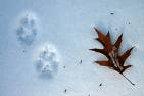
I believe our desert population is quite a bit lower than usual, and has been trending that way for a couple years. I attribute this at least partially to the ongoing drought that seems to have negatively impacted the prey base. It's been years since I've seen a noteworthy number of rabbits, and areas that used to be covered up in rodent tracks are mostly devoid of sign. Same goes for coyote sign. Five years ago. I couldn't drive down one of my favorite roads without seeing fresh coyote tracks in the sand. Now? Fewer and much farther between. They're still out there, but I think there are fewer of them.
 
It's interesting to hear everyone's observations. I'm fairly new to coyote hunting so I can't comment on the historical trend. I will say that I have heard and shot more coyotes this year than I have in the last 4 years of chasing them ( this being my 5th). I had a lot of answering and shot 3 during the breeding season, missed about the same amount. My calling has gotten better and I am constantly asking and looking for new spots to call so that may be part of the success.
 
I’m actually having an about average year as far as bagged dogs, but one thing I have been noticing the last couple of years is responses to coyote vocals……either be it lone howls or locator calls. When I’d hit a howl call to start a set it would trigger groups of coyotes all around me for miles in a chain reaction of sorts that would go on for minutes. This year and much of last that has not happened hardly at all. And most of the dogs I’ve downed have come in near the end of my set when I was nearly ready to move to the next spot. Whether the numbers are lower or they are changing how they react to the calls is definitely eye opening. I’m going out again for a few days this week so we’ll see if this trend continues in my location.
 
I’d say pretty stable up here. Nothing like when I was a kid but, pretty stable over say the last 10 years. One thing I will say, I don’t see coyotes just driving around like I used to. I recall many days when it was say -40C and we would just drive around. Many of those days, a guy would see over 50 coyotes. You sure don’t see that anymore. We don’t have the prey base that we used to enjoy though. Lost habitat, deer numbers are a joke compared to 30 years ago. More crops. Less cattle country. Lots of guys just pound at them off the road. There’s a number of factors.

I don’t put a pile of weight in the bird flu aspect. We are in a major migration path. I’ve seen hundreds upon hundreds of dead birds. Ducks, geese, birds of prey etc. It happens for sure that some critters contract it consuming dead but, not every one. Not by a long shot. If it has killed a lot of them, I surely haven’t seen it. That could be a factor of differences in climates too. Population density of predators to begin with. Maybe. Just speculating.

I have seen some lower coyote numbers in my lifetime. I can say for sure, we are currently not there. Plenty around. Sure sounds like several other areas of the continent are not enjoying the same.
 
I don’t put a pile of weight in the bird flu aspect.

Even if they don't contract the flu, there are WAY fewer geese and ducks in my area now, less for food. The sonw geese normally when they come through are in the 10's of thousands for weeks. This year, I don't think 10,000 arrived all winter; one day, a big push came in and was gone that morning. The local canada geese pupulation was a 1/10 of normal, and the chicks were almost nil. The ducks just did not show up at all. Pheasants seemed to be only around the farm houses, even the Eagles were not in the numbers as, even in a poor year. I have read reports of bears with it. I have talked with ranchers saying they have lost a LOT of ranch dogs to it, also. It has to be impacting all the predators to some extent.
 
I don't want to speak to soon but the numbers around here are above average. In the last 5 months I have at least seen coyotes 90+ % of the nights.
 
Even if they don't contract the flu, there are WAY fewer geese and ducks in my area now, less for food. The sonw geese normally when they come through are in the 10's of thousands for weeks. This year, I don't think 10,000 arrived all winter; one day, a big push came in and was gone that morning. The local canada geese pupulation was a 1/10 of normal, and the chicks were almost nil. The ducks just did not show up at all. Pheasants seemed to be only around the farm houses, even the Eagles were not in the numbers as, even in a poor year. I have read reports of bears with it. I have talked with ranchers saying they have lost a LOT of ranch dogs to it, also. It has to be impacting all the predators to some extent.
In the contrast to what you and I are seeing, I’d say that there are substantially different impacts regionally. I don’t doubt what you’ve been seeing. I can’t. Haven’t been there.

What you’re describing sounds much more dire. I wouldn’t say that bird numbers have really suffered all that much for our area. We still saw massive numbers throughout migration. Most of the local ponds that hold a pair of Canada’s raising a brood, did once again. Broods of ducks were abundant. Hungarian Partridge numbers are higher than I’ve ever seen in my lifetime. I haven’t heard first hand of one person losing a pet to it. Magpies are what I’ve noticed a decline in more than anything. Fox numbers have definitely been on the rise.

I don’t know what to say. Our experiences are pretty much a night and day difference.
 
Last edited:
Even if they don't contract the flu, there are WAY fewer geese and ducks in my area now, less for food. The sonw geese normally when they come through are in the 10's of thousands for weeks. This year, I don't think 10,000 arrived all winter; one day, a big push came in and was gone that morning.

What you’re describing sounds much more dire. I wouldn’t say that bird numbers have really suffered all that much for our area
As for migratory game migrations, a huge factor in southern tip of Texas, at least, is the long term extreme drought. Migratory game was plentiful 30-40 years ago, and again around 20 years ago when we had an extremely wet year. 2004:
1772989365469.jpeg
1772989437161.jpeg

Waterfowl almost non-existent in the last few years of drought, as would be expected. Obviously the birds change migration routes according to availability of water, effecting the habits of predators.
Can't judge predator population where I hunt by vocalizations because our coyotes are not very vocal at all.
 
The success or failure of a few hunters over previous years mostly reflects things like conditions, hunting pressure, and how cagey the coyotes are acting—not the actual population. Calling success just measures how willing coyotes are to show themselves at that moment, not how many are out there.

So, judging an area’s coyote population based on the success of hunts is kind of like declaring the lake empty because you didn’t catch a fish off the dock that morning.

One thing that is pretty much guaranteed anywhere, though: there are fewer coyotes around in March than there were in November—and yet we’re still killing them in March.

IMG_6426.jpeg
 
Back
Top