
Determining a mated pair of coyote's territory

medic joe

Well-known member
IMO that varies based on differing regions & current populations. To name a few factors.

Many years ago I wanted to figure that question out. At that time I knew of 3 neighboring pairs of coyotes. Whose territories over lapped. I use to try & understand them. Was where I would see those 3 pairs & where I would not see them. Back in those days I hunted roughly 18 days a month. I hunted mainly open rolling foothills/crop land. Due to observing those pairs. I estimated their territories to be roughly 6-8 square miles in total mass. I also determined(guess work, based on observations). That their territories over-lapped by roughly 1/4 mile give or take.

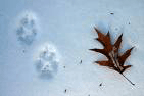
I also noted where their yearlings ranged. The territory over lap areas, often trespassing occurred. Or otherwise was tolerated. One pair of which the alpha male was extremely large. He had a 4" long paw print. He was a solid dark burnt reddish brown in color. I also tried to figure out their travel behaviors. ie; Any given day why did they travel to a given place on their territory. That behavior ended up being inconclusive. Because it was inconsistent.

When I would see those pairs on the hunt. Was the female was often the lead coyote. Female being based on watching them pee or other wise I based it on the size difference between the two. One thing that was very consistent. Was the lead coyote was the female coyote. At times the male would take over the lead for a short while. But soon the female became the lead coyote again.

One thing I noticed quite often was. The alpha female was more wary than her mate. When they would bed down. Most often, she was the last coyote to lay her head down.
 
Last edited:
When coyotes are on the hunt from what I have observed was. They most often hunt the down wind slopes of hills & ridgelines. They will travel into a head wind. But not for very far. Before they will angle or cut across that headwind. As they travel from one down wind area to the next.
 
One guy on another web site many years ago. Questioned me as to how I can identify specific coyotes? I told him back then. I used an 80x power spotter scope. I would note specific color markings. I will also say. Some coyotes look identical to other coyotes that are or may be non-related. Those pairs I ID'd. I studied them very closely(zoomed in) over continued Winters. As to their respective size to each other. I also noted, their markings & where exactly I viewed them. The coyotes that look like another coyote. I've found there are slight differences, at times very slight in fur coloration. Territorial pairs, do have some "preferred" bedding areas. When the wind would be from a specific direction. All other bedding areas were secondary & or random areas. I've noted that the "specific" bedding areas of territorial pairs. They would bed down on almost the exact same focal spot. I thought that very interesting. MOST coyotes when bedded down. Will choose to be "elevated". Versus bedding down on a low spot or in a weeded/brushy ravine. They will either be bedded down. Right below or very near a ridge top on a hillside. Otherwise around 1/2 down the leeward side of a hill.
 
Good info! The more we know, the more effective we can be.

I'll add an unusual scenario- I had coyote hunting privileges on a 710 acre private duck hunting club for maybe 15 years. As far as I know, I was the only coyote hunter allowed on the property.

Over time and experience, I concluded that this 710 acre property had 3 pairs of coyotes on it, at nearly all times. I would kill 2-3 most times I went out, and, usually, the vacancies would be filled in a couple of weeks.

This property had an abundance of cover and food, lot's of pheasant, rabbits and other small creatures.

And, yes, the 3 pairs had distinct bedding areas, and when I killed a mated pair, the next pair that moved onto the property also seemed to take over the same bedding areas of the ones I just killed.

Since the bedding areas were the same, I could reasonably count on the coyotes coming from the same direction, if the wind was the same.

As a side note, I kind of think that coyotes howl in the AM and again in the PM, not to be sociable, but to hear if there are any vacancies. If "Jack & Jill", the pair that controls a parcel, don't howl back for a couple of days, that could mean their territory is available.

Of course, I could be way off base with that thought, lol.
Coyote & Red Fox behaviors facinate me. More so than killing them these days. I'm in my 70's now & my memory is not what it once was. Not to mention. I've had 3 strokes in the last 15 years or so. Which further fragmented my memory recall. Established/estimating a mated pair of coyotes territory is just that. (Based on) I have not personally witnessed their exact territory borders down to a knats rump. The only factor(s) I can use is. Where I've seen those pairs( or 1 of the pair) & where I have not seen them. Over continued Fall/Winters.

I've read where other coyote hunters remarking on trespassing of transient/nomadic coyotes. On a known pair's territory. Some hunters state it happens a lot. Myself, I have not witnessed that. The only time I've seen rampant trespassing is. When yearling coyotes have dispersed or scattered. They are on the move alone or run in groups of other single coyotes.
 
I think 'trespassing' accounts for me having a blank stand, moving 300 yds., and then having a coyote come in fairly quickly.

I 'believe' (can't know for sure), the coyote heard me and realized I was on his neighbors territory, and would not 'trespass' to get to me.

When I move 300yds closer, I'm either in the other coyotes territory, or I'm close enough to the border that it's worth them taking a look.

I have read papers written about 'transient' coyotes moving through established territories, and that these transients are the ones we recreational callers kill most of the time.
 
IMHO it's common (yote)sense. Live where there is food, sleep where it's comfy but protected and area is visible for food/enemy. Eye, ear and nose detection. Those that don't learn from parents lose. They tend to be curious so we try to trick them. They are territorial, normal girls and boys. Hear the White Rock gal eagle passed (bird flu) and has been replaced (naturally) by a banded one. The way it works.
 
Have experienced coyotes who obviously refused to cross a territorial line on several occasions. The most memorable:

Close enough??

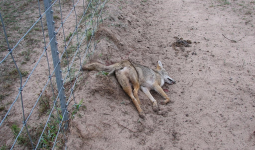
This coyote paced the boundary fence for over half an hour bugger barking, passing within 10' multiple times but refused to cross the line.
I had that happen 1x. Coyote seemed to want to come bad. But refused to clear/breach the fence.

One of the pairs I observed over 3 Winters. They used 2 neighboring 1sq mile land sections. They used mainly the southern 3/4 of each section. Over those Winters. Prior to yearling dispersal. I can count on 1 hand. The times a lone coyote would cross coming from their territory. Going North of either section. Trying to figure out why that was. I concluded that 1/4 +/- mile swath. Was a territorial marker boundry.
 
This was one of my favorite stands; there are several well used crossings on that N-S fence (vertical in pix) that he could have used. He would stop and make false moves as if to cross, but never did stick his nose under the fence (no permission on adjoining ranch). Here's a couple that did not honor that boundary to their peril.

1794318642752.jpeg
1794318504128.jpeg
 
1794332983690.jpeg
This one brought back some funny memories.
My son didn't get down for a hunt often, but this particular weekend he brought his .416 RM to hunt nilgai. We can only shoot cows. Young bulls and cows are the same color and it is extremely difficult to see the horns on young bulls. I always make a couple of coyote stands while waiting for good light before hunting nilgai. Its really easy to overlook a young bull's short horns and that is a mistake I do not wish to make, so this morning we were sitting side by side in the SW corner of the ranch facing north.
I had pointed out the crossings to my son and told him to expect the coyotes to cross the fence and beat it across the two track to the brush, so sit w/rifle on sticks pointed down the roadway and be ready! You can see the approach on the other side of the fence on some of the crossings, but others are obscured.
1794332194988.png

I had my Mforgery shouldered and pointing at the middle crossing and had advised him to do the same when this coyote burst through on the trot. I fired as soon as his head and shoulders appeared under my crosshair and his forward momentum was sufficient to carry him all the way into our pasture.
As stated, my son was sitting within 5' on my left and I asked him why he didn't shoot and he said, "I was wondering why you didn't shoot". :oops: Neither of us heard the other's shot! Upon examination, it was very obvious that there was only one (tiny) hole in his shoulder. My son said his aim was true, and he saw the coyote drop at his shot and was sure he had hit it. I kid him to this day about the old saw, "speed kills". His lumbering 400 gr. RN bullet has MV of 2449 fps while the .223 clocks nearly half again that speed.🤣
 

Attachments

  • 1794324932583.png
    1794324932583.png
    1.3 MB · Views: 8
There may be multiple reasons why a coyote chooses not to jump/breech a fence imo. What I do know is. I've seen more than 1 coyote clear a 4' barbed fence with ease. I also know of a few coyotes than climbed an 8' high horse panel fencing(they were sheep killers). I suppose some fences are indeed boundrys. I seriously doubt no one alive. Will ever truly understand the coyote & it's ways.
 
Most of the ranches I hunted had (about) 6' hog wire outside perimeter fences and mostly barbed wire separating inner pastures. BW fences were, of course, no obstacle for coyotes. Ground ranges from sandy to clay to limestone. Hog wire, for the most part varied from about 3x9" to maybe 7x9" grid. Coyotes almost always went under the hog-wire. I did see a YOY coyote coming from an adjacent ranch that was either very hungry for that cottontail he heard or fleeing from a Tasmanian devil, or both. He never slowed down, leaped through the hog wire about 3' or so off the ground (I'd guess the panels were about 4-5" high at point of impact). He slowed down visibly as he squirted through the fence leaving a puff of hair in the process, twisting a bit on exit, but successfully navigated the wire. I thought for a second that the fence was going to act like a gill net; I would wager that he never tried that again.
 
Back
Top