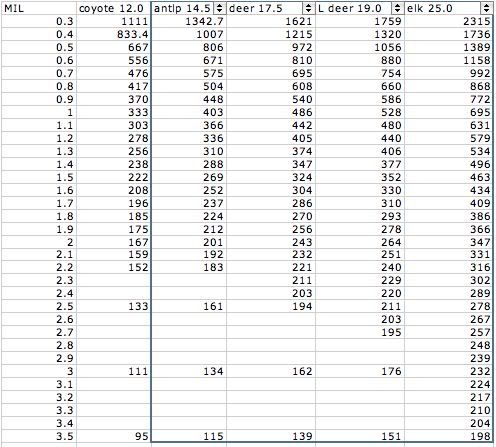
Kyle do a google search on ranging in mil dot and Moa. The two work the
same but are different in their graduations. Moa is based on degrees , minutes
and seconds the same as surveying or star charting. Mil dot is based on milliradrians which the french developed for targeting artillery in meters and kilometers. There are 6.2832 radians in a circle (pie cuts, angles,57.3 degrees)
Each mil is 1/1000 of a radian or there are 6283.2 mils in a circle.
There are 360 degrees in a circle and 60 minutes in a degree or 21,600 Moa
in a circle. For geographic measuring it is carried to 60 seconds in a minute
or 1,296,000 graduations in a circle. My theodolite measures in 1/2 seconds
or 2,592,000 graduations in a circle. The best theos' measure in 1/10 of a
second.
Now all you are doing in ranging is bracketing your target between known
mil or moa points on your reticle. You must also know your target height.
From there it is math, target height in inches x 100 divided by the moa you
read in your reticle= distance to target in yards. For mil it is height of target in meters x 1000 divided by mils= distance to target in meters or height of
target in inches x 27.78 divided by mils = distance to target in yards.
Now on the surface it looks like moa would be more accurate due to the
finer graduations, but you cannot bracket your target well enough to use
any more than about .1 mils.
So a mil angle subtends to 1 meter at 1 kilometer. At 100 yards it subtends
3.6 inches , at a 1000 yards it is 1 yard.
A true MOA subtends 1.047 inches at 100 yards. So shooters Moa is a true
1 inch at 100. It is also called IPHY (inches per hundred yards) or SMOA.
So shooters moa is 10 inches at 1000 yards.
If you bracket a 10" target in your reticle and it is 5 moa here is the
formula 10x100=1000\5=200 yards.
In mils it would be 10x27.78=277.8\1.4 mils ( what the target bracketed
in your reticle)= 198.5 yards.
As I said earlier the DOA appears to be 1 moa between dots.