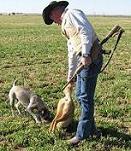
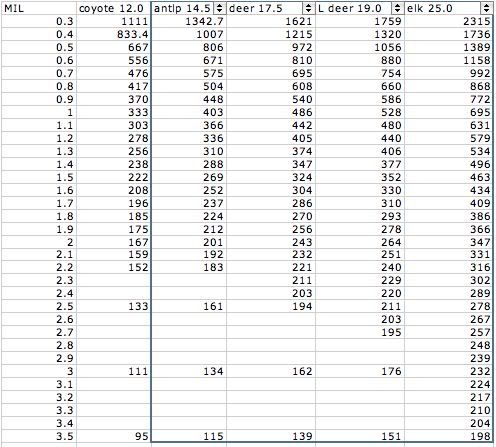
Finished a MIL chart for ranging game.

bigwheeler

New member

I have a couple of mil reticles also so here is a range chart for game in MILs


milgam.jpg
 
would this type of chart work on the DOA system for bushnell? And if you have some time to kill could you explain the chart to us?

Thanks,

Kyle
 
You fit the animal back to chest in your reticle and see how many mils he
measures, then look at the number on the chart for the range. It removes
doing any math. Look up ranging with a mil dot. When you understand it
you will understand the charts usefulness. I posted one the day before for
Shooters MOA. From what I can tell the bushnell has dots that are 1 moa.
 
Originally Posted By: kylesredapplewould this type of chart work on the DOA system for bushnell? And if you have some time to kill could you explain the chart to us?

Thanks,

Kyle

Kyle, ranging with any reticle is based on the mil-ranging formula. With a ballistic reticle that has stadia points that don't repeat (like a mil-dot), the best way to use it is as explained in this article-- www.ottllc.com/specialtypistols/sp20.pdf under Item C2) Ballistic Reticle Rangefinding.

The system is still based on "interpolation" or guessing the decimal equivalent between stadia points as Big wheeler's mil-based chart above, i.e. 1.0, 0.9, 0.8, etc. U'll probably have to go out and measure the points in that reticle since they don't give u the subtensions (measurements between stadia points and main x-hair), unless u can find someone at Bushnell that knows that info. There r ways to use a reticle like that to get very accurate calcs. (as accurate as any stadiametric ranging can be in a riflescope, that is), probably more accurate than the mil-dot, in fact.

BTW, good chart BW.
 
Originally Posted By: sscoyoteOriginally Posted By: kylesredapplewould this type of chart work on the DOA system for bushnell? And if you have some time to kill could you explain the chart to us?

Thanks,

Kyle

Kyle, ranging with any reticle is based on the mil-ranging formula. With a ballistic reticle that has stadia points that don't repeat (like a mil-dot), the best way to use it is as explained in this article-- www.ottllc.com/specialtypistols/sp20.pdf under Item C2) Ballistic Reticle Rangefinding.

The system is still based on "interpolation" or guessing the decimal equivalent between stadia points as Big wheeler's mil-based chart above, i.e. 1.0, 0.9, 0.8, etc. U'll probably have to go out and measure the points in that reticle since they don't give u the subtensions (measurements between stadia points and main x-hair), unless u can find someone at Bushnell that knows that info. There r ways to use a reticle like that to get very accurate calcs. (as accurate as any stadiametric ranging can be in a riflescope, that is), probably more accurate than the mil-dot, in fact.

BTW, good chart BW.


Thanks for posting, could you dumb it down for me a little? whats stadiametric ranging? and how do I measure points? Do I get targets at known distances and chart that way? Do I have to have different points(equivalents) for different powers on the scope? Is there a quick way to do this? Seems like a multi power scope defeats the purpose of mil-ranging. I constantly change power while shooting coyotes. Low for close, high for far.
 
Kyle do a google search on ranging in mil dot and Moa. The two work the
same but are different in their graduations. Moa is based on degrees , minutes
and seconds the same as surveying or star charting. Mil dot is based on milliradrians which the french developed for targeting artillery in meters and kilometers. There are 6.2832 radians in a circle (pie cuts, angles,57.3 degrees)
Each mil is 1/1000 of a radian or there are 6283.2 mils in a circle.
There are 360 degrees in a circle and 60 minutes in a degree or 21,600 Moa
in a circle. For geographic measuring it is carried to 60 seconds in a minute
or 1,296,000 graduations in a circle. My theodolite measures in 1/2 seconds
or 2,592,000 graduations in a circle. The best theos' measure in 1/10 of a
second.
Now all you are doing in ranging is bracketing your target between known
mil or moa points on your reticle. You must also know your target height.
From there it is math, target height in inches x 100 divided by the moa you
read in your reticle= distance to target in yards. For mil it is height of target in meters x 1000 divided by mils= distance to target in meters or height of
target in inches x 27.78 divided by mils = distance to target in yards.
Now on the surface it looks like moa would be more accurate due to the
finer graduations, but you cannot bracket your target well enough to use
any more than about .1 mils.
So a mil angle subtends to 1 meter at 1 kilometer. At 100 yards it subtends
3.6 inches , at a 1000 yards it is 1 yard.
A true MOA subtends 1.047 inches at 100 yards. So shooters Moa is a true
1 inch at 100. It is also called IPHY (inches per hundred yards) or SMOA.
So shooters moa is 10 inches at 1000 yards.
If you bracket a 10" target in your reticle and it is 5 moa here is the
formula 10x100=1000\5=200 yards.
In mils it would be 10x27.78=277.8\1.4 mils ( what the target bracketed
in your reticle)= 198.5 yards.
As I said earlier the DOA appears to be 1 moa between dots.
 
Last edited:
LEO's use targets like door heights 80", license plates 6" etc, that are next to
or near their target. snipers use the torso and head measurements of a man
unless there is something more consistent next to the target like a wheel
rim on a vehicle. Hunters can use body measurements, head measurements
etc.. to get their target height.
 
nevermind the different powers, if they are less than 200 I'll use no hold over and can see them clearly on low power. If I think that they are over 200 I'll turn up the power and use the DOA.
 
No you set a bushnell at it's highest power to range with it. You also need to
go check the scope at your range on targets of known heights and distances
and mark it on the power ring if it is slightly off. You could multiply your answers by 3 if you set the scope on 3x. But it is going to be hard to accurately
bracket an animal on a low power. Your hold over is a completely different
consideration. It is based on your load.
 
Last edited:
OK, I understand. Its a ranging system. I was thinking where do I put the crosshairs if the coyote is 400 yards, not is that coyote 400 yards.
 
Grab the moa chart in the thread below. And go out and practice. Electronic
rangefinders are worthless in fog and snow, and the batteries are worthless in
cold weather.
 
I don't have a rangefinder, but I guess I do now that I got that scope. Now I have to find where my load hits and then I'm set, after practicing rangefinding in a scope.
 
Back
Top