FMJ-CONFUSED

GrizleyHunter

New member
I see alot said about hunting with FMJ bullets and am confused as to why we can hunt with solid bullets and the so called green bullets such as the Barnes TSX and TTSX.
But when someone says they want to use a FMJ there is alot of reasons why we should not use them.So what is the difference between these solids that everyone makes and a FMJ.
Just wondering
 
I was just using The Barnes TSX as a broad example,I shoot many different types of solids from hard cast to guilding metal,from my pistols up to my 416 Rigby.
So I guess I should ask the question better is it because they do not deform enough to absorb some of the energy???
 
Generally fmj's are non-expanding and don't kill the game very quickly - they just pencil thru. Some guys use them for fur due to not damaging pelts as much, but have a number of runners, and will have time not being able to track them down to where they actually died.

The new Barnes, Hornady, Nosler and (maybe others?) expanding, non-lead bullets (sometimes referred to as monolithic) still expand as the have a hollow cavity in front, sometimes capped with a plastic tip, and doe expand, while still retaining pretty much 100% of their initial weight for deeper penetration, and/or no lead dispersal into the meat of environment. A few of the non-lead bullets are not monolithic, but are filled with a metal powder to disintegrate on impact - for varmints, law enforcement training to prevent ricochets, etc.

Some solids are used on LARGE African game where conventional bullets have proven not to penetrate deep enuf reliably for killing. Usually they are round-nosed to still get some tissue damage, but stay together for breaking large bones and getting maximum penetration to vital organs.

Clear as mud??
 
Mike B, summed it up very well.
Some times youll also hear of guys using Heavy hardcast bullets in there bear guns. That decision means they are looking for increased penentration over expansion. Which for a larger caliber maybe just fine, if your already shooting a .45 or .50" bullet, then pentration maybe the better bet.
 
I thought that Fred Eichler guy said they were just fine for hunting?
confused.gif
 
The difference is in their design and function. The barnes Tsx and TTSX are designed to relaiblly expand and penetrate at a wide range of velocities and thus can make clean kills in a variety of situations. FMJ ammo on the other hand relies on a yaw and fragmentation concept that results in poor penetration on larger, heavy or thick targets. I've seen tests that showed only 15% of FMJ tested fragmented properly and some FMJ (hornady, due to it's thicker jacket) will sometimes not even fragment when impacting water. Condition have to be right to make a quick, clean killl with FMJ ammo. The barnes stuff(and it's similar competeing bullet types) is just plain wicked lethal.

Let me see if I have some of my pics from testing I did on the barnes 95gr TTSX even before it hit store shelves.

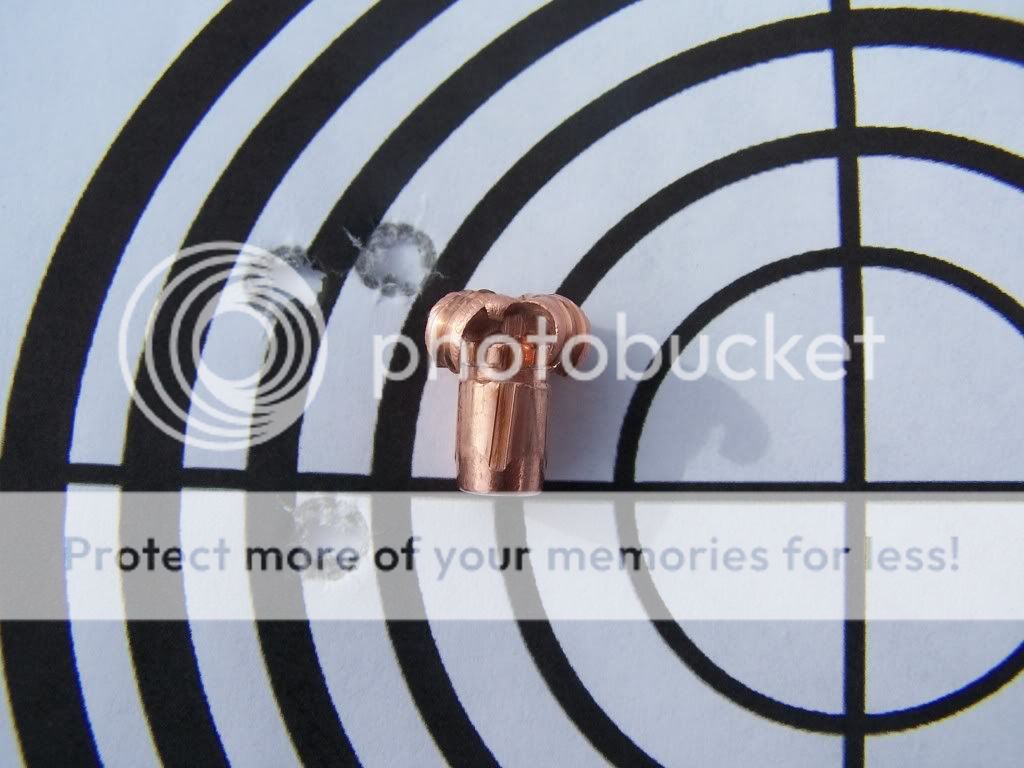
ETA here are 2 pics of lower Velocity tests (about 2100fps) with a Barnes 95gr TTSX It is designed to reliably expand down to 1600fps.

101_6386-1.jpg


101_6387-1.jpg


That is 100% weight retention (minus the polymer tip) and penetration of over 24 inches.

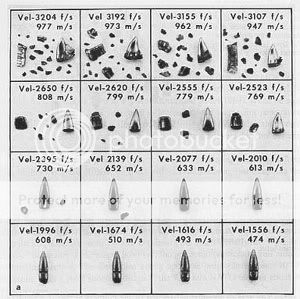
This is someone elses pic of various velocity and results from FMJ ammo.

FMJammo.jpg
.

FMJ ammo requires high velocity to fragment properly, below 2600 fps it gets very spotty.

I've personally witnessed 2 deer be wounded and not recovered after being shot by .224 fragmenting type ammo. I no longer hunt with people who insist on useing .22 caliber bullets and thin jacketed ammo on big game anymore. There is too much that can go wrong to NOT use a bullet designed to expand, hold it's weight and penetrate.

YMMV

Ricky
 
Last edited:
My buddy mistakenly had his SKS loaded with FMJ's one day while we were deer hunting and shot a buck 3 times before it ever flinched. It ran off, We thought he had missed till we went to where the deer was standing.Not only did he hit the deer all three times but the bullets all went through and then through a 10" diameter black jack oak tree and who knows where from there.We found the deer, with 3 holes in the vitals, which was still very much alive and I finished it off.Shoot through a deer and a tree? Very dangerous for hunting. What if it went through the deer then somebody else. They should be illegal to use anywhere while hunting.They are made for wounding on the battlefield and are good for nothing else.
 
Originally Posted By: ricky_arthurThe difference is in their design and function. The barnes Tsx and TTSX are designed to relaiblly expand and penetrate at a wide range of velocities and thus can make clean kills in a variety of situations. FMJ ammo on the other hand relies on a yaw and fragmentation concept that results in poor penetration on larger, heavy or thick targets. I've seen tests that showed only 15% of FMJ tested fragmented properly and some FMJ (hornady, due to it's thicker jacket) will sometimes not even fragment when impacting water. Condition have to be right to make a quick, clean killl with FMJ ammo. The barnes stuff(and it's similar competeing bullet types) is just plain wicked lethal.

Let me see if I have some of my pics from testing I did on the barnes 95gr TTSX even before it hit store shelves.

ETA here are 2 pics of lower Velocity tests (about 2100fps) with a Barnes 95gr TTSX It is designed to reliably expand down to 1600fps.

101_6386-1.jpg


101_6387-1.jpg


That is 100% weight retention (minus the polymer tip) and penetration of over 24 inches.

This is someone elses pic of various velocity and results from FMJ ammo.

FMJammo.jpg
.

FMJ ammo requires high velocity to fragment properly, below 2600 fps it gets very spotty.

I've personally witnessed 2 deer be wounded and not recovered after being shot by .224 fragmenting type ammo. I no longer hunt with people who insist on useing .22 caliber bullets and thin jacketed ammo on big game anymore. There is too much that can go wrong to NOT use a bullet designed to expand, hold it's weight and penetrate.

YMMV

Ricky

You got me confused as [beeep], I always heard that FMJ's do not expand or break up and that is whey they are a no,no for hunting.

You are the first person that I have ever heard say that FMJ's fragment. I never tested them.

Help me out here would you please?

Hope you are not getting Hollow points mixed up with FMJ's.

DAB
 
Originally Posted By: DAB[/quote]

You got me confused as [beeep], I always heard that FMJ's do not expand or break up and that is whey they are a no,no for hunting.

You are the first person that I have ever heard say that FMJ's fragment. I never tested them.

Help me out here would you please?

Hope you are not getting Hollow points mixed up with FMJ's.

DAB


Perhaps a quote from the ammo oracle will clear it up for you.
smile.gif


Quote:Testing by combat surgeon Col. Martin L. Fackler, MD (USA Medical Corps, retired), determined that M193 and M855 bullets (both FMJ bullets*) need to strike flesh at 2,700 feet per second in order to reliably fragment. Between 2,500 fps and 2,700 fps, the bullet may or may not fragment and below 2,500 fps, no significant fragmentation is likely to occur. If there isn't enough velocity to cause fragmentation, the result is a deep, 22 caliber hole, except an area where the yawing occurred, where the diameter of the hole grows briefly to the length of the bullet.

* added by me

What you have heard is correct. Well partly. They do not "expand", but they do fragment by design. The fragmentation is brought about by the bullet "yawing" or tilting to one side as it strikes tissue (or whatever you hit). The forces then exerted on the sideways bullet tear it apart. That is how FMJ ammo is designed to work. It is not designed to hit bone and stay together and keep penetrating like "expanding" bullets will. To the contrary it is designed to do maximum damage with minimal penetration, and at proper velocity and on a human target with a chest thickness of 8-12+ inches it works reasonably well.

FMJ is not suitable for deer hunting for several reasons but one of them is that if the bullet falls below 2700fps it will not fragment properly or possible at all leaving a .22 caliber hole that will not kill quickly or cleanly but will often result in a fatal wound over time. Namely about 6 hours after you give up looking for your buck.
thumbdown.gif


The pictures above are all of FMJ bullets and as you can see thay do indeed fragment if everything goes right.

Well then you might ask, why not just make sure to take shots where your velocity will stay above the magical 2700fps? Won't FMJ ammo be ok then?


Not necessarily, as the bullet fragments it breaks into tiny pieces which have very little individual mass, and penetration is far less than ideal. A FMJ that hits a shoulder or even a rib(which is what happened to one of the deer I saw wounded)may simply "splash" off leaving a superficial wound.

Again let me quote the Oracle.
Quote:
Assuming true M193 or M855 ammo, velocity is the key. Velocity is dependent on barrel length and environmental conditions.

As barrel length increases, the bullet is propelled faster by the expanding gasses in the barrel, imparting more velocity on the bullet, resulting in a longer range before a fired bullet drops below 2700 fps. A shorter barrel imparts less velocity, and therefore the bullet has less range.

Temperature, altitude and humidity are other factors. As temperature or altitude increases, air becomes less dense and bullets travel faster. Contrary to common conceptions, as humidity increases air also becomes less dense and helps bullets retain velocity.

It is important, then, to keep in mind that any statistics given can only be approximate and can be affected by a wide range of factors. But as a baseline, these numbers are what you could expect for 75° F, 25% humidity, at sea level, from various barrel lengths:

Distance to 2700 fps


20" Barrel M193 190-200m


16" Barrel 140-150m


14.5" Barre 95-100m


11.5" Barrel 40-45m

M855
140-150m
90-95m
45-50m
12-15m

As you can see, barrel length and ammo selection make a major impact on fragmentation range.

I fully understand that there are probably hundreds of deer killed every year with .224 FMJ ammo, but I also know from my own eye witness experience and many others who care to be honest that there are an inexcusable number of wounded or lost deer every year due to poor bullet or caliber choice. You owe it to the deer(elk, etc) and you owe it to your hunt to make the quickest and cleanest kill possible and FMJ ammo is just not a reasonable option when for a few pennies more a bullets designed for that job is available.

...descending from soap box because it occurred to me that noone actually hinted they wanted to hunt with FMJ ammo
blushing.gif


One more thing, google AR15.com ammo oracle and you will find more info on FMJ ammo than you could imagine existed. I've read it several times and still reference it occasionally.

Hope that clears it up.

Ricky

 
Last edited:
If you want to experiment on the cheap,compare solid .22 long rifle to hollow point .22 LR in a phone book or something you can recover the bullet.It may not b exactly like the FMJ question but will give you some idea of the difference.
There are so many options now that a person can tailor a load to do what you need.
 
Back
Top