

In the thread, “DVD’s that actually help” several of our members expressed interest in finding DVD’s that could help with their stand set ups. In that thread several of you mentioned that there are not a lot of resources for those of you that hunt in the thicker brush and forests of the east coast. Hunting is brush and forests presents some unique and similar challenges to setting up in more open areas. Many of my videos show hunting in the desert areas of Arizona, New Mexico, Nevada and Texas. This is not because I don’t enjoy hunting in thick brush and the forests. I do enjoy those hunts. Unfortunately, those areas are as challenging to film in as they are to call in and it can be hard to get good, usable footage.
So, I have gone through the footage that I have that I think is useable and I will be posting up several videos along with maps and discussion points that I hope will help to shed some light on the techniques that I have used to hunt in the thicker brush and forests. Now full disclosure, the footage that I will be sharing is from out west. But I have used these techniques to hunt in areas further to the east, I just don’t have usable footage of those hunts. If you want help learning to hunt specific areas back east, I and many other members of Predator Masters would be more than willing to help. I travel for work, and I would even be willing to see if we can set up a hunt the next time, I find myself out in your neck of the woods. Just send me a personal message and we can see if we can get something set up.
This hunt started as a predator hunting contest that myself and another PM member, AZBushman were competing in. The check in for the contest was up in Northern Arizona, so we decided to focus our calling in that area to save windshield time. So, at 0’dark thirty, the first day of the contest we rolled into our hunt area. This was an all-predator contest, and teams were awarded different points for the different predators; 5 point for foxes, 10 for coyotes 30 for bobcats and 100 for mountain lions. Because we knew that we’d be hunting in the thicker brushy areas of the northern forests we opted to focus on foxes, bobcats and mountain lions. It wasn’t that we thought that we might not get a coyote out of those same areas, we have on plenty of occasions. All of those predators are found in these same areas. But the odds were higher that we would find foxes and cats in these areas.
Because we were in a contest, it was very disappointing to go into our selected hunt area and run into a traffic jam and camp after camp of weekend campers right in some of our selected stands.
We had selected our stands on several factors. First off, we looked for areas of thick brush, trees and rocks that also had canyons or creek bottoms. Predators have confidence issues. The more comfortable that you make them feel, the more confident that they will be. If you are selecting areas that make you feel more comfortable the predators may shy away and you will pull a lot of blank stands. But if you give them the advantage, such as thicker brush, rocks, creek bottoms or canyons that they can hide in and travel without being seen, then you are going to start upping your success rates.
But now all our plans went out the window with the weekender invasion. The best laid plans of mice and men, right? So, we had to drop back and punt. It was too late for us to try and run to another area, so when you get lemons, make lemonade. We knew that when the sun came up that the noisemakers, the UTV’s, quads and jeeps would come out. Normally this would discourage a predator hunter. In this case, we needed to use this to our advantage. Predators are a lot like predator hunters, they want to avoid noisemakers as much as we do. Noisemakers tend to stick to easy trails and roads. So we needed to shift our focus towards areas where the noisemakers would avoid. We started looking closer at areas that had scrawny, nasty little canyons, thick brush, rocks and no trails. We started working those kinds of areas that we could see from the trail.
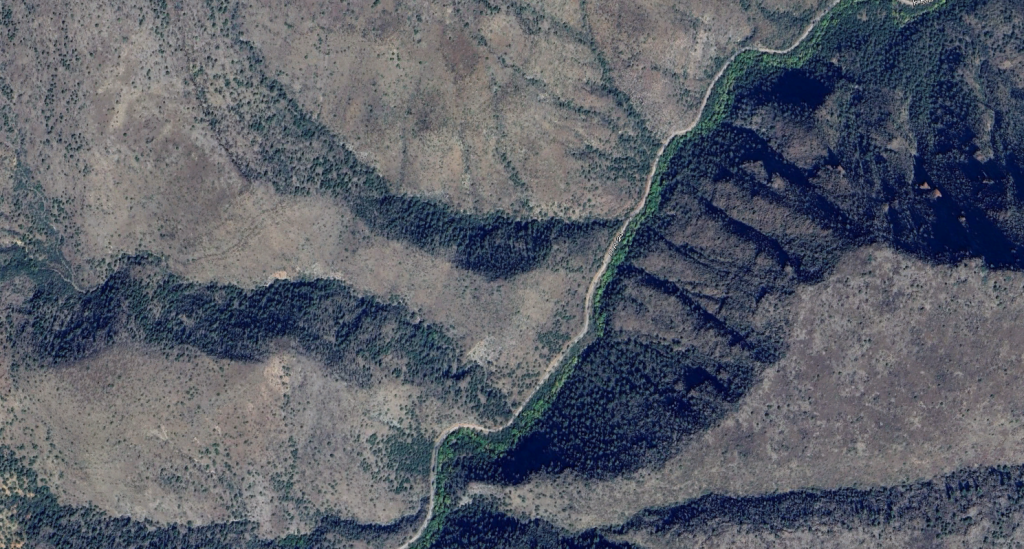
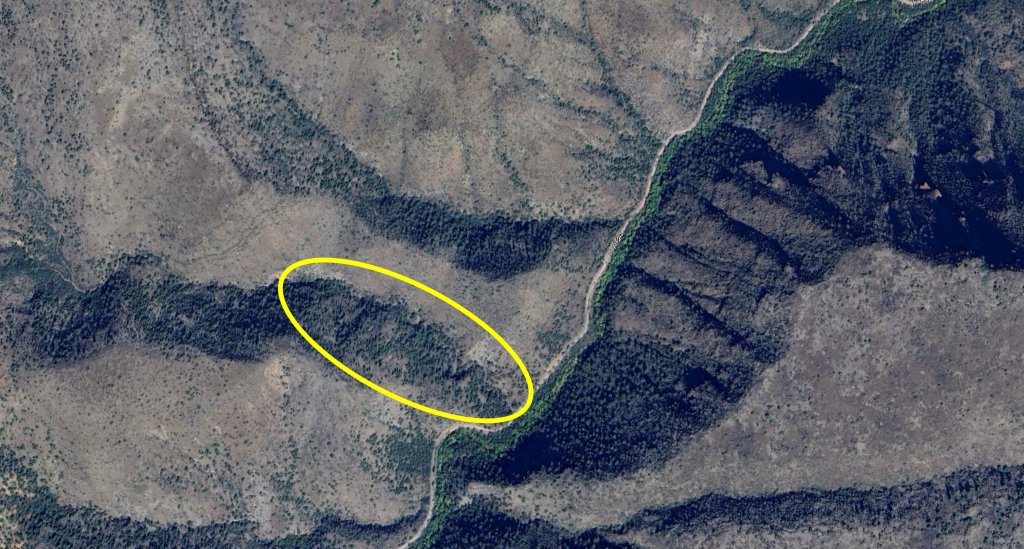
The area in this picture has a LOT going for it. Yes, it has a trail down the middle of it. But it has a lot of smaller canyons that branch off from the main trail. Yes, there would be noisemakers probably running up and down that main trail. But remember, predators are like us and they will want to avoid the noisemakers as well. The traffic often times will push the predators back into those nastier areas because it keeps the noisemakers out.
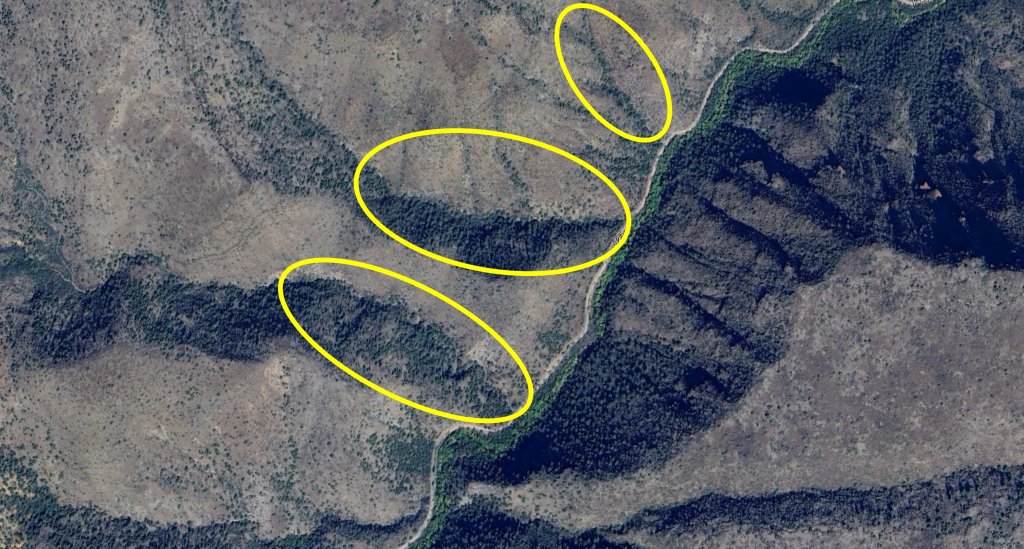
As we were travelling down the trail, we saw 3 small canyons that caught our attention. All 3 of them were areas that the trail riders would want to avoid. While we crept along the trail, we began to rule out some of the options.
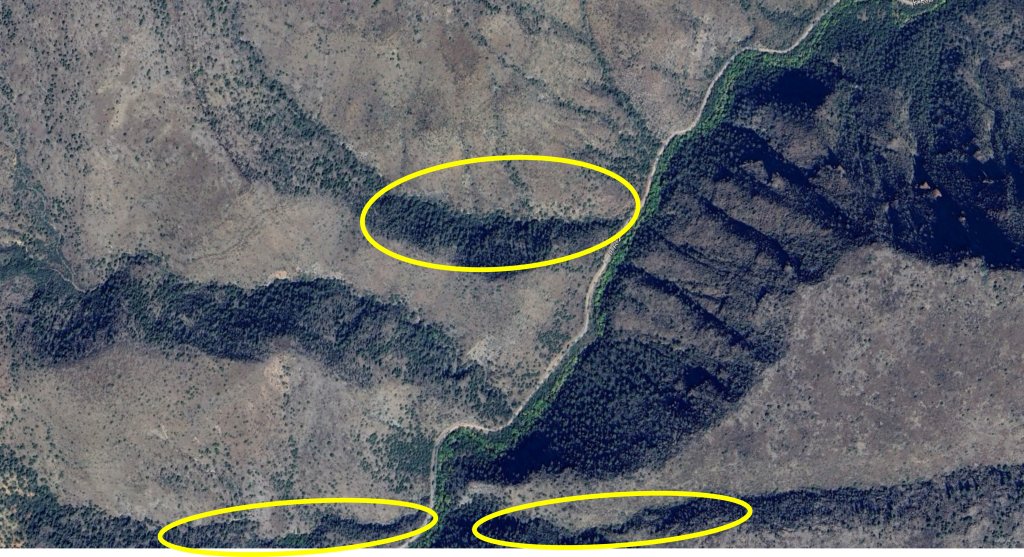
The 2 canyons at the bottom of this picture were ruled out because the canyons were very tight and steep. We could tell that by looking at the slopes of the mountains behind them. There were 2 of us, so we needed an area that we could pull a 2 man stand in. Those areas were off the list. The 1 at the top was wider, but as we approached, we couldn’t see where there was a good area for us to set up.
We decided to go with the one here. We could tell by the slopes of the mountain behind that there were several variations of the slope indicating that there might be some flatter areas. We could also see that there was a good approach. Trying to slide up the canyon, through thick brush would have made too much noise and we could see that there was a way from us to approach from the trail side and keep from burning our stand.
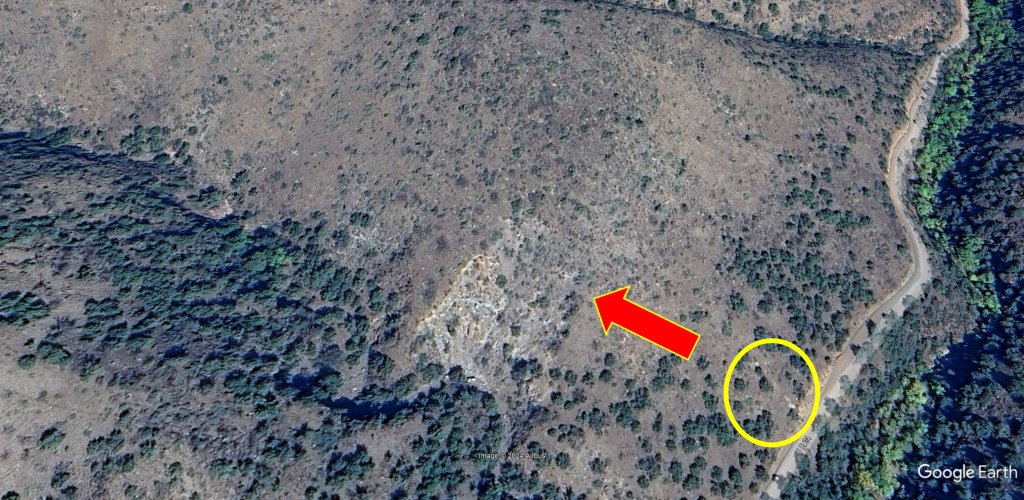
We stashed our vehicle on the trail side of the canyon and used the hill to hide it. We then made our approach up the backside of the hill and as we crested the hill, we like what we were looking at.
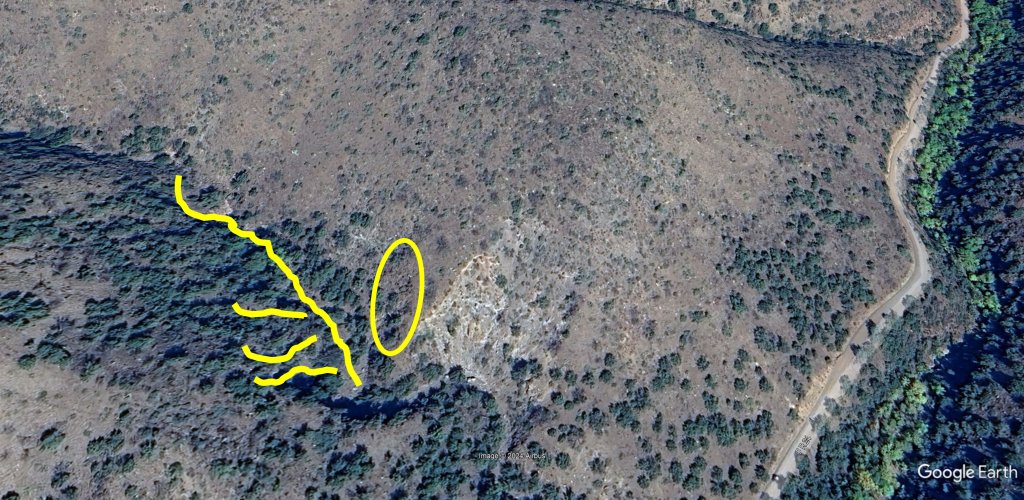
First, we had a good area to sit. We would have bushes and rocks at our backs that would help to break up our outlines. There was the clear area that we just walked through that the predators would be more inclined to avoid as well as the trail at our backs which they would also avoid. Out in front of us, we had a round area that leveled out a bit, that had several small paths through the brush that the predators would be likely to approach on. We also had the small canyon continuing off to our right, while the down canyon side would be protected from likely approach by the main trail.
As we assessed the stand, we did so through the filter of the predators that we were looking to call in. In my experience, coyotes will come from the downwind side to take a look at the source of the sounds but will usually try to approach from behind or the side of the call. Bobcats, on the other hand, seem more likely to try and square up on the source of the sound. It seems like they do that so that they can get clear eyes on the source of the sound. Foxes seem to try and approach from the sides of the sound. Out of those 3, coyotes tend to use scent the most, followed by foxes. Bobcats seem to only have a nose to round out their faces. Because we were in a canyon, broken up by thick brush, the wind would not play as big a factor. The canyon and brush kept our chosen stand area calm.
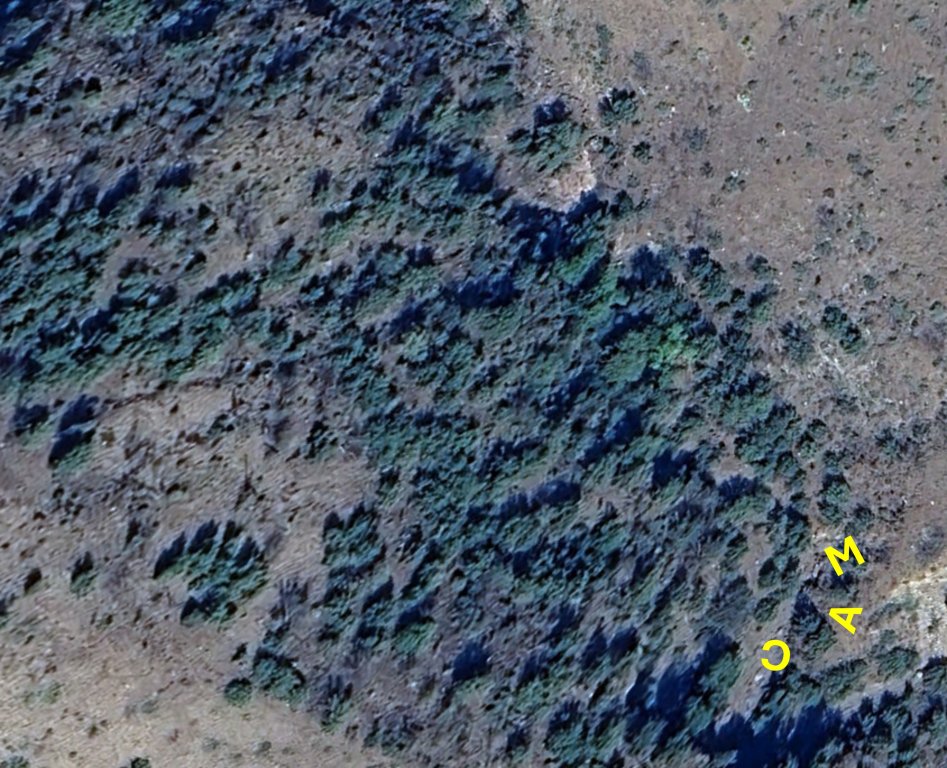
We set the caller up down in the canyon. AZBushman then sat right above the caller to watch straight out from the call. He was using an AR-15 chambered in .204 Ruger. I was lugging around a 12 gauge shotgun loaded with #4 buckshot and equipped with a .660 constriction choke. He took the higher overwatch to watch the area that slopped gently towards the canyon floor so that if something hung up he could reach out and knock it down. I was watching to the right towards the uphill slope of the canyon. Foxes are smaller and being more likely to come from the side of the call, we felt that I was better equipped to take them down.
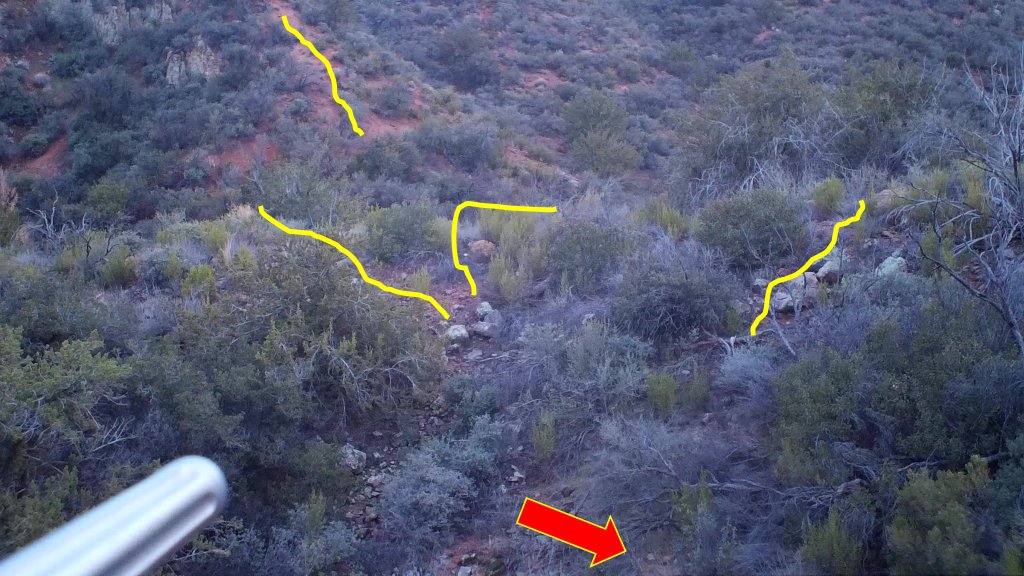
Here is the view for AZBushman looking over the area to the front of the call. The areas that we focus on when working these kinds of stands are the clearer areas. Yes, predators will try to approach from concealment. But at some point, they are going to need to get eyes on the call. If you look over your selected stand locations ask yourself this question; if I were going to approach, how would I do it? Predators want to conserve energy. There is no guarantee that they will be successful in a hunt. If they miss, they want to expend as few calories as possible. In this way they are much like us. You wouldn’t want to crawl through brush when you can simply walk around it. You should watch areas more likely to offer a quiet and easy approach. Look for gaps in the brush. Look for logs or rocks that a predator might use to try and get to the high ground so that they can see the source of the sounds. This will help to minimize the area that you have to cover and will increase your odds of success. This is NOT to say that predators may not come in another way. I can’t tell you how many times a predator comes in from a direction that I may have ruled out or may not have accounted for. It’s just that I am playing the odds. So here in this picture I have highlighted some possible approaches that Bushman is covering.
So, I have gone through the footage that I have that I think is useable and I will be posting up several videos along with maps and discussion points that I hope will help to shed some light on the techniques that I have used to hunt in the thicker brush and forests. Now full disclosure, the footage that I will be sharing is from out west. But I have used these techniques to hunt in areas further to the east, I just don’t have usable footage of those hunts. If you want help learning to hunt specific areas back east, I and many other members of Predator Masters would be more than willing to help. I travel for work, and I would even be willing to see if we can set up a hunt the next time, I find myself out in your neck of the woods. Just send me a personal message and we can see if we can get something set up.
This hunt started as a predator hunting contest that myself and another PM member, AZBushman were competing in. The check in for the contest was up in Northern Arizona, so we decided to focus our calling in that area to save windshield time. So, at 0’dark thirty, the first day of the contest we rolled into our hunt area. This was an all-predator contest, and teams were awarded different points for the different predators; 5 point for foxes, 10 for coyotes 30 for bobcats and 100 for mountain lions. Because we knew that we’d be hunting in the thicker brushy areas of the northern forests we opted to focus on foxes, bobcats and mountain lions. It wasn’t that we thought that we might not get a coyote out of those same areas, we have on plenty of occasions. All of those predators are found in these same areas. But the odds were higher that we would find foxes and cats in these areas.
Because we were in a contest, it was very disappointing to go into our selected hunt area and run into a traffic jam and camp after camp of weekend campers right in some of our selected stands.
We had selected our stands on several factors. First off, we looked for areas of thick brush, trees and rocks that also had canyons or creek bottoms. Predators have confidence issues. The more comfortable that you make them feel, the more confident that they will be. If you are selecting areas that make you feel more comfortable the predators may shy away and you will pull a lot of blank stands. But if you give them the advantage, such as thicker brush, rocks, creek bottoms or canyons that they can hide in and travel without being seen, then you are going to start upping your success rates.
But now all our plans went out the window with the weekender invasion. The best laid plans of mice and men, right? So, we had to drop back and punt. It was too late for us to try and run to another area, so when you get lemons, make lemonade. We knew that when the sun came up that the noisemakers, the UTV’s, quads and jeeps would come out. Normally this would discourage a predator hunter. In this case, we needed to use this to our advantage. Predators are a lot like predator hunters, they want to avoid noisemakers as much as we do. Noisemakers tend to stick to easy trails and roads. So we needed to shift our focus towards areas where the noisemakers would avoid. We started looking closer at areas that had scrawny, nasty little canyons, thick brush, rocks and no trails. We started working those kinds of areas that we could see from the trail.
The area in this picture has a LOT going for it. Yes, it has a trail down the middle of it. But it has a lot of smaller canyons that branch off from the main trail. Yes, there would be noisemakers probably running up and down that main trail. But remember, predators are like us and they will want to avoid the noisemakers as well. The traffic often times will push the predators back into those nastier areas because it keeps the noisemakers out.
As we were travelling down the trail, we saw 3 small canyons that caught our attention. All 3 of them were areas that the trail riders would want to avoid. While we crept along the trail, we began to rule out some of the options.
The 2 canyons at the bottom of this picture were ruled out because the canyons were very tight and steep. We could tell that by looking at the slopes of the mountains behind them. There were 2 of us, so we needed an area that we could pull a 2 man stand in. Those areas were off the list. The 1 at the top was wider, but as we approached, we couldn’t see where there was a good area for us to set up.
We decided to go with the one here. We could tell by the slopes of the mountain behind that there were several variations of the slope indicating that there might be some flatter areas. We could also see that there was a good approach. Trying to slide up the canyon, through thick brush would have made too much noise and we could see that there was a way from us to approach from the trail side and keep from burning our stand.
We stashed our vehicle on the trail side of the canyon and used the hill to hide it. We then made our approach up the backside of the hill and as we crested the hill, we like what we were looking at.
First, we had a good area to sit. We would have bushes and rocks at our backs that would help to break up our outlines. There was the clear area that we just walked through that the predators would be more inclined to avoid as well as the trail at our backs which they would also avoid. Out in front of us, we had a round area that leveled out a bit, that had several small paths through the brush that the predators would be likely to approach on. We also had the small canyon continuing off to our right, while the down canyon side would be protected from likely approach by the main trail.
As we assessed the stand, we did so through the filter of the predators that we were looking to call in. In my experience, coyotes will come from the downwind side to take a look at the source of the sounds but will usually try to approach from behind or the side of the call. Bobcats, on the other hand, seem more likely to try and square up on the source of the sound. It seems like they do that so that they can get clear eyes on the source of the sound. Foxes seem to try and approach from the sides of the sound. Out of those 3, coyotes tend to use scent the most, followed by foxes. Bobcats seem to only have a nose to round out their faces. Because we were in a canyon, broken up by thick brush, the wind would not play as big a factor. The canyon and brush kept our chosen stand area calm.
We set the caller up down in the canyon. AZBushman then sat right above the caller to watch straight out from the call. He was using an AR-15 chambered in .204 Ruger. I was lugging around a 12 gauge shotgun loaded with #4 buckshot and equipped with a .660 constriction choke. He took the higher overwatch to watch the area that slopped gently towards the canyon floor so that if something hung up he could reach out and knock it down. I was watching to the right towards the uphill slope of the canyon. Foxes are smaller and being more likely to come from the side of the call, we felt that I was better equipped to take them down.
Here is the view for AZBushman looking over the area to the front of the call. The areas that we focus on when working these kinds of stands are the clearer areas. Yes, predators will try to approach from concealment. But at some point, they are going to need to get eyes on the call. If you look over your selected stand locations ask yourself this question; if I were going to approach, how would I do it? Predators want to conserve energy. There is no guarantee that they will be successful in a hunt. If they miss, they want to expend as few calories as possible. In this way they are much like us. You wouldn’t want to crawl through brush when you can simply walk around it. You should watch areas more likely to offer a quiet and easy approach. Look for gaps in the brush. Look for logs or rocks that a predator might use to try and get to the high ground so that they can see the source of the sounds. This will help to minimize the area that you have to cover and will increase your odds of success. This is NOT to say that predators may not come in another way. I can’t tell you how many times a predator comes in from a direction that I may have ruled out or may not have accounted for. It’s just that I am playing the odds. So here in this picture I have highlighted some possible approaches that Bushman is covering.