
CV32
New member
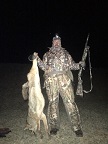
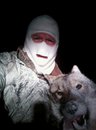
I post that title because that is how it is being reported, but suffice to say I hold plenty of skepticism that it is actually a coyote.
Even though our "eastern coyotes" are big (50-60 lbs is not unheard of, with 38 lbs about average for an adult male), and are known to have more than their fair share of wolf DNA in the lineage, this animal is exceptional.
For the sake of background, this animal was taken on or about March 12/12, near Halfway Pond on the island of Newfoundland. Note I said "island". This is important because we haven't had an indigenous wolf population here since the 1930s, when the Newfoundland wolf subspecies was completely extirpated.
There are wolves on the mainland, in Labrador, which is separated from the island by about 16 km of ocean. In winter, this strait is traditionally ice covered, and there would be no real obstacle to a wolf making the crossing. Still, with that being the case, this animal was taken at a place another 440 km away, straight line distance. More like 800 km if it stayed entirely on land while making the trek.
Local wildlife department will be conducting genetic testing and morphological measurements, but I will be very surprised if it doesn't come back 100% wolf, wolf-coyote hybrid, or wolf-malamute/husky-coyote hybrid, or the like.
But, in any event, I thought I would share:


Even though our "eastern coyotes" are big (50-60 lbs is not unheard of, with 38 lbs about average for an adult male), and are known to have more than their fair share of wolf DNA in the lineage, this animal is exceptional.
For the sake of background, this animal was taken on or about March 12/12, near Halfway Pond on the island of Newfoundland. Note I said "island". This is important because we haven't had an indigenous wolf population here since the 1930s, when the Newfoundland wolf subspecies was completely extirpated.
There are wolves on the mainland, in Labrador, which is separated from the island by about 16 km of ocean. In winter, this strait is traditionally ice covered, and there would be no real obstacle to a wolf making the crossing. Still, with that being the case, this animal was taken at a place another 440 km away, straight line distance. More like 800 km if it stayed entirely on land while making the trek.
Local wildlife department will be conducting genetic testing and morphological measurements, but I will be very surprised if it doesn't come back 100% wolf, wolf-coyote hybrid, or wolf-malamute/husky-coyote hybrid, or the like.
But, in any event, I thought I would share: