

You are using an out of date browser. It may not display this or other websites correctly.
You should upgrade or use an alternative browser.
You should upgrade or use an alternative browser.
Paint or not to paint?
- Thread starter Teamroper
- Start date
ARCOREY
New member
When painting your rifles and scopes, make sure you plug the barrel and remove anything easy to take off like buttpads, sights, slings, and scopes if you don't want them painted. Mask off the action parts that move like bolt body or ejection ports, triggers and safeties and chambers and put screws in any holes left open to prevent threads from getting clogged. Make sure to bottom the screws out when you do this. I also mask off the inlets on my stocks so I don't alter the fit of my action to the stock. Cut cardboard disks the size of your scope lenses and insert them into the ocular and objective them tape over the ends of the scope with several layers of good painters tape or put flip up caps on and spray over them. Make sure overspray can't seep into important places like moving parts, bores, and onto coated lenses. Mask off the turret numbers or cap them. Mask the area where the turrets meet the main tube as well as the eye piece focus and adjustable objective. Be sure and scuff any parts you intend to paint to give the surface some "tooth" to adhere to and have all parts degreased thoroughly. Don't rush it and let the paint have ample time to cure between coats and assembly. If you can, let it sit in the corner for a week or two and cure in. Plan your patterns in advanced and practice on something like a 2x4 board, piece of cardboard, toy gun or pellet gun first. Always wear a mask and ventilate
 .
.

OldTurtle
Moderator - Deceased
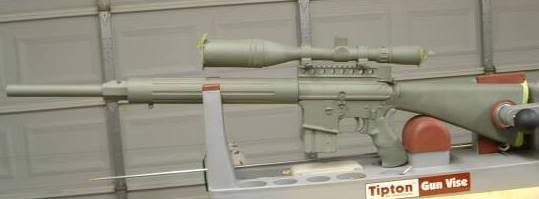
If you want the paint to really stick to the surfaces of metal, use a "Self Etching" primer as a base coat...I get mine at the local NAPA Auto parts store...It's about $10 per rattle can, enough to do several rifles..The primer color is also a good base color for camo jobs...The stripes on the one below are the primer..

My .204 AR primed:
10mm 1911 primed (left as a carry coating):

As stated, preliminary preparation is the key to a successful paint job and taking your time will pay dividends in the long run...I use a thing called "Auto Prep" to degrease and clean the surface, but denatured alcohol will work as well, just a little messier..and it tends to evaporate faster...The Auto Prep is a spray-on and gets into a lot of crevices that you might miss with the alcohol...
Try to select a low humidity day for your painting as it will allow the paint to dry better and with the primer, you will not worry about adhesion or tacky problems that you usually get with the humidity high..
If you are going to use multiple colors, light coats and detail cutting of stencils is almost mandatory to cut down on ridges between color changes...Just be sure to let one coat thoroughly dry before applying the second or the stencil will have a tendency to pull off your base coat...
My .204 AR primed:
10mm 1911 primed (left as a carry coating):
As stated, preliminary preparation is the key to a successful paint job and taking your time will pay dividends in the long run...I use a thing called "Auto Prep" to degrease and clean the surface, but denatured alcohol will work as well, just a little messier..and it tends to evaporate faster...The Auto Prep is a spray-on and gets into a lot of crevices that you might miss with the alcohol...
Try to select a low humidity day for your painting as it will allow the paint to dry better and with the primer, you will not worry about adhesion or tacky problems that you usually get with the humidity high..
If you are going to use multiple colors, light coats and detail cutting of stencils is almost mandatory to cut down on ridges between color changes...Just be sure to let one coat thoroughly dry before applying the second or the stencil will have a tendency to pull off your base coat...
Rock Knocker
Well-known member
This should be fun. I have not done camo before but have painted one of my rifles stainless parts with ceracote that was interesting also. The camo will be fun.
CWeeks
New member
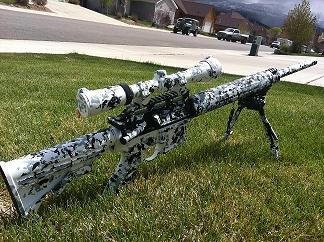
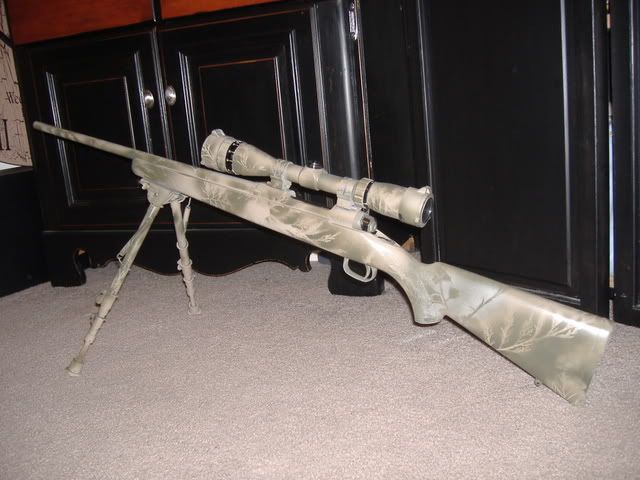
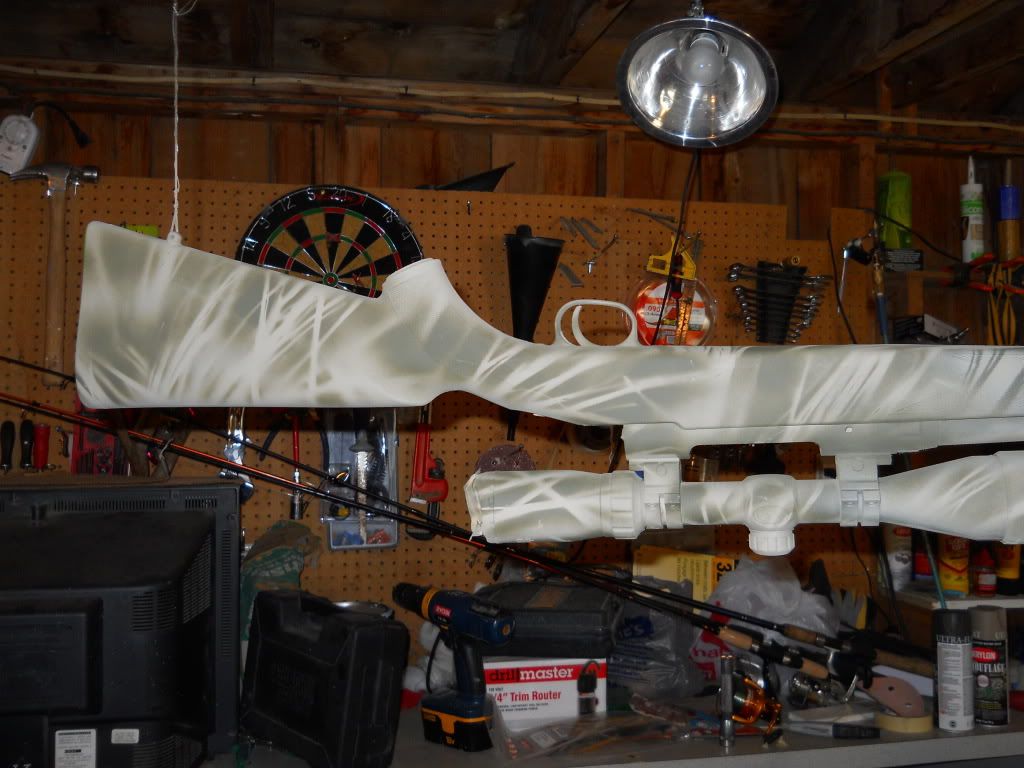
Here is a picture of the exact same rifle that I also own all Krylon'd up. The first paint job lasted 6 years. I put a clear coat on it and then took some fine fine sand paper and scuffed the sheen off. So the first pic is the first paint it got the second picture the latest paint from 3 months ago.
I think I am old fashioned, when I have $2000 into an AR I just can't see taking a can on spray paint to it. I have never asked a yote if he seen my gun before I put the smack down on him.
Some of you guys have some nice looking painted guns, I just think I will keep mine plain for now. Good Luck and Good Shooting----Riflemann
Some of you guys have some nice looking painted guns, I just think I will keep mine plain for now. Good Luck and Good Shooting----Riflemann
jhartwig24
New member
Ok, I just recently started painting my savage axis and i used the rustoleum camoflague flat paint, i tried doing a digital camo pattern, and had about 4 coats of paint on the gun, i just started peeling the tape off the gun, and in alot of places, the tape peeled the paint off as well. I preped the gun wiping it with alchohol to make sure it was clean from oils and dirt, should I have used a primer for the first coat, or ruffed up the stock with sand paper, it looks like [beeep] right now, so I need to fix it. What is the best way to get the current paint (that did stay on the gun) off the gun, so that I can repaint it?
Thanks
Thanks
packhunter
New member
jhartwig24, I would have definately roughed the surface of the stock(or any painted surface) with sandpaper, I use 220 grit, then clean off any dust, oils and tape the inside of the stock off in the barrel and action area. I would also use a good primer and apply a coat or two, before painting. Applying several light coats help with the paint not building up edges against the tape and peeling but I would imagine its going to happen regardless, and the severity will depend upon the type of tape used and drying/curing times between coats, taping and removal of the tape. Patience is key in painting firearms.
Ive heard brake cleaner will remove paint, or thinner or acetone.
I kind of wanted to do a digital pattern on one of my rifles but I didnt care to take all the time doing stencils etc. so I used the sponge technique. I feel the sponge pattern blends better than the digital pattern anyway. I use a few light coats of krylon matte clearcoat for the last layer to help protect the finish.
I am actually doing my .243 in a winter camo right now... Ill post up results later.
Edit:
Finished the .243
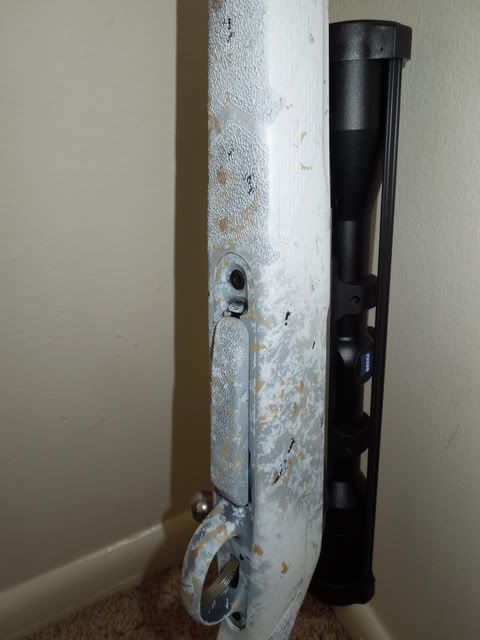
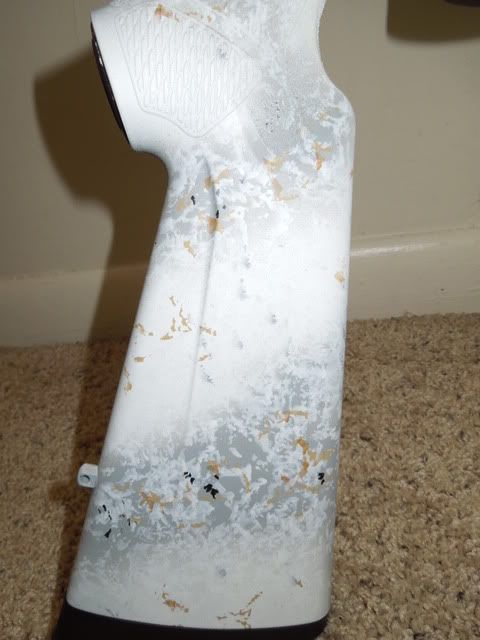


Ive heard brake cleaner will remove paint, or thinner or acetone.
I kind of wanted to do a digital pattern on one of my rifles but I didnt care to take all the time doing stencils etc. so I used the sponge technique. I feel the sponge pattern blends better than the digital pattern anyway. I use a few light coats of krylon matte clearcoat for the last layer to help protect the finish.
I am actually doing my .243 in a winter camo right now... Ill post up results later.
Edit:
Finished the .243
Last edited:
Rocky1
New member
Originally Posted By: MO1You fellas do some really nice work. I kinda wish I had the nerve to do up a couple of mine.
I was hesitant to paint mine at first too, but the old 870 wasn't cherry by any means, blueing was worn thin in several spots, stocks needed to be refinnished as well. Bought the gun a couple years ago because it is definitely a shooter, but I abuse it... it rides in the truck a lot, hangs in the gun rack on the mule a bunch. Otherwise gets drug through the brush, beat around on stand; it's basically a working class gun. Couldn't see spending the money on bluing and going to the effort af refinishing, and I needed to protect it. Paint does that.
-- If you're talking a beat up working class gun, it's the easiest way to maintain it.
-- Synthetic stock, I wouldn't hesitate to paint in a heartbeat, as I'm not a big fan of synthethic look.
-- Some wood stocks, yeah I probably wouldn't hesitate.
-- But a good, clean, well finished wood stock, with any character at all, I probably wouldn't go there.
I was hesitant to paint mine at first too, but the old 870 wasn't cherry by any means, blueing was worn thin in several spots, stocks needed to be refinnished as well. Bought the gun a couple years ago because it is definitely a shooter, but I abuse it... it rides in the truck a lot, hangs in the gun rack on the mule a bunch. Otherwise gets drug through the brush, beat around on stand; it's basically a working class gun. Couldn't see spending the money on bluing and going to the effort af refinishing, and I needed to protect it. Paint does that.
-- If you're talking a beat up working class gun, it's the easiest way to maintain it.
-- Synthetic stock, I wouldn't hesitate to paint in a heartbeat, as I'm not a big fan of synthethic look.
-- Some wood stocks, yeah I probably wouldn't hesitate.
-- But a good, clean, well finished wood stock, with any character at all, I probably wouldn't go there.
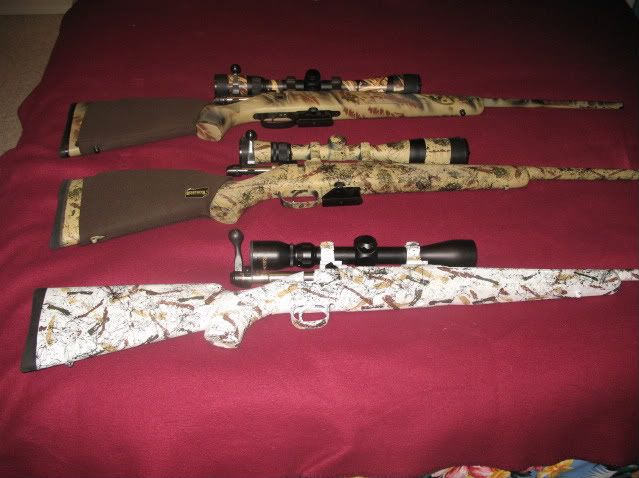
Paint it! The bottom one is a Stevens 200 that i made my snow camo gun. Krylon flat white, tan, brown and olive. Also used their black spider web paint. I painted everyting white first and than used a sponge to dab on the other colors and finally went over everything with the webbing paint.

Teamroper
New member
Originally Posted By: DucksoupPaint it! The bottom one is a Stevens 200 that i made my snow camo gun. Krylon flat white, tan, brown and olive. Also used their black spider web paint. I painted everyting white first and than used a sponge to dab on the other colors and finally went over everything with the webbing paint.
Great Job!

Great Job!

Widow maker 223
Well-known member
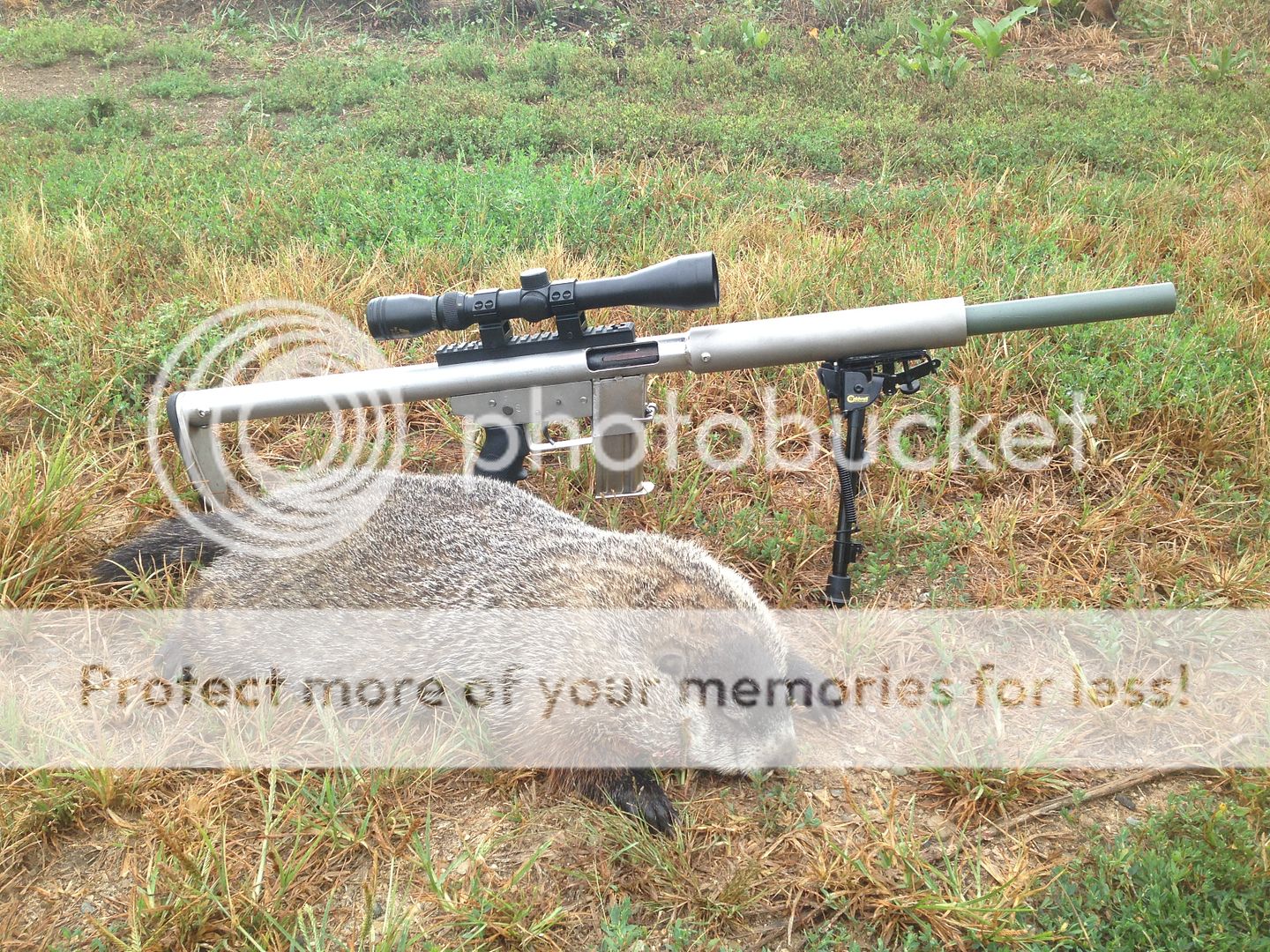
Didn't work says something about not having a public viewed profile. Get a free photobucket account and copy and paste the img code.
Houser in NC
New member
I say paint it. You can always strip it and paint it again.
From this ;
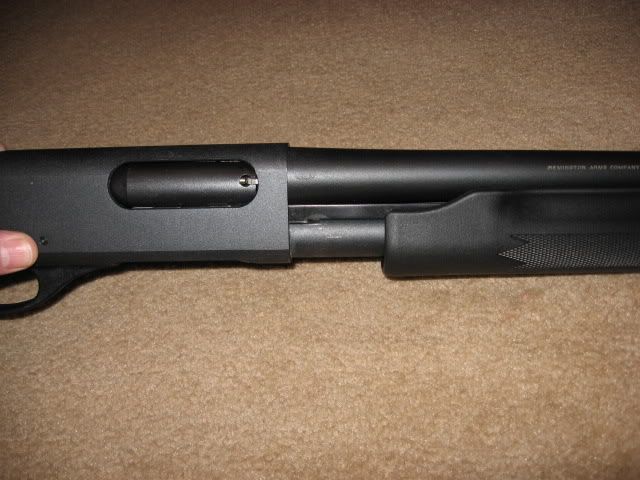
To this;
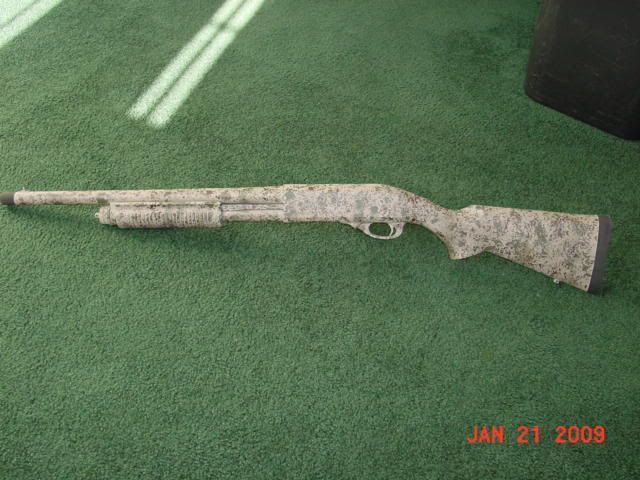
To this;(Barrel to be painted later)
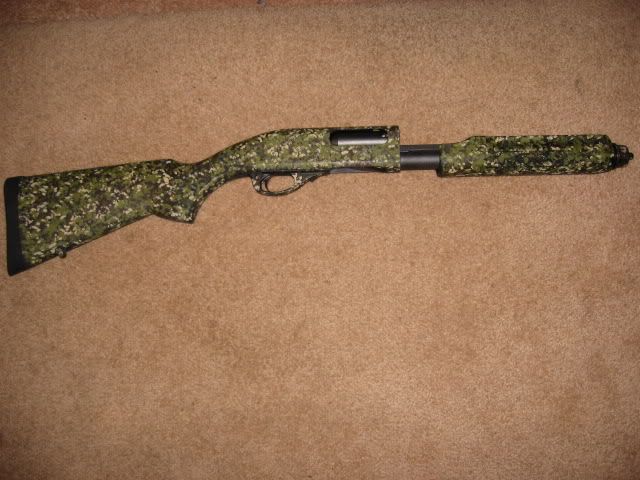
From this ;
To this;
To this;(Barrel to be painted later)
motorcop491
New member
This maybe dumb question, but when painting scope do you take off of rifle, out of rings etc. or just paint in place.
heres a great how-to-paint firearms.
http://www.duckhuntingchat.com/forum/viewtopic.php?f=13&t=36000
http://www.duckhuntingchat.com/forum/viewtopic.php?f=13&t=36000
aftCG
New member
old turtle,
I hit several places in town today and quickly got used to blank stares when I asked about "etching primer". I didn't get to NAPA because I was going from memory.
motorcop,
Depends on the gun. For an AR I strip the lower so the selector, trigger, etc are still black. For handguns I strip COMPLETELY. The gun, I mean. Just to be clear.
I hit several places in town today and quickly got used to blank stares when I asked about "etching primer". I didn't get to NAPA because I was going from memory.
motorcop,
Depends on the gun. For an AR I strip the lower so the selector, trigger, etc are still black. For handguns I strip COMPLETELY. The gun, I mean. Just to be clear.