problem-point of impact moves left to right as range increases

easy_money

New member
Hi guys,
I was wondering what your thoughts on this might are.

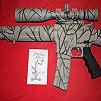
I'm shooting a tikka t3 varmit in .223. 1 in 8 twist.
60 grain vmax bullets.
Scope is a burris fullfield II 4x14 with the balistic plex reticule.
The scope is mounted with the rings that came with the gun.

Point of impact changes from a little left of target at 100 and 200 yards, to on at 300 yards, and then a little further and further right at 4,5, and 600 yards.
Center of the pattern is about 12" right of center at the 500 yard range.

I've played with this a little and I don't believe its the wind.
I don't believe I'm holding over to the right.
I think something IS actualy wrong with my set up and need some advice on what to change.
Any ideas on the most likely cause of this?
unsure.gif


Thanks Clint
 
My first thought is there is some canting going on somewhere. Either the crosshairs are not level, (easy fix) or you are like me and you have a tendency to tilt the gun a little when you shoulder it and think it is level. (not such an easy fix with out a level on the scope, for me anyway.)
 
How light and crisp is your trigger? Could it be as you tighten your finger your pulling you shots to the right. Just a thought
 
for the tikka i would look at some dnz rings/bases. its what i have on my tikka. then take a level when you put your scope on and make sure you gun is level then put the scope on and make sure that it is level too. then go to the range and see if that fixes it.
 
i would remove scope and put a scope lapping tool to it and make sure rings are centered. if that doesnt work , its the scope.
 
Last edited:
Do you adjust your parallax at each range... If you don't, your point of aim/impact will change a little depending on your cheek weld and eye position relative to the scope on each shot...

A quick check on the level factor would be to pull the bolt, line up the bore so it's centered on the side of the target stand (providing it's plumb) and then check to see if your center line of the reticle lines up with it as well, top to bottom...
 
Just a little food for thought. If your not dead nuts on at 100, your gonna be off the farther out you shoot. Alittle at 100 is a whole lot at 600. JMO
 
Thanks guys,

Those are some good ideas. I'll give them a try.
thumbup1.gif


Sounds like a little tinkering should get this fixed.
smile.gif


Thanks for your help.
thumbup.gif
 
Originally Posted By: viperHow light and crisp is your trigger? Could it be as you tighten your finger your pulling you shots to the right. Just a thought

I would also say this is a possibility. When you are pulling the trigger you push the heal of your hand against the stock which makes it shoot to the right. IF you are shooting right handed.
Not saying this is the cause but just a possibility if every other thing else is perfect.

DAB
 
Are you using the same power setting at all ranges?

I've had scopes that shift left/right with changes in power setting.


Are you adjusting your elevation turret setting between ranges?

If so, it could be cant, and your "vertical" won't actully be straight up-down. Or the scope doesn't track properly.

If it's neither of those, I'd guess your scope base is offset from the bore line (incorrectly drilled).

 
Last edited:
It amazed me last year how much a canted reticle will walk your shots at a distance. For that reason I bought a scope ring level and use it while varmint hunting. Set a plumbob up at 100yds and match your scope vertical post to it. Then verify the reticle again at a distance of 300-400yds the same way and shoot and see if it is still going right. If you have no wind, then it's not external cant.

My 17HMR did this when I first scoped it too. I ended up putting windage adjustable rings on it as the receiver seemed to be tapped off center with the bore. All the above suggestions should get you straight.
 
I saw a program on snipers and if I heard correctly they talked about rotational drift( rotation of the bullet making the bullet drift)at long ranges.
If so, how much will it affect the flight of a bullet?


Dang I answered my own question

Gyroscopic drift (Spin drift)

Even in completely calm air, with no sideways air movement at all, a spin-stabilized projectile will experience a spin-induced sideways component. For a right hand (clockwise) direction of rotation this component will always be to the right. For a left hand (counterclockwise) direction of rotation this component will always be to the left. This is because the projectile's longitudinal axis (its axis of rotation) and the direction of the velocity of the center of gravity (CG) deviate by a small angle, which is said to be the equilibrium yaw or the yaw of repose. For right-handed (clockwise) spin bullets, the bullet's axis of symmetry points to the right and a little bit upward with respect to the direction of the velocity vector as the projectile rotates through its ballistic arc on a long range trajectory. As an effect of this small inclination, there is a continuous air stream, which tends to deflect the bullet to the right. Thus the occurrence of the yaw of repose is the reason for bullet drift to the right (for right-handed spin) or to the left (for left-handed spin). This means that the bullet is "skidding" sideways at any given moment, and thus experiencing a sideways component.[20][21]

The following variables affect the magnitude of gyroscopic drift:

* Projectile or bullet length: longer projectiles experience more gyroscopic drift because they produce more lateral "lift" for a given yaw angle.
* Spin rate: faster spin rates will produce more gyroscopic drift because the nose ends up pointing farther to the side.
* Range, time of flight and trajectory height: gyroscopic drift increases with all of these variables.

Doppler radar measurement results for the gyroscopic drift of several US military and other very-low-drag bullets at 1000 yards (914.4 m) look like this:
Bullet type US military M193 Ball US military M118 Special Ball Palma Sierra MatchKing LRBT J40 Match Sierra MatchKing Sierra MatchKing LRBT J40 Match LRBT J40 Match
Projectile weight (in grain) 55 gr 173 gr 155 gr 190 gr 220 gr 300 gr 350 gr 419 gr
Projectile diameter (in inches and mm) .223 in / 5.56 mm .308 in / 7.62 mm .308 in / 7.62 mm .308 in / 7.62 mm .308 in / 7.62 mm .338 in / 8.59 mm .375 in / 9.53 mm .408 in / 10.36 mm
Gyroscopic drift (in inches and mm) 23.00 in / 584 mm 11.50 in / 292 mm 12.75 in / 324 mm 3.00 in / 76 mm 7.75 in / 197 mm 6.5 in / 165 mm 0.87 in / 22 mm 1.90 in / 48 mm

The table shows that the gyroscopic drift is rather variable and no clear trend is easily distinguishable.


The table does not print out like it is printed from where I copied and pasted.

I searched for (Rotational drift) and got this. and found what I pasted.

External ballistics - Wikipedia, the free encyclopedia
Source

External ballistics is the part of the science of ballistics that deals with the behaviour of a non-powered projectile in flight. External ballistics is frequently associated with firearms, and deals...
en.wikipedia.org/wiki/External_ballistics


So please if you do not agree with it, Please don't hang the messenger whom is little old ME.

DAB

 
Last edited:
Back
Top