I know this is an old thread, but this topic is something I know a bit about. I make my own hardened steel targets, so...
I'll answer a few questions from my experiences shooting steel. First, commercial target manufacturers recommend shooting their ar500 targets with lead only in handgun calibers. This, I assume, is not because the target can't handle the jacketing, but is a recommendation made to reduce risk of ricochets to the shooter because of the shorter distance when using handguns. I'll add something else here: Never, NEVER shoot steel with shotgun slugs. A police sniper buddy tells me they mushroom upon impact, basically turn inside out then return in the direction they came from. Injuries have resulted...
In long range rifle chamberings, some recommend limiting the velocity of the cartridge to less than 3000 fps. My experience shooting my own targets is that velocity is irrelevant by itself. The damage done to targets is a function of mass x velocity, not one or the other by itself. On my targets, a .308 bullet traveling 2500-2600 fps did slightly more damage than a .223 bullet running 3350. Also, full metal jacket bullets tend to leave more of a mark than soft point or hollow point, so those are definitely not recommended, not because of ricochets, but to extend the life of the target. Full metal jacket bullets turn to powder upon impact just like soft points.
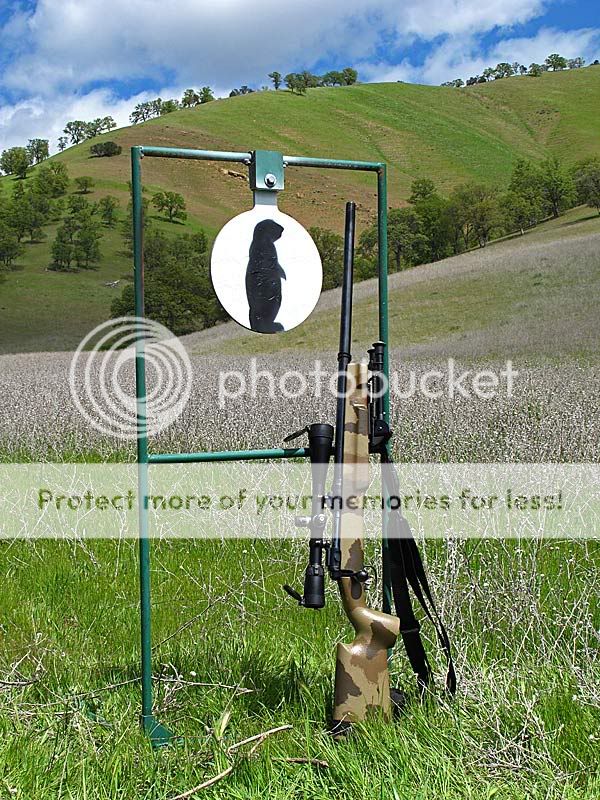
If you hang a target using rope or strap, you want to be sure that no part of the rope or strap is protruding from the front of the target, even if it is well above the target area. When bullets impact the front of the target, they spray copper jacketing and lead in all directions, and if your rope or strap is in the way of any of it, you'll likely have to replace it before long. I have a life-sized prairie dog that I shot last time I was out and after 15 shots, I noticed a freshly dug 2-inch deep trench extending two feet on either side of the target. So exposed ropes/straps are a no no. Chains are better.
In regard to the thickness of the target, I use 3/8" 4140 alloy hardened to 52 Rockwell/500 Brinell. This is enough for standard and varmint calibers, but magnum rounds have a bit too much horsepower. I shot one of my prairie dogs with a 180 grain .300 Weatherby Magnum traveling 3250 fps, and while the bullet turned to powder and totally disintegrated, it still punched a plug out of the point of impact on the target. The target very nearly defeated the .300 wby mag though, because I found the plug from the target laying on the ground next to the target. If the magnum round had been way too much for the target I'd never have found it. Also, it occurred to me after punching a hole in my target I should pepper the area around the hole made by my .300 with .223 and see if I could damaged it further. No such luck. It held up with no problems, no fragmentation occurred.
One more thing. Distance is up to you, but I recommend shooting steel at a minimum of 100 yards for safety, but there is another side to this. One of the satisfying things about shooting steel is hearing the SMACK of the bullet when it impacts the target. At 100 yards, there isn't much time between the report of the gun and the sound of the impact. The further away the target, the more distinctly you will hear that deeply satisfying KA-SMACK. This is one of the reasons metal targets are also called reactive targets, because you get some feedback! Shooting steel at distances of 300 yards or greater is a unique experience that everyone should try, IMHO...
I am by no means an expert on this topic, but if anyone has questions not answered here, feel free to message me, and I'll answer the best I can...