

Rubbing, what is it?

Good thread. Sorry I've been gone.

Tac 20 hit on something most don't think about. Coyotes in open country tend to have better furs because they aren't brushy up against foilage all of the time. Thus the wonderful furs of the prairie. Coyotes also loose fur by laying in the snow and guard hairs freezing. When they get up it is pulled out. Rubbing, or breaking as some will call it, usually starts along the flanks. A good fur buyer immediately looks to the flanks for rubbing. Most coyote hunters have a hard time telling if a coyote is slightly rubbed or not but a fur buyer will see it immediately and will dock the hide accordingly.

I just sold my furs and had three go into the rub pile. I hate it when that happens as the rub pile is usually 15-20 dollars less!
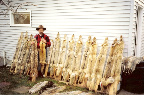
 
Mike, the buyer was real picky this year, I had one that was a good price. I went to another buyer with the ones he did not want to buy and I got nearly as much money for the "bad" ones as the "good" ones. I think Groenewold doesn't want me to come back?? The guy that bought my IA yotes looked at the flank, but couldn't find any missing fur! Thus, for the first time in ten years of taking WY yotes the IA ones brought more money!!!! I wonder why they were missing more hair on the flank than in years before? Some times the WY ones are all good except a couple. Oh Mike did you have any thoughts on what the fur clumps are? I posted on this earlier. T.20
 
I think NASA did a great job covering the coyote fur getting rubbed. Good info. /ubbthreads/images/graemlins/grinning-smiley-003.gif Here the rubbed hides will be graded down one in price and depending on how good the fur still looks...
 
Early stages of mange may be mistaken for "rubbed." And I question "mounting" as a cause for rubbed. Large dominate males may appear rubbed at the same time as females, and they darn well aren't mounted. Early season during periods where the snow sticks around for awhile may cause fur damage. Coyotes will lay in the snow, the snow melts temporarily, then refreezes freezing the guard hairs, especialy on the hips, into the snow. Damage results when the coyote stands up. Most coyotes are in prime only about two weeks...they're on there way in or on there way out. Most of the time the "rubbed" thing is just shedding like most other animals do.
Late stages of mange are quite obvious. Mange is caused by the mange mite which burrows into the hide and caused the guard hairs, and soon the underfur, to drop out. Three types...one affecting the face, neck and withers and one affecting the rump and base of the tail. These two are recoverable. the third type is call sarcoptic (sp) mange is always fatal and affects its entire body. The coyote digs and bites at its hide because of the intense itching. The guard hairs are the first to go, then the underfur next. As the critter bites and digs leisions result with oozing. The underfur becomes wet and matted. And eventually if the coyote doesn't die of hypothermia, it dies of a staph infection. In the latter stages it become quite lathargic. It may run from you only to sit down a hundred yards later and give the appearance of wondering "Now what was I running from?" They smell quite badly, and in the mid to late stages other coyotes will have nothing to do with them. I can tell a mangy coyote more than a mile away over snow. One half of it will appear quite dark. If mangy on the front half, the front half appears nearly black (nearly the color of the underfur) and the ears quite large due to minimal hair on the face.
Seems like I have seen just about everything imaginable while observing Wiley Taken somewhere in the 2300s in my 35 years of hunting them (spot and stalk). Montana Mike
 
In OH a lot of our "rubbed" coyotes have patches missing on or over the shoulder area. Most likely rubs from ducking under barbed wire and other fences, but likely some scratching as well.

I don't think you'll be confused when you see a bad red gox or coyote with mange. Do an internet search. You'll do that critter a favor by killing it.

According to a trapper vet in IN the mange mites will leave the carcass of the animal when it dies. Old theories were to burn the critter to kill the mites off. ** Humans can also get the mange-be at least a little cautious.

Mark
 
Back
Top