


Self Recovery

Sgt_Mike

Well-known member
@steve garrett ,
Glad to see you guys work it out. I could expound upon "IF" and state all kinds of differing methods.
But the bottom line is one is limited by resources in those situations. Ya'll did well you got the truck recovered

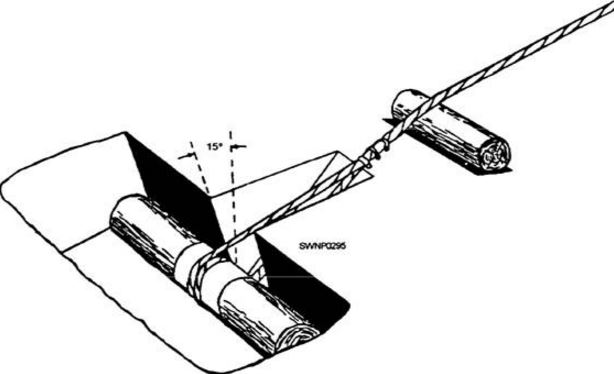
A 1-1-1 picket hold fast (x4, in other words put in a 1-1-1 four time on line) with a log or even a railroad rail section for example would work even for my 1 ton. But you have to have 12 pickets at least, and a railroad rail or even a log the appropriate length and diameter. (here is the crappist picture / diagram I could find which depicts 1-1 configuration with log, the smaller sticks in the diagram is to load the manila rope tension )
View attachment 29524

Steel Picket construction ?
hmmm I would say 48" long 1 " dia. (cold rolled works well) with one end a circulator steel plate welded on to prevent the lashing from slipping and help with removing picket. the the other end sharpened to a point via grinder.

Wood Pickets I would use at least 2X the diameter or as close as I could get for the same length (drive 2/3's into the ground). heck even lumber i.e. 2x4's would work

Lay out would be determined by the picket length one would want the picket distance between pickets the length of the picket at a approximate 15 degree slant away from the pull / load.

Rebar or smaller diameter sticks are used to load / tension the pickets together regardless of pickets in a row. Chain could be used but would need a binder to preload the tension. Rope (mania, although marline will work) would be my preference one because of weight, and also it provide a slight pull back to the other pickets. Add the fact I was taugt to use the manila rope yeah pretty much explains why I lean toward it. Although I have seen ratcheting tie down straps used provided they aren't the ones one would use to hold down a ATV, but it that is all one had. The preference should be a good bit heavier.

A picket plate can be utilized as well this works just as well as the Picket / Log method without looking for a log.


View attachment 29528

IF one wanted the absolute brute in holding power the dead man is the way to go but is labor intensive
1777489621771.png


The depth and width of the deadman is determined by load weight and soil type. One could easily be looking at 7 foot depth say in wet sandy loam earth. Or simply done in rows or even integrated into a picket hold fast design which means less digging. Or if the existing Picket holdfast is starting to fail , if room allows put it 2 to 4 x or more the distance from the Picket hold fast. Just would use something to load the tension from deadman to picket hold fast.

 
Sheaves would help a lot. Although words have meaning, and when looking for sheaves to buy, the use the term pulleys usually net a result. same thing, kind of , sheaves allow one to multiply the pulling power of a pulley system. As sheaves generally, usually, or rather should have at least one more groove than the pulley. This could be in a 2 to 1, 3 to 1, which make it easier on a winch to accomplish a clean easy pull requiring less torque.

Now all of this advocating items is adding weight and taking up room inside, or on my beloved 4x4 off-roading experience. So could I use say a clevis (2) with washers? To improvise and do some room saving?
1777491944663.png

routed properly the answer is most likely it could suffice for a pully / sheave function. One is limited only by their own mind and understanding. So two clevis's with 5 washers could work as a sheave and pulley. The trick is to not have the load bearing rope/ wire rope /recovery strap pulling in opposite directions. Would the sheave and pully be superior absolutely it would be.
 
On the HMMV series there is a hidden winch MANY do not know about.... here is a video describing the setup.


1777493233846.png


So many are going OK Mike great it works for the HMMMV I don't own...
Ha ,, not so fast ... go and look at your own back axles could the same principles be used ? with a adapter that allows the same usage of a steel rod or rebar. huh yes.
(side note here the idea used on the HMMMV was also used on the M151 (Ford MUTT), M38 Jeep, vast number single wheeled truck during WWII, and will probably be included in future designs, The funniest part is they are listed as air mobility sling points)
This works great for those of us using factory or steel rims. Purdy after market rims? well probably could be done as well. The purpose of the video was to demonstrate the idea

Now for a disclaimer on the SRW self recovery the rope needs to be double tied in a figure eight to lock the bar onto the adaptor, and go slow to take up the tension. does it work every time? no, but beats the heck out of standing there going dang boys we are stuck. Is a winch better OH heck yeah.
FM 21-306 describes it the best I've seen
"Field expedients are one-time emergency operations or procedures that you may use to get out of tight spots during tactical operations. Use expedients only under unusual or emergency conditions. The equipment is usually prepared as needed from materials at hand, most of which are designed or intended to serve another purpose"

These are truly last ditch methods that one stands a decent chance of it working. As always go slow, think about where wire rope of rope will break shear and it's path and don't be in it. Think about where your picket holdfast / deadman is and where it will go when it fails.


Ok what about dual's Here it get stupidly easy. Rope or ? (material will be dependent on rim material) routed through the "spokes" and secured across the two rims (away from the valve stems) in my personal case I would remove the valve stem extensions. I would then tie or secure another rope section to the rope I used to secure the two rims together . The tire then act as a guide to wind the rope between the tires.
1777495308834.png


1777495273087.png


Key note for either method to actually work well both back wheels must be used. Why simply because of the way differentials are made. True lockers on the rear wheels would other wise would go straight... ever tried to turn a tractor with the diff lock engaged yeahhhh don't work well.
 
I always have at least one sheave on hand. And a handful of clevis. Basic recovery kit. We also usually carry a Pull Pal, mine is a smaller version for Jeep size vehicles and Steve's is a larger one for full size pickups. They don't work in every situation, but most situations, and they are the easy button for anchoring.

We can attest that ratchet straps are not suitable for picket rigging :ROFLMAO: . Not from this recovery, but our first try at picketing. We didn't really think they'd work. And we were right :ROFLMAO:. Fortunately, we were able to switch up and repurpose some chain and get 'er done that time.

I'm what I'd call an advanced novice/amateur at self recovery. I've done a helluva lot of it, for a helluva long time, and learned from experience. But I also know three guys who are all I4WTA certified trainers and I've served as a volunteer staff member for several of their advanced recovery classes. So, I guess I think I'm more savvy than the average bear, but certainly no expert. I either lead or tail gun on at least two large group runs every year and we always encounter some sort of recovery situation. From mud stucks, snow stucks, roll overs, high centers to you name it. There is usually one or more of those I4WTA guys along and we always make these teaching opportunities for the paying attendees. I learn from them too.

- DAA
 
Copy of FM 21-305

(see chapter 22, page 143? )

Copy of FM 20-22

Those links just for those members interested in the concept on our forum.

@DAA And @steve garrett Honestly guys when I looked at the picket setup I was like yep they have done this before. Nice setup. Sorry about going all woohoo stuff.

But Like I said when one is stuck in the great outdoors and Triple A is just too far away..... Time to engage the noggin... as honestly that and understanding the concepts will save the day. (while I seem to really like the deadman in my posts it is named exactly right. That is exactly what you are after digging it out by hand Jaysus it's is way labor intensive. And honestly is my last resort to anchoring).

I had to actually look those guys up.... HUH neat... bet they have a pretty decent course happening.

(and the winch for the class V hitch I've always thought that to be just a absolute great setup.)

The best recovery I've ever done/assisted was a D-7G buried to the top of the engine cowling.... all the recovery specialists was babbling etc etc. When I showed up as the senior Engineer NCO.
After watching them snap 1 +" diameter wire rope like crazy. I asked the Battalion commander if he really wanted the dozer out, or continue training on how "not to" recover a dozer. Everyone stood there wide eyed when I said that (the BC and I didn't like each other).. Then had the operator use the blade to pick up the nose of the cowling handed him a short handed shovel "dig" the front belly pan out.. once he had clearance Grabbed two mechanics and the operator and instructed them to take off the front belly pan. That done had him use the ripper for the rear same instructions. Two Hemmit wreckers , and three more D7G/F (two with rippers one with winch) as the anchor, three chainsaws cutting the timber felled by the snapping wire rope, she waddled right out. Then the operator (whom was actually a mechanic) caught hades for sticking it and panicking. Would have been way easier and faster with the M88 "Hercules" but it was elsewhere in a recovery.

I honestly think it pissed him off to no end when what I instructed actually worked after the recovery team using almost 18 hours.
 
Last edited:
Mike, I've kept a .pdf copy of that manual on the tablet devices I've used for electronic navigation for many years, and have read it, well, more than three times :p . It's solid info.

The I4WTA is legit. The courses are rigorous and they don't give out participation awards. Either you really learn the stuff and understand it, AND can teach to others, or, you spent your money to go home without a certification. It's a lot more than just what equipment and how to use it, they are heavy on geometry, knowing working load limits and math. If I was ten years younger, I do it just to do it. Not happening at this stage of life though.

I'm on the board of directors of a Utah non-profit that promotes vehicle based exploration and recreation. The group runs I do every year are to raise money to support local causes - donating to legal defense funds, trail maintenance and cleanup, etc. One of my fellow board members and a constant attendee on all the runs I lead or tail gun for is an I4WTA instructor. He spends a few weeks each year teaching aspiring instructors. As I already mentioned, I've helped him out as a staff member for his advanced recovery classes. But his bonafides are pretty impressive. He's driven across all seven continents. Including a first ever south to north traverse of Greenland. He's driven the Darien Gap - where they actually had to cut trails through the jungle and make rafts and bridges to get their vehicles across rivers. Just crazy stuff. Best of all, as he's world known as an expert, he gets sought out and paid well for most of his constant world wide adventures. Last month he traversed Africa.

Anway, when I say I'm no expert. I know of what I speak. I get to hang out and do recoveries with real experts. And I'm not one!

Couple of links to my friend Kurt's bonafides.

His Greenland traverse


Expeditions 7 - crossed all 7 continents

- DAA
 
Oh, and as a total aside, nothing to do with nothing really, other than it's a small world. That Expeditions 7 website sucks. And, the guy who built it, used to work for me many moons ago. I still run into him from time to time and always tell him his website sucks :ROFLMAO: .

- DAA
 
Man there is NO WAY I could keep up with those guys. Sheeet I'm a amateur compared to others in that world. yeah I know the above sounded like I was a god in recovery ( everyone kept overlooking the suction on the belly pan, as well as the anchor point needed 2 to 3 X the weight of the stuck vehicle).
I know enough sometimes to be my own worst enemy at a task LMAO
 
the suction on the belly pan, as well as the anchor point needed 2 to 3 X the weight of the stuck vehicle).

That's exactly the kind of stuff those I4WTA guys thrive on! I've watched them lay it out and do the math a few times. Makes my head hurt. But, still, end of the day, I know what suction/stiction is and take it into account when formulating a plan to get free again. Or, being more real, I see it, know it's there, and hope for the best, fail the first try and have to come up with a new plan :p . That's happened to me and @steve garrett pretty routinely. And the advice I always give but don't often seem to follow is "give it everything you've got on the first try". Instead of following my own advice, we usually try what looks easiest first, fail, and have to do it over again.

- DAA
 
I carry 100 ft of recovery rope 5/8 synthetic and a 2 ton lugall, four screw in mobile home anchors and a length of chain with clevises to hook to the anchors. I haven't needed to use the anchors but have been able to tie off to pull the truck out. I can two-part the lugall to double the pull.
 
Erich, I know you said you haven't had to use them, but I'm pretty interested in how those mobile home anchors actually work. I don't know anyone who has actually used them. They look promising though.

- DAA
 
I guess my rambling on is the fact that DAA and Steve actually did a successful recovery to add to the story. Which make no mistake it wasn't easy lugging recovery materials. I didn't have to be there to know the labor involved of actually staking everything in place can be brutal.
Have to say I was "right proud of the boys". And I know they was tired and just had a great story to add to the memory of that trip. Hopefully will recount several times. So to @DAA and @steve garrett Gents thank you for you sharing this tale / story I have thoroughly enjoyed it, accomplishing a hard task much like settlers did in mostly likely the same region without fossil fueled equipment.
Imagine given two mules a wagon in a similar situation. or even two wagons and a team of two mules, it's no wonder why most pioneers died on the journey to settle the west.

Mobile home anchors I heard of them being used, but never attempted them or really looked into them. Yes please expand upon them color me interested....
 
Just for fun... A video I put together a few years ago. Adventures with getting unstuck using a Hi-Lift jack. Illustrates what I'm saying about do as I say, not as I do.


- DAA
 
Imagine given two mules a wagon in a similar situation. or even two wagons and a team of two mules, it's no wonder why most pioneers died on the journey to settle the west.

Mike, one of my "other" hobbies, and a focus of the non-profit I'm a BoD member of, is retracing the steps of the pioneers. I was expecting to lead a trip to retrace the path of the Hastings Cutoff this summer. That's the path the Donner party took that doomed them. I've spent years retracing it on my own. Unfortunately, I've had a torn rotator cuff for about three months now and the surgery/recovery from that is going to make me leading this trip impossible - so the trip isn't going to happen. But I've done a ton of research and already travelled all these paths myself. To include a lot of metal detecting.

To see the evidence of the hardship, firsthand, sometimes perhaps to be the first to uncover it, is soul wrenching.

- DAA
 
We use to have church groups (youth mostly with adult supervision) that would do weekend pioneer reinactments in the summer time pushing hand carts on the pioneer trails in Utah. And not just flat land stuff either. Had a leader die from a heart attack one year.
 
I use the ones that screw in. I have the ones with eye welded shut. I use them mostly to secure my boat when duck hunting when there is nothing to chain it to at night. You can't pull them out of even in a muddy bank and two a foot apart with a chain run through you can't screw them out. We have used them as a anchor point doing construction. I think that you don't disturb the earth and any roots just add to its holding ability.
 
Our fore fathers had strength and perseverance that was incredible. I used to compete in voyager backpack races, 180# pack with just a trumpline. To think those old voyagers move all the supplies for Hudson Bay Company and just about everything that moved across the north country before roads.
 
Back
Top