

The Priciple Behind Killing Power of a Cartridge

CalCoyote

Member
With regard to muzzle energy (knock down power), more is always considered better. We always look in the books and see what is the hardest hitting cartridge that we can accurately shoot and then run out and buy it. But I really DON’T understand some of the concepts of killing power. Below is a comparison of the energy of two different cartridges at 200 yards (a reasonable distance for shooting deer sized game):

A 300 Weatherby Mag shooting a 180gr bullet will generally produce around 3000 lbs of energy out at 200 yards. Whereas a 270 pushing a 140 grain bullet will only produce around 2000lbs of energy at the same distance. Obviously, the Weatherby has 50% more foot lbs of knock down power thereby making it the more lethal weapon.

But, will the 300 mag bullet transfer ALL of those 3000lbs upon impact, or will some of the energy pass through and be wasted on whatever the bullet strikes after leaving the body of the animal? Does the thicker jacket help to “contain” some of the energy on deer sized game?

If a 140gr bullet from a 270 with a thinner jacket that would expand quicker, expended 85% of its energy “inside” the animal before passing through, you would have 1700 lbs being expended. 2000 lbs x 85% = 1700

If a 180 grain 300 mag bullet passed through with only expending 50% of its energy you would come up with 1500 lbs being expended “inside” the animal. 3000lbs x 50% = 1500.

Now, I am not going to sound foolish by saying that a Win 270 would hit harder than a 300 Weatherby, but I would like some of you guys to explain the principle behind killing power of a cartridge.

Also, with respect to the two above mentioned cartridges, would more energy mean more killing power, or would it only increase the effective range (distance) that game could taken if your were shooting the magnum?

Well, there you have it, ignorance and all. Enlighten me with your wisdom…

Calcoyote
 
Bullets heavier for the caliber (higher sectional density) will penetrate deeper than lighter bullets. Basically, the heavier the weight of the bullet the more resistant it is to slowing down.

The ft/lbs of energy you are looking at represents an instantaneous moment in time. If you were to put an immovable/impenetrable plate in the path of the bullet that's how much force it would exert on it. In the case of moving through a fluid object (flesh) you the heavier bullet retains it's velocity such that it it retains more energy as it works it's way through the flesh. As such, it has a greater energy potential than the lighter bullets.

Large calibers create larger wound channels. Greater likelihood of hitting a vital organ, given similar bullet designs.
 
Last edited:
I have learned through trying different bullet types through reloading over the years using my 30-06 that if I choose a harder bullet like a Nosler Accubond it goes through alright but doesnt come apart as easy or expand like a soft point, therefore not creating as much shock value causing a bang, plop effect. I have also noticed the same when using softer bullets like their ballistic tips. It comes apart easier and normally drops deer where they stand but they kick around for a while. This type of bullet to me comes apart too fast. You need a bullet built for the speed of the gun. I have had the best luck with 180g Remington core locts at factory velocities and Seirra 150g Gamekings loaded around 3000fps. These bullets seem to expand to the optimum point and keep pushing right through, creating the best possible energy transfer on deer size game. You have to pick the bullet type to match the velocity of your rifle and game you are after. I have had the best energy transfer with soft pointed bullets on thin skinned game for rifles with muzzle velocities under 3000fps and better transfer with premium bullets at higher speeds.
 
I believe what you say is true, the energy does no good if it is in the ground behind the deer. I have shot deer with a muzzleloader shooting a 240 gr lead bullet that just poked a hole in them making them bleed and run for about 100yds. The energy from the bullet, had it hit something solid, would've been unreal, between the ribs and through the lungs, far less than spectacular. On the other hand, I have seen the small deer calibers shooting large bullets like the .260, 7mm-08, and even 30-30 and 35 Remington pick deer up and slam them to the ground like Thor's hammer hit them. All the energy absorbed into the body and bullet able to expand to full capacity seemed to make a difference. I use to shoot a .280 Remington with 139 gr. bullet at deer less than 100 yds. away. Now I shoot practically the same bullet in my 7mm-08 at the same distance and don't have to tolerate the excessive recoil and powder usage for the same, if not better result. Now if my game was 300yds. plus, the .280 would still be in my possession. Just some of my limited experience and opinions /ubbthreads/images/graemlins/confused1.gif.
 
I also have to give the speed factor credit for instant kills as well. After using slower moving projectiles like shotgun slugs, pistols, and muzzle loaders and have watched whitetails run after perfect shots with these slower moving projectiles being bullets have a harder time expanding at slower speeds creating little energy transfer and little shock value. Faster moving bullets create more shock causing the bullet to come apart and expand better causing the "drop in thier tracks" effect on game. Faster bullets, quicker kills.
 
Muzzle energy (fpe) does NOT equal knock down power OR killing efficiency. The idea that there is a shock wave that travels through the body destroying tissue is completely wrong (though a widespread misconception). The only place where that comes close to being true is the liver, which is almost 100% blood (liquid) and homogeneous (no variation in density). Everywhere else there is too much variation in density and to much interstitial space for a shock wave to be transmitted very far.

We have good high speed x-rays nowadays showing wound channels as they are created. Especially with high velocity bullets a very large temporary wound channel is created, but it closes up almost immediately and there is almost no damage outside the permanent wound channel (flesh is extremely elastic).

The only (possible) exception to that is if the temporary wound channel involves a major nerve nexus. Observational (non x-ray) evidence indicates that a nerve nexus may possibly be damaged or "shocked" by a temporary wound channel.

Where fpe DOES matter in terminal ballistics is in the work it does to the bullet over time, not to the animal. What work it does, how much energy is needed to do it, and what the wound effects are are functions of the bullet design which is MUCH more important to killing power than fpe.

A broadhead arrow typically only has about 50fpe for instance, but is a marvelous killer because no energy is needed to make it mushroom, fragment, or deform (it slices instead of crushing). The only important factor (related to energy) is it's momentum, allowing it enough penetration to work it's magic.

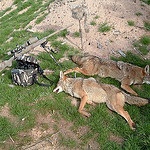
The killing power of a bullet has to do with the damage it does, not the kinetic energy it has when it reaches the target. The energy is used to make the bullet do what it's designed to do (deform, expand, fragment, penetrate) and anything beyond that is wasted and can actually be counterproductive. A 7mag at 100Yds that passes completely through a coyote without even starting to expand (pencil hole) had tons of energy, but that energy was almost completely wasted (and the coyote ran for a little ways).

Here's some pretty recent stuff done by the Division of Military Trauma Research you may find interesting.
 
Quote:
I also have to give the speed factor credit for instant kills as well. After using slower moving projectiles like shotgun slugs, pistols, and muzzle loaders and have watched whitetails run after perfect shots with these slower moving projectiles being bullets have a harder time expanding at slower speeds creating little energy transfer and little shock value. Faster moving bullets create more shock causing the bullet to come apart and expand better causing the "drop in thier tracks" effect on game. Faster bullets, quicker kills.


Your first arguement makes some sense. The above one does not. NMleon's opening sentence is true. FPE does NOT necessarily equate into knock-down power or killing power. Other factors are at play.......

Exactly how much expansion do you feel a bullet or slug of .44 cal or larger needs to kill? Fast, pointy bullets do NOT impart more shock value than big, slower ones. When you shoot a deer with a flat-nosed 45-70 or 444 or whatever, you can literally see the animal get hit as if it were kicked sideways by a work boot. This is shock value. This is knockdown power. Not a fast pencil hole. If you stab someone with a knife, they may still be standing in the same place. Throw a brick at 'em, and I'll guarantee you they will move. If a 30 cal bullet expands to 1.5x it's diameter, it's only as big as a 45 started out......

An example would be a large handgun. On paper, most rifles have more energy. However, what a big-bore handgun has that most rifles do not have is a large bore diameter. Expansion does not really matter. Most pistols do not have the energy to push a highly expansive bullet very deeply. Therefore a hard cast bullet is chosen that will penetrate from ANY angle WITHOUT expansion......

For the same reason, hunters of HEAVY game use solids in big bore rifles, NOT jacketed bullets......

I'll leave it at that for now........
 
I tend to agree with nmelon. Once an animal is above a certain weight I think energy has a job to do, however, it isn't "knockdown." That really doesn't exist. Here is an example...

Richard Davis was the first guy to offer bullet resistent vest to police officers with his Second Chance company. Davis toured the country and would wear one of his products and then shoot himself with a large caliber handgun in the chest or stomach. Often he would stand on one leg and shoot himself with a .44 Magnum handgun in the chest while wearing one of his vest. He wouldn't even be rocked off balance by this. When he developed a vest that would stop rifle rounds he wore one of these vest while his father stepped about five feet away and shot him point blank in the chest with a .308 Winchester while Davis balanced on one leg. Surely that would knock him off balance, absorbing the full energy of the .308 from such short range while he precariously balanced on one leg, right? Nope, didn't even sway him...

The job energy has to perform is to drive the bullet deeply to disrupt and scramble vital organs. Again, once an animal is above a certain weight, penetration is key, and knockdown simply doesn't apply.
 
Quote:
Muzzle energy (fpe) does NOT equal knock down power OR killing efficiency. The idea that there is a shock wave that travels through the body destroying tissue is completely wrong (though a widespread misconception). The only place where that comes close to being true is the liver, which is almost 100% blood (liquid) and homogeneous (no variation in density). Everywhere else there is too much variation in density and to much interstitial space for a shock wave to be transmitted very far.

We have good high speed x-rays nowadays showing wound channels as they are created. Especially with high velocity bullets a very large temporary wound channel is created, but it closes up almost immediately and there is almost no damage outside the permanent wound channel (flesh is extremely elastic).

The only (possible) exception to that is if the temporary wound channel involves a major nerve nexus. Observational (non x-ray) evidence indicates that a nerve nexus may possibly be damaged or "shocked" by a temporary wound channel.

Where fpe DOES matter in terminal ballistics is in the work it does to the bullet over time, not to the animal. What work it does, how much energy is needed to do it, and what the wound effects are are functions of the bullet design which is MUCH more important to killing power than fpe.

A broadhead arrow typically only has about 50fpe for instance, but is a marvelous killer because no energy is needed to make it mushroom, fragment, or deform (it slices instead of crushing). The only important factor (related to energy) is it's momentum, allowing it enough penetration to work it's magic.

The killing power of a bullet has to do with the damage it does, not the kinetic energy it has when it reaches the target. The energy is used to make the bullet do what it's designed to do (deform, expand, fragment, penetrate) and anything beyond that is wasted and can actually be counterproductive. A 7mag at 100Yds that passes completely through a coyote without even starting to expand (pencil hole) had tons of energy, but that energy was almost completely wasted (and the coyote ran for a little ways).

Here's some pretty recent stuff done by the Division of Military Trauma Research you may find interesting.


Where is my dictionary?
 
NMLeon and others,

I need some time to review the links that you have sent. Some of your postings were carefully worded and proof of much study. I had to read a couple of them more than once to more fully “absorb the energy” into my brain. There was a bit of “pass through” the first time.

NMLeon,
So can I accurately draw this conclusion from your response: Muzzle energy is more important in what it does to the bullet, than what it does to the animal. The bullet expanding and destroying the surrounding tissue is the real killing power of the cartridge. This sounds accurate and true but, if this is the case, I have a couple of questions:

What causes the DRT effect we sometimes see on an animal? All of us have shot deer, and coyote that were dead before they hit the ground. While at other times, they run a distance before falling even though they are hit in the vitals.

And related to the above question: An animal shot in the vitals with a good broadhead from a bow receives massive internal damage by means of a huge wound channel produced by the broadhead. But, you virtually never see a deer DRT with a bow. They almost always travel 30-40 yards before piling up. If the killing is in the damage done to the tissue and not the “shock” why aren’t deer DRT when shot with a bow?

I will take time to review the links you guys have sent. In my opinion this is a needful subject to be discussed and understood.

Calcoyote
 
Yes and no 2much. Other than a CNS hit (nerve nexus/spine/brain), and given a hit in the vital organs, it's the amount of trauma that determines the lethality of a wound and how quickly it will be lethal, not any hypothetical "knockdown power".

Large non expanding bullets do an adequate amount of soft tissue damage because they are large and make a big hole. They will generally penetrate deeply because they have enormous momentum (actually inertia) and their energy isn't quickly spent in expanding the bullet. Because of their solidity and mass, they will also break large bones. Those factors make them ideal for very large game where extreme penetration is needed (elephant) and dangerous game where you want to disable the animal immediately more than a DRT shot (griz, lion, buff), but they are limited by velocity to (relatively) short range.

The "fast pointy" bullets that are designed to expand will do more damage to soft tissue given a caliber suitable for like game, because they will (on average) expand to twice their caliber. So where a .577 NE solid puts a .585" tube of destruction through the animal (actually closer to 1" dia of irreparable damage), the (expanded) 30-06 puts a .616" tube (closer to 1 1/2" damage). Of course the 30-06 won't have enough penetration because of the energy used in expansion to get deep into the vitals of an elephant, and if it hits the heavy shoulder of a cape buff or griz, it might very well be the bullet that disintegrates instead of the bone, but it will be much more accurate and able to be used on lesser game at vastly increased ranges (and is much easier and cheaper to shoot).

Your "knockdown power" is mostly muscle reaction as demonstrated by GC's story. If you don't believe it, try filling a 24" square box with soaked telephone books (about 80lb, half the weight of a good deer), set it on a smooth flat surface and shoot it with your 444 or 45-70 from a few feet away. It won't move an inch.

The TKO formula you cited was said by Taylor himself to pertain to near brain shots on large African animals using copper solids. Using his formula, TKO = Bullet Weight (lbs) x Impact Velocity (fps) x Bullet Diameter (in), a baseball thrown at 90mph has a TKO of 124. Your 45-70 shooting a 500gr bullet at 1500fps has a TKO of 49.

Even though the baseball has more than 2 1/2 times the "TKO" of your 45-70, I wouldn't expect nearly the physical reaction form a deer or elk to being hit with the baseball that I'd expect from being hit with a bullet of just about ANY caliber.

Read the paper I cited. Colonel Fackler is THE definitive source on wound ballistics. He (the Army) spent years and millions of dollars studying the subject. He had a large staff working for him full time, access to medical records from several wars, sophisticated laboratory ballistics equipment and mainframe computers, took thousands of high speed x-rays of bullets traveling through living flesh, and had the medical facilities to both see what damage was reparable and to do extensive autopsies. The only downside (from our point of view) is that while much of his work pertains in general, he was focused on human wounds and not big game or big game ammo.

In the treatise Savage 99 cites, HTL (who is a "student" of Fackler) gets a lot more technical and long winded than Fackler (you can skip the math if you want), but concentrates on big game ammo and ballistics more specifically. He did the research himself without a large staff and millions of dollars of research money, so it's not as definitive, but the science is sound and some of the tests with specific bullets and loads are pretty interesting.
 
Cal-All the mechanical work is performed by the energy carried in the bullet, so the energy is used to cause the damage to the animal too, but the major use is to first get the bullet on target, then to get it to penetrate and perform as designed (fragment, expand, etc). What it doesn't do is kill by some sort of "hydrostatic shock", which is what the popular misconception is regarding fpe numbers.

The DRT shots we see can be caused by several things.

When a body experiences trauma it releases chemicals to constrict the blood vessels, forcing blood into the thoracic cavity to maintain a survivable blood pressure and keep the vital organs alive. That's what shock is (in the medical sense).

With a (properly placed) fragmenting bullet (V-max, etc.) the wound channel is a wide cone of destruction that basically destroys everything in the thoracic cavity. When the body tries to constrict blood vessels etc to keep the trunk alive, it immediately pumps the blood to non-existent organs. That causes a catastrophic loss of blood pressure, resulting in immediate loss of consciousness, and death soon after.

If the (very large) temporary wound cavity from a "normal" bullet (expanding or solid) is close enough to the cervical spine or to a nerve nexus, it can cause temporary paralysis and loss of consciousness making the animal appear to be DRT while internal bleeding makes it a fact (hopefully before it regains consciousness). Think of what happens to the function of your arm when you hit your "funny bone" (nerve nexus in your elbow).

One of the "secrets" the video guys use is to (when they can) deliberately hit the "high shoulder" with a bullet heavy enough to go through it. A bullet that goes through the shoulder (at the proper angle) will probably fragment (even though not designed to) and will carry bone fragments with it. The animal isn't going to run far with a destroyed shoulder in the worst case, the fragments will go through the lungs at least (maybe heart and liver too), and with any luck will hit the nerve nexus and/or spine too causing immediate loss of consciousness. Voila, a DRT shot for the camera.

An arrow doesn't cause much (if any) of a temporary wound cavity since it's slicing tissue and not displacing (crushing) it. If the shot is properly placed it won't hit a nerve nexus and will instead go cleanly through the heart and lungs. The medical shock response will often be to the blood loss and not to the blunt force/crushing trauma caused by a bullet, so blood won't be forcibly pumped into damaged organs as soon (and blood pressure won't drop as quickly). The animal will bleed to death, but may walk (or run if startled) for quite a distance since it may be many minutes before dropping blood pressure causes loss of consciousness.
 
NMLeon,

Your explanation seems to make a LOT of sense and answers the DRT question. The funny bone illustration also helps to explain things. I have known people that were in auto accidents that lost consciousness even though they did not suffer a blow the head. They probably received a blow to a nerve sensitive part of the body that triggered temporary unconsciousness from blunt trauma.

Your example of the guys in the hunting videos hitting game in the shoulder also explains something. Over the years, I always hunted with a 7mm mag while my Dad used his 30-06. My deer were always DRT while his often ran 30-40 yards before dropping. I thought it was the performance of the 7mm mag (and it probably was to a small degree). But now that I think about it, Dad always aimed behind the shoulder at the vitals (when possible). Whereas, I have almost always put the crosshair directly on the shoulder (when possible). Probably the bullet exploding the shoulder (and sometimes both shoulders) caused more trauma (shattered bone striking a nerve nexus), thereby causing the DRT effect. In essence, bullet placement, and not bullet ballistics performed the DRT magic. Dad’s deer always ran farther, but always had less damaged meat that had to be thrown away.

I remember reading a book years ago by the late Jack O’Conner. He also brought up an interesting point. He said that in his life of hunting, he observed that the thing that mattered most was what mental state the animal was in immediately prior to being shot. If it was relaxed and unaware of danger, even large animals like elk would often drop in their tracks. One the other hand, if the animal was scared and running with lots of adrenalin pumping, even small whitetail would often continue running after being shot in a vital area with a magnum load. Bow hunters probably understand this concept better than rifle hunters.

Calcoyote
 
Last edited:
Back
Top