I have a 18x mil dot scope that the mils are correct on 18x. Theoretically, would the mil dots equal half mil increments if the scope was set on 9x? I realize 18x might not actually be 18x and the 9x mark on the ring might not be exactly half of full power, but wanted to know if anyone knew this. It would save me some legwork of confirming it on a known target.


You are using an out of date browser. It may not display this or other websites correctly.
You should upgrade or use an alternative browser.
You should upgrade or use an alternative browser.
Theortetical Question on SFP Mil Dot
- Thread starter GoVandals
- Start date
I think it is the other way around, at 9x it would actually be 2 mils. I don't want to guarantee this, but I am pretty sure. Look through your scope at something at 18x and note how much of the object the mildots subtend, then turn it down to 9x and see how much of the object the mildots subtend. It will either be 1/2 mil or 2 mil.
You'll still have to confirm it if u wish to use the optic at a different power [and consequently subtension], but the system is as Obaro said ~inversely proportional, i. e, as power is INCREASED reticle subtension [measurements] DECREASE, and of course vice versa.
I have the 6-18x Nikon Buckmasters MD reticle where the std. mil subtension [3.6 inch per hundred yds.] is set up for 12x. I apply it for rangefinding and downrange zeroing at 18 where the subtension then becomes 2.4 IPHY--
12/18x3.6=2.4
It also measures correctly as calibrated, and calculated.
The el cheapo Centerpoint 4-16x MD Wal-Mart special is similar as well. It's set up for 10x so at 16 it's--
10/16x3.6=2.25 IPHY
That optic make not warm folks insides much, but both mine return to zero very well and the reticle is excellent in it [7 mil units in each quadrant]...although i relegate it to rimfire use only.
I have the 6-18x Nikon Buckmasters MD reticle where the std. mil subtension [3.6 inch per hundred yds.] is set up for 12x. I apply it for rangefinding and downrange zeroing at 18 where the subtension then becomes 2.4 IPHY--
12/18x3.6=2.4
It also measures correctly as calibrated, and calculated.
The el cheapo Centerpoint 4-16x MD Wal-Mart special is similar as well. It's set up for 10x so at 16 it's--
10/16x3.6=2.25 IPHY
That optic make not warm folks insides much, but both mine return to zero very well and the reticle is excellent in it [7 mil units in each quadrant]...although i relegate it to rimfire use only.

skinney
Director
I have all MOA reticles... but the principles are the same for SFP optics... EXAMPLE: NXS 5.5-22X56 with the NR-R2, on full power the value of the reticle is correct, @ 1/2 power the value of MOA is doubled... ie. value between hashes @ 22X is 2MOA, value between hashes @ 11X is 4MOA!!!

willy1947
Active member
I first used a one inch grid chart @ 100yds. Them, I made a mil rad chart to understand what I was doing. I could see what my book was talking about. After I got that done, I moved the chart out to 200yds.
Some scopes sweet spot is at 10X or 14X or ???
The charts made sense of what I was looking at.
Yes, the mil. unit is set up for different powers depending on the company [most are now using the 3.6 inch per hundred yds. subtension between dot centers, but the dot diameters vary a little. This is not terribly significant but can affect rangefinding accuracy].
Leupold typically uses the highest power, Nikon is 12, Bushnell is 14 [i think]. Most companies have some sort of witness mark on the power ring for the calibrated power. The Centerpoint optic does not though--maybe some other Chinese knock-offs may not as well.
Here is a pic of the CP 7-mil. unit that i've become so fond of [most mil-dots are 5-mil units only] for a couple 22's.--
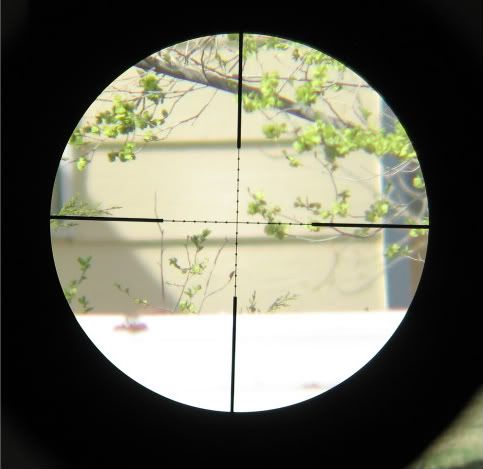
The inversely proportional nature of subtension vs. magnification is a lot of fun to play with in the field sometimes. I have seen a kid make 3-290 yd. connections in calm conditions on prairie dogs [with 2 kills] using a Marlin 22 Long Rifle in about 6 shots by improvising that concept with a 3-9x Simmons plex-reticled scope set to 3x using the plex post tip as a reference.
Recently we established a long-range shooting system with a buddies 17 HMR using a 6.5-20x Leupold Duplex reticle out to 300 yds. or so. That optic subtends 4 MOA to the Duplex post tips at 6.5x according to the catalog, so we just left it there for longer range shooting, and made some great 1st shot connections at LR [300 yds. +] even in some wind, just by calculating a system for elevation and windage using that Duplex subtension matched to a ballistics programs calcs. only without even testing. Some pretty amazing things can happen in the field by the judicious application of a little mathematics.
Here's a very in-depth discussion we had over at varminter.com about the applications of subtension vs. magnification and calculations using mil-based reticles mostly-- http://www.varminter.com/forums/topic/15183-anyone-else-use-mildot-scopes/
Leupold typically uses the highest power, Nikon is 12, Bushnell is 14 [i think]. Most companies have some sort of witness mark on the power ring for the calibrated power. The Centerpoint optic does not though--maybe some other Chinese knock-offs may not as well.
Here is a pic of the CP 7-mil. unit that i've become so fond of [most mil-dots are 5-mil units only] for a couple 22's.--
The inversely proportional nature of subtension vs. magnification is a lot of fun to play with in the field sometimes. I have seen a kid make 3-290 yd. connections in calm conditions on prairie dogs [with 2 kills] using a Marlin 22 Long Rifle in about 6 shots by improvising that concept with a 3-9x Simmons plex-reticled scope set to 3x using the plex post tip as a reference.
Recently we established a long-range shooting system with a buddies 17 HMR using a 6.5-20x Leupold Duplex reticle out to 300 yds. or so. That optic subtends 4 MOA to the Duplex post tips at 6.5x according to the catalog, so we just left it there for longer range shooting, and made some great 1st shot connections at LR [300 yds. +] even in some wind, just by calculating a system for elevation and windage using that Duplex subtension matched to a ballistics programs calcs. only without even testing. Some pretty amazing things can happen in the field by the judicious application of a little mathematics.
Here's a very in-depth discussion we had over at varminter.com about the applications of subtension vs. magnification and calculations using mil-based reticles mostly-- http://www.varminter.com/forums/topic/15183-anyone-else-use-mildot-scopes/
willy1947
Active member
Here's a very in-depth discussion we had over at varminter.com about the applications of subtension vs. magnification and calculations using mil-based reticles mostly-- http://www.varminter.com/forums/topic/15183-anyone-else-use-mildot-scopes/
That link is nice and way over my head. That doesn't take much. Some of made my head hurt. LOL
I went a long gun school at 29Palms to many years ago but that was M14 with iron sights @ 500m. I just use Mil-dot for hold over and wind. Sometimes I hit something or not.
But thats for that link.
That link is nice and way over my head. That doesn't take much. Some of made my head hurt. LOL
I went a long gun school at 29Palms to many years ago but that was M14 with iron sights @ 500m. I just use Mil-dot for hold over and wind. Sometimes I hit something or not.
But thats for that link.