


You are using an out of date browser. It may not display this or other websites correctly.
You should upgrade or use an alternative browser.
You should upgrade or use an alternative browser.
Think going to be addicted to thermals
- Thread starter Krockus
- Start date
DoubleUp
Well-known member
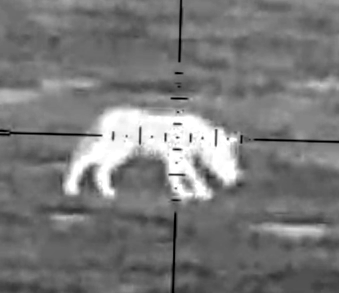
Here is a video my buddy shot on a coyote with the Thermion XP50. Keep in mind that he was new to the scope, and in the intensity of the coyote coming in probably didn't have the scope adjusted as well as it could have been. It does show briefly 2x, 4x, 8x, and a 16x PIP. He killed the coyote at just over a 100 yds. on 8x main screen.
G Anderson
Active member
"Finally, the continuous activation of this function may heat the device more and shorten the battery charge."
Ernest, has this really been proven? I know others go along with this as well, but I have not seen anything from Pulsar stating this and nothing in print(other than on here) that this may actually happen.
I guess it would be nice to know/understand what about the "image boost" function would make it generate more heat. I would have to think that if that would happen then a person could expect the unit to also "heat up" if they were to run with the brightness function run up to maximum. What is it about the image boost that would actually make it heat up? It makes me wonder if the term "boost" somehow indicates to people that extra power is supplied somehow...perhaps if it was called "image enhancement" then maybe it wouldn't heat up?
I ask this because I have run with my image boost on continuously and cannot say that it gets any hotter or drains the battery more. I have run it this way purposely to check this theory out and cannot find where it makes any difference at all in temp or battery life. I am genuinely interested in knowing if this is an actual or perceived notion, because I just have not been able to definitively say it does heat up and drain the battery.
Maybe your source could find out if this actually does happen and explain why it does happen. What happens when the image is "boosted"? Why would more battery power somehow "boost" the image? What is it about "boosting" the image that makes it sharper/clearer?
Could this image enhancement merely somehow just be refining the pixels just a little more to make the image sharper and providing more contrast? I just don't see how boosting the power would make the image better.
Anyhow, it seems that you have a very good source to get these kind of issues put to rest and hopefully we can determine if this is an actual or perceived notion.
Thanks
Gene
Ernest, has this really been proven? I know others go along with this as well, but I have not seen anything from Pulsar stating this and nothing in print(other than on here) that this may actually happen.
I guess it would be nice to know/understand what about the "image boost" function would make it generate more heat. I would have to think that if that would happen then a person could expect the unit to also "heat up" if they were to run with the brightness function run up to maximum. What is it about the image boost that would actually make it heat up? It makes me wonder if the term "boost" somehow indicates to people that extra power is supplied somehow...perhaps if it was called "image enhancement" then maybe it wouldn't heat up?
I ask this because I have run with my image boost on continuously and cannot say that it gets any hotter or drains the battery more. I have run it this way purposely to check this theory out and cannot find where it makes any difference at all in temp or battery life. I am genuinely interested in knowing if this is an actual or perceived notion, because I just have not been able to definitively say it does heat up and drain the battery.
Maybe your source could find out if this actually does happen and explain why it does happen. What happens when the image is "boosted"? Why would more battery power somehow "boost" the image? What is it about "boosting" the image that makes it sharper/clearer?
Could this image enhancement merely somehow just be refining the pixels just a little more to make the image sharper and providing more contrast? I just don't see how boosting the power would make the image better.
Anyhow, it seems that you have a very good source to get these kind of issues put to rest and hopefully we can determine if this is an actual or perceived notion.
Thanks
Gene
With the Image Detail Boost feature in the "on" position I can only report what I observed with my Pulsar Accolade XP50 LRF (before I sold it ...). As for the battery life, I only found empirically that it had gone from about 6.5 hours to about 5.5 hours. With a decrease in duration of about 15%. As for heating the device, I can only give an impression of perception. It seemed to me that the device warmed up a little more than normal. As for the detail of the functioning of the Image Detail Boost function, I think it consists in the activation of a very sophisticated software that optimizes the sensor performance. I've seen something similar, but at a much higher level, trying the Russian thermal riflescope Dedal 380 Hunter at night. It only has 384x288 pixels, but you can see incredible details! You could see the hair on the body of the deer that was in the middle of the lawn at 100 yards. A precision and a detail of the fantastic image. And it all depends on military-derived software. On the official Russian website of Dedal there is an interesting physical explanation on the functioning of night observation devices:
"ABOUT THERMAL VISION
Every object having a temperature above the absolute zero (- 273.2 ° C) emits electromagnetic waves in the infrared range. According to the laws of physics, the intensity of thermal emission is proportional to the fourth power of the temperature of the heated object. Consequently, the detection ability of heated objects ’emission by receivers sensitive in the infrared range depends mainly on the temperature of the object and its surrounding background. It does not depend practically on the illumination level in the visible range.
Infrared emission occupies an extensive part of the spectrum, which is commonly divided into several ranges.
A commonly accepted division of infrared emission into ranges is connected with both sensitivity ranges of existing receivers and atmospheric transparency windows.
A night vision device works in visible and close infrared ranges (wavelengths from 0.4 to 1.0 microns) thanks to the detection of natural and artificial light reflected from observed objects.
100% atmospheric transparency
NV Night Vision Devices
0.4 - 1 µm
NIR Near-infrared
0.75 - 1.4 µm
SWIR Short-wavelength infrared
1.4 - 2.9 µm
MWIR Mid-wavelength infrared
3 - 6 µm
LWIR Long-wavelength infrared
7.4 - 14 µm
Modern compact thermal vision devices work in the range from 8 to 14 microns that corresponds to one of several atmospheric transparency windows. The action principle of thermal vision devices is based on the ability of certain materials to register object images formed by infrared emissions and transform them into electrical signals. Received electrical signals that are determined by the thermal scene of observed terrain are transferred onto the built-in microdisplay after amplification and software processing. The display transforms these signals into a picture of the observed objects that is visible to the human eye."
"ABOUT THERMAL VISION
Every object having a temperature above the absolute zero (- 273.2 ° C) emits electromagnetic waves in the infrared range. According to the laws of physics, the intensity of thermal emission is proportional to the fourth power of the temperature of the heated object. Consequently, the detection ability of heated objects ’emission by receivers sensitive in the infrared range depends mainly on the temperature of the object and its surrounding background. It does not depend practically on the illumination level in the visible range.
Infrared emission occupies an extensive part of the spectrum, which is commonly divided into several ranges.
A commonly accepted division of infrared emission into ranges is connected with both sensitivity ranges of existing receivers and atmospheric transparency windows.
A night vision device works in visible and close infrared ranges (wavelengths from 0.4 to 1.0 microns) thanks to the detection of natural and artificial light reflected from observed objects.
100% atmospheric transparency
NV Night Vision Devices
0.4 - 1 µm
NIR Near-infrared
0.75 - 1.4 µm
SWIR Short-wavelength infrared
1.4 - 2.9 µm
MWIR Mid-wavelength infrared
3 - 6 µm
LWIR Long-wavelength infrared
7.4 - 14 µm
Modern compact thermal vision devices work in the range from 8 to 14 microns that corresponds to one of several atmospheric transparency windows. The action principle of thermal vision devices is based on the ability of certain materials to register object images formed by infrared emissions and transform them into electrical signals. Received electrical signals that are determined by the thermal scene of observed terrain are transferred onto the built-in microdisplay after amplification and software processing. The display transforms these signals into a picture of the observed objects that is visible to the human eye."
Last edited:
Bowhunt
Active member
Originally Posted By: varminter .223The problem with higher magnification is you lose so much field of view this is where picture-in-picture is key and I can't imagine needing more than what the xp50 offers for clarity and zoom. You have the big field of you before and after you shoot and the pip to shoot with. I would really like to look through one of the hogster 35s just to see how the PIP is. I always stress to guys when calling at night field of view, field of view, field of view!!!
I can understand wanting more clarity with zoom to help with ID. I think everybody that hunts with thermal would like that but there's some give-and-take with that when you lose field of view.
Agree 100%! My buddy has an ATN with a base mag of 5X. I kill twice as many coyotes as he does because he has trouble finding them in the scope when they come charging in.
I can understand wanting more clarity with zoom to help with ID. I think everybody that hunts with thermal would like that but there's some give-and-take with that when you lose field of view.
Agree 100%! My buddy has an ATN with a base mag of 5X. I kill twice as many coyotes as he does because he has trouble finding them in the scope when they come charging in.

DoubleUp I saw the video that made your hunting partner with the Pulsar Thermion XP50. He selected the "eye" mode, which means identification. IMO was supposed to set the "mountain" mode. With my Accolade XP50 LRF I had made several tests .... and I had observed that the "mountain" mode gave the best definition of the image. Suggest to your friend to do a comparative test by recording two short videos framing the same landscape, one with mountain mode and one with "eye" mode ....
... then I observed another thing ... I don't see the diamond symbol ... so I don't think he activated the Image Detail Boost function ...
... then I observed another thing ... I don't see the diamond symbol ... so I don't think he activated the Image Detail Boost function ...
Last edited:
After looking through the thermal the last few nights there is no way I could or want to go back to lights. These things are awesome..So much easier to use and the animals don't seem to know your there..Even with red lights when hit them with the light they could see something and would be hesitant before coming in..Just amazing..Just waiting for them to make regs now so we can use them in PA and it should be real soon..Dan
DoubleUp
Well-known member
Ernest, I will have him do that, and try to post a comparative video. Unfortunately I don't have editing software that allows me to do dual video side by side. I have been reading about the Image Detail Boost recently, but thought it was default on at start up and had to be turned off manually. Will certainly give him the advice and thanks. He probably set his Thermion to the ID mode because that is what always seemed to give the best detail with the Trail and Apex models.
varminter .223
Well-known member
Originally Posted By: KrockusYou both use a scanner or swing with the gun.Dan
Not sure who your question is directed at but I have a pair of xp28 helions that we scan with.
Not sure who your question is directed at but I have a pair of xp28 helions that we scan with.
Last edited:
limbhanger10
Well-known member
..If one can call and kill coyotes with red lights..thermal kill is cake..
We scan and shoot with our thermals. We have not had a single situation that we weren't able to re-mount thermals and make the shot.
We have been doing this in OH and NY for years and it is second nature re-attaching scope to base..
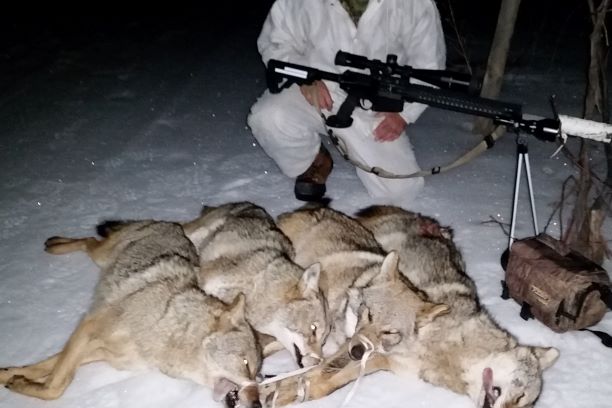
As far as more "power"..not really needed..you have to remember that the yotes will come in well under 100 yards with no hesitation unlike when using our red lights...I have shot them as close as 40. The important thing to remember is not to panic when using thermal...cause they have no clue you are there...study them during this "implementation lull" ..their body language and such...the most amazing thing with thermal is the amount of yotes that you will see..ones that you would never know were there with the red lights. We have have seen yotes come from over 1000 yards...come down driveways...crouch in ditches..circle using roads
Doubles and triples and more will be easier to come by because you can follow it's companion till it stops..they wont see a red light or shadows and keep hightailing it. Try not to take running shots
...your red lights will now be used for coon with the .22

We scan and shoot with our thermals. We have not had a single situation that we weren't able to re-mount thermals and make the shot.
We have been doing this in OH and NY for years and it is second nature re-attaching scope to base..
As far as more "power"..not really needed..you have to remember that the yotes will come in well under 100 yards with no hesitation unlike when using our red lights...I have shot them as close as 40. The important thing to remember is not to panic when using thermal...cause they have no clue you are there...study them during this "implementation lull" ..their body language and such...the most amazing thing with thermal is the amount of yotes that you will see..ones that you would never know were there with the red lights. We have have seen yotes come from over 1000 yards...come down driveways...crouch in ditches..circle using roads
Doubles and triples and more will be easier to come by because you can follow it's companion till it stops..they wont see a red light or shadows and keep hightailing it. Try not to take running shots
...your red lights will now be used for coon with the .22
Last edited: