

You are using an out of date browser. It may not display this or other websites correctly.
You should upgrade or use an alternative browser.
You should upgrade or use an alternative browser.
Varmint Recticle vs. Scope with turret?
- Thread starter jdl5ak
- Start date
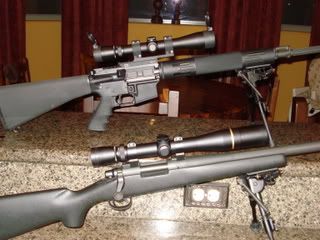
If there'as 1 reticle in the world that doesn't allow an intuitive system of LR zeroing it's the 22 Long Rifle Rapid Reticle that i have on my AR-15. Here's the reticle--
http://www.rapidreticle.com/22lr3-9x32.htm
There r so many stadia in that reticle that it gets complicated to calculate a LR zeroing system for it-- but it's complicated only in the calculation, not the application of it once it's verified at the range, and here's the reason that IMO it's better than a turret system--
Recently i was up in WY hunting antelope with some buddies, and we had an encounter with a very nervous doe that was approaching us at a tangent, stopping for just a couple seconds. Everytime she stopped my partner was calling range to me, and i just needed to glance up at my range sticker that's located in the ocular cover of my Butler creek scope cap cover. In a hunting scenario like this, it's not just a simple matter of zeroing your gun, and having the dope somewhere on your gun. Logistics is also important here. If i'd had that info on a riflestock, every time that doe stopped i would have had to get out of position a little to reference the dope that i've often seen shooters put elsewhere on their rigs. That's a little inefficient for practical apps. If i'd had to adjust a turret, that also means movement, and looking away from the game for a little longer, than just glancing up at the range sticker in my BC covers, and back to the optic.
When the doe hit the 350 mark, i glanced up to the range sticker referenced the interpolative zero, adjusted for it and windage, and fired. If it took 3-4 seconds, it was a lot, but if i'd had to get out of position to reference range, and turret comeups, then it would have taken longer, for certain. I would have had to do everything i did with the reticle, and reacquire position. This is the fastest system i've seen in the field. I've seen turret spinners that r fast, but once practiced i'd put the reticle guy up against the turret guy, most every time.
When i calculate a field system for my reticles, i never care if they match even 100 yd. intervals (they rarely do anyway since i use specialty pistols and VLD bullets most of the time). Once the system's calcd., and checked/troubleshot, i calculate DR zeroing in 50 yd. intervals. Oftentimes i may not even know exactly where a particular stadia is zeroed for. IMO, reticle stadia r only there to provide a std. for calculation, and referencing the interpolative system, since game only occasionally shows up at a range that exactly matches a stadia.
Even if a reticle doesn't provide an intuitive system (even 100 yd. intervals between stadia), i've seen SOME shooting with them. The best LR shooting i've ever seen accomplished was with a reticle that was not intuitive. My handgun shooting partner ran the long-range leg of the '04 ITRC (Iternational Tactical Rifleman's Championship) up in Gillette, WY and i saw him run 10 in a row on 8" steel discs between 585 and 685 yds. using the 3-12X Burris BP reticle calcd. to a 6.5-284 XP-100/140 A-Max.
I've often wondered what guys do when their custom BDC reticles no longer add up to an intuitive system. Do they spend the money for new reticles? Man, they sure don't have to. Not in my experience.
http://www.rapidreticle.com/22lr3-9x32.htm
There r so many stadia in that reticle that it gets complicated to calculate a LR zeroing system for it-- but it's complicated only in the calculation, not the application of it once it's verified at the range, and here's the reason that IMO it's better than a turret system--
Recently i was up in WY hunting antelope with some buddies, and we had an encounter with a very nervous doe that was approaching us at a tangent, stopping for just a couple seconds. Everytime she stopped my partner was calling range to me, and i just needed to glance up at my range sticker that's located in the ocular cover of my Butler creek scope cap cover. In a hunting scenario like this, it's not just a simple matter of zeroing your gun, and having the dope somewhere on your gun. Logistics is also important here. If i'd had that info on a riflestock, every time that doe stopped i would have had to get out of position a little to reference the dope that i've often seen shooters put elsewhere on their rigs. That's a little inefficient for practical apps. If i'd had to adjust a turret, that also means movement, and looking away from the game for a little longer, than just glancing up at the range sticker in my BC covers, and back to the optic.
When the doe hit the 350 mark, i glanced up to the range sticker referenced the interpolative zero, adjusted for it and windage, and fired. If it took 3-4 seconds, it was a lot, but if i'd had to get out of position to reference range, and turret comeups, then it would have taken longer, for certain. I would have had to do everything i did with the reticle, and reacquire position. This is the fastest system i've seen in the field. I've seen turret spinners that r fast, but once practiced i'd put the reticle guy up against the turret guy, most every time.
When i calculate a field system for my reticles, i never care if they match even 100 yd. intervals (they rarely do anyway since i use specialty pistols and VLD bullets most of the time). Once the system's calcd., and checked/troubleshot, i calculate DR zeroing in 50 yd. intervals. Oftentimes i may not even know exactly where a particular stadia is zeroed for. IMO, reticle stadia r only there to provide a std. for calculation, and referencing the interpolative system, since game only occasionally shows up at a range that exactly matches a stadia.
Even if a reticle doesn't provide an intuitive system (even 100 yd. intervals between stadia), i've seen SOME shooting with them. The best LR shooting i've ever seen accomplished was with a reticle that was not intuitive. My handgun shooting partner ran the long-range leg of the '04 ITRC (Iternational Tactical Rifleman's Championship) up in Gillette, WY and i saw him run 10 in a row on 8" steel discs between 585 and 685 yds. using the 3-12X Burris BP reticle calcd. to a 6.5-284 XP-100/140 A-Max.
I've often wondered what guys do when their custom BDC reticles no longer add up to an intuitive system. Do they spend the money for new reticles? Man, they sure don't have to. Not in my experience.

Hangtime
New member
Quote:
I own two of the Springfield scopes - a First gen 308, and the .223.
Both have been excellent, and flawless.
When I showed up with the First Gen scope, a lotta guys laughed.
I cleaned the match - I have NEVER used a reticle that was so fast, and so accurate, with absolutely NO calculating - it was literally "Point n shoot". I have owned them both since the early 90's and neither has given me a moments problem.
I do think the Gen two and Gen three were not as well made.
.
Catshooter,
Glad your experiences have been nothing but positive as well!
I really hope Springfield follows thru, and re-introduces a scope with that reticle, or if they're unwilling, at least sells the rights to their patent to a company that will allow it to become available on the market again.
I guess you certainly got the "last laugh" when you cleaned the match. /ubbthreads/images/graemlins/ooo.gif
Your "point and shoot" is an excellent description of what I was trying to say, you did a much better job describing it than I did.
I've only been exposed to my Gen 3. Would you happen to know the basic differences between the generations? Always been curious about that.
TIA,
Hangtime
I own two of the Springfield scopes - a First gen 308, and the .223.
Both have been excellent, and flawless.
When I showed up with the First Gen scope, a lotta guys laughed.
I cleaned the match - I have NEVER used a reticle that was so fast, and so accurate, with absolutely NO calculating - it was literally "Point n shoot". I have owned them both since the early 90's and neither has given me a moments problem.
I do think the Gen two and Gen three were not as well made.
.
Catshooter,
Glad your experiences have been nothing but positive as well!
I really hope Springfield follows thru, and re-introduces a scope with that reticle, or if they're unwilling, at least sells the rights to their patent to a company that will allow it to become available on the market again.
I guess you certainly got the "last laugh" when you cleaned the match. /ubbthreads/images/graemlins/ooo.gif
Your "point and shoot" is an excellent description of what I was trying to say, you did a much better job describing it than I did.
I've only been exposed to my Gen 3. Would you happen to know the basic differences between the generations? Always been curious about that.
TIA,
Hangtime
Jack Roberts
Moderator - Deceased
And don't forget that weather you use a recticle or dialing, it is only good for one: altitude, temperature, barometric pressure, etc. The most important being altitude. Bullets shoot a lot flatter at the higher altitude.
Jack
Jack
Last edited:
The best way to set up a system has been mentioned. Get your load down, send it to someone that can design a ret for your load with exact drops, (Like Premier Ret's used to do) and you are in business. Ret's are much faster than clicks if they are on the money. Problem is how much they are off. As mentioned before large targets are not a problem but small ones are. The range, click, and shoot works really well for fixed targets that don't move around such as PD's.

jimanaz
New member
Quote:
There is just a certain quality about being able to not guess and hold dead on..........
Trust me, I'm not guessing, I have an X and I'm holding dead on that particular X without coming off the scope. Venatic went into more detail, and trust me (and him) it works. It all comes down to what you want to do. If you want 1 shot accuracy at ranges that are determined by digital ranging and consulting a table whether it be by memory ot written, by all means, turrets are tops. If you're hunting, you don't always have that option. It all depends on your majority of the time application.
There is just a certain quality about being able to not guess and hold dead on..........
Trust me, I'm not guessing, I have an X and I'm holding dead on that particular X without coming off the scope. Venatic went into more detail, and trust me (and him) it works. It all comes down to what you want to do. If you want 1 shot accuracy at ranges that are determined by digital ranging and consulting a table whether it be by memory ot written, by all means, turrets are tops. If you're hunting, you don't always have that option. It all depends on your majority of the time application.

CatShooter
New member
Quote:
"... Catshooter,
Glad your experiences have been nothing but positive as well!
I really hope Springfield follows thru, and re-introduces a scope with that reticle, or if they're unwilling, at least sells the rights to their patent to a company that will allow it to become available on the market again.
I guess you certainly got the "last laugh" when you cleaned the match. /ubbthreads/images/graemlins/ooo.gif
Your "point and shoot" is an excellent description of what I was trying to say, you did a much better job describing it than I did.
I've only been exposed to my Gen 3. Would you happen to know the basic differences between the generations? Always been curious about that.
TIA,
Hangtime
Hang...
Two other things I absolutely L-O-V-E-D was:
The built in bubble level...
... and the that reticle was accurate at ALL magnifications - I didn't have to find some mark on a power ring. So if the target was 50 yd movers, or 600 yd "E"s, it made no difference.
I think that Springfield went wrong when they started adding things like illuminated reticles, and went to a 6x20 scope... they tried to please too many masters, and would up pleasing none.
.
"... Catshooter,
Glad your experiences have been nothing but positive as well!
I really hope Springfield follows thru, and re-introduces a scope with that reticle, or if they're unwilling, at least sells the rights to their patent to a company that will allow it to become available on the market again.
I guess you certainly got the "last laugh" when you cleaned the match. /ubbthreads/images/graemlins/ooo.gif
Your "point and shoot" is an excellent description of what I was trying to say, you did a much better job describing it than I did.
I've only been exposed to my Gen 3. Would you happen to know the basic differences between the generations? Always been curious about that.
TIA,
Hangtime
Hang...
Two other things I absolutely L-O-V-E-D was:
The built in bubble level...
... and the that reticle was accurate at ALL magnifications - I didn't have to find some mark on a power ring. So if the target was 50 yd movers, or 600 yd "E"s, it made no difference.
I think that Springfield went wrong when they started adding things like illuminated reticles, and went to a 6x20 scope... they tried to please too many masters, and would up pleasing none.
.
CatShooter
New member
Quote:
And don't forget that weather you use a recticle or dialing, it is only good for one: altitude, temperature, barometric pressure, etc. The most important being altitude. Bullets shoot a lot flatter at the higher altitude.
Jack
Jack...
I don't think it is as critical as you present. Of the "etc"s, humidity is not a player - a change from 10% to 90% humidity will amount to less than 2" at 1,000 yds.
Altitude and Barometric pressure are one in the same - the actual altitude means nothing... it is only the local barometric pressure - called the "Station pressure" by the weather bureau.
If you try to tie altitude, AND barometric pressure together, you will have twice the compensation... which is what a lot of guys do with their palm tops... and miss /ubbthreads/images/graemlins/frown.gif
There are only two "metros" that effect a bullet, the absolute barometric pressure, and the temperature... and these are easily adjusted for at really long range, and to 500 yds, they have very little, or NO effect.
.
And don't forget that weather you use a recticle or dialing, it is only good for one: altitude, temperature, barometric pressure, etc. The most important being altitude. Bullets shoot a lot flatter at the higher altitude.
Jack
Jack...
I don't think it is as critical as you present. Of the "etc"s, humidity is not a player - a change from 10% to 90% humidity will amount to less than 2" at 1,000 yds.
Altitude and Barometric pressure are one in the same - the actual altitude means nothing... it is only the local barometric pressure - called the "Station pressure" by the weather bureau.
If you try to tie altitude, AND barometric pressure together, you will have twice the compensation... which is what a lot of guys do with their palm tops... and miss /ubbthreads/images/graemlins/frown.gif
There are only two "metros" that effect a bullet, the absolute barometric pressure, and the temperature... and these are easily adjusted for at really long range, and to 500 yds, they have very little, or NO effect.
.

Blacktail_8541
New member
I use a combo of both the Leupold varmit recticle and M1 dials. For the fast shots at range the rectical is plenty accurate for yotes. Any thing that needs more precision, I fine tune with my dials. 500 yards only require 5 Moa of come ups with my particular .223 load. I can do this with out takeing my eye off of the target. If you want to post your come ups very conviently, place them in your flip up scope cap in 25 yd increments. For those that have the clearance they can put a scope mounted level on the scope with the level on the underside of the scope. With this set up you never have to shift your head to be able to adjust for fast moveing conditions.