
Zeroing a Rifle

I have my 22/250 zero @ 200yds. I am about 2" high @ 100yds and about 2" low at 300yds. That whole area will get me into the vitals without having to adjust anything. I just put my cross hairs on my mark and squeeze one off. Closer than 100yds may require a hold under. It also depends on how hot your loads are. I made a mistake at the range last week. I was shooting some factory ammo and noticed that my zero was off. So, I tweeked it, shot off the rest of my factory ammo and then switched to my own reloads. I squeezed off a three round group and was shooting way high. Then I had the "A-HA" moment. My reloads are hotter than the factory ammo. So then I re-adjusted my zero and was printing pretty targets again. So, for whats its worth, you should take your ammo into account when zeroing in. Just my $.02........
 
Quote:There's no hold under with MPBR, from muzzle to final distance you're w/in your target zone.

Not always. Let's say I'm using a 2" target "box", and my scope centerline is 2.5" over the bore. There's going to be a short distance there where the bullet is going to be below the "box".

It's not a big factor, unless you're shooting tiny critters. It's never a bad idea to shoot a couple on paper at 10, 25 and 50 after you're sighted in just to get an idea, though.
 
Originally Posted By: MalazanDo you guys zero your rifle to be dead on at 100 yds. and then just compensate for bullet drop at 100, 200, 300 etc. with scope adjustments or hold over. Or do you zero at different ranges i.e 200, 300 yds. and then deal with hold over and hold under?

Different things work, depends on the situation. My rifles are just for varmint shooting. Most are zeroed at 200-225-250, depends on trajectory and how far out that particular round will create some excitement.......221 zero @ 200, 22-250AI/243AI zero @250. More powerful rounds for shooting further are zeroed 300yds. Muzzle brakes and a powerful scope make a huge difference. With real flat shooters you can go a pretty good ways out and still have easily judged holdover. Small targets on the ground can be at different distance/direction from one shot to the next. Just laser and have a trajectory chart, you'll know holdover...... it's a lot easier to hold over than mess with turrets every time. Shooting pd's or groundsquirrels you see the bullet splash and compensate. Not a big deal. Another way if there're a bunch of (chuck) targets in pretty much the same area at longer distance - say on a rockpile or hillside - and it's far past being on fur at zero with that particular gun......pick a spot of bird crap or some mark on the rock - and zero to that. Again, this is shooting varmints. Do what works.
 
Follow the Old Turtle method, the man knows ballistics. I would also recommend following Evil Lurkers advice and shoot some close targets just so you know where it will hit.
 
Malazan, Most of the PDs I've shot stand about 12" high, on average, and almost any part of them is a 'vital zone'... I use a 4-16x Mil-Dot scope on my .204 AR and have my hold overs set by mil-dot..or portions thereof...Obviously, if you hit one in the leg, you will have a 'crawl off' but usually, the parts scatter in different directions..

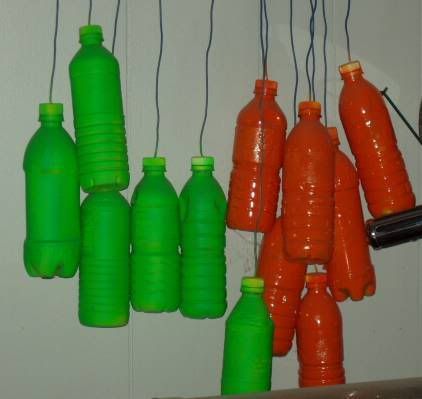
Here are some targets that I've made up to use for practice before I go on a PD trip... They are just plastic water bottles that I've painted bright yellow and then with orange or green paint... I hang them from a piece of rebar that I've bent and can be set at different distances to work out my scope hold over/under..Hits show up like the "shoot & see" targets that some use at a range..Even if you accidentally hit the cap and the bottle falls, it's still a good ground target..

Targets1-29-08002.jpg


Set a bunch of these out at different distances (30-50 yard increments) and you will have a full days practice before they are shredded...Take each shot as a learning exprience with your scope and load...rather than just 'banging' away..
 
Originally Posted By: MalazanWhat is the vital zone on a PDog? 1", 2", 3"?


I'm trying to figure out my MPBR

A prairie dog stands about 9-11" high. With a varmint bullet going fast, pretty much the whole thing is a kill zone. A decent hit just about anywhere and it'll come apart.
 
Originally Posted By: Evil_Lurker Quote:There's no hold under with MPBR, from muzzle to final distance you're w/in your target zone.

Not always. Let's say I'm using a 2" target "box", and my scope centerline is 2.5" over the bore. There's going to be a short distance there where the bullet is going to be below the "box".

It's not a big factor, unless you're shooting tiny critters. It's never a bad idea to shoot a couple on paper at 10, 25 and 50 after you're sighted in just to get an idea, though.

Ok,
laugh.gif
For reasonable hunting, there's no hold over. For a 2" target at 10' that may be different
smile.gif


I always figure based on big game when I sight it so never thought about anything smaller than 4" or so. I do forget there's other reasons to be pulling the trigger.
 
Quote:I always figure based on big game when I sight it so never thought about anything smaller than 4" or so.

We used to be able to shoot Ruffed Grouse with hunting rifles during big-game season in Idaho. I remember a lot of them getting blown up or missed high, trying to shoot their heads off.
I never figured sighting in your rifle to shoot grouse at close range would be the smartest move, however.
grin.gif
 
I normally start at the 50 yd. target to get my rifle on paper. I will group four rounds at that range, then move to the 100 yard target. I normally will paste up three targets and shoot four rounds at each. One using a Cadwell sled, one using a shooting bag and the other using my shooting sticks. The sled usually gets me the grouping that I want, the bag helps me with shooting with a rest and the sticks are normally what I shoot when hunting coyotes. I use a ballistics chart for the particular round that I'm shooting, and have a friend laminate it so that I can carry it out to the field. I;m to frigging old to remember the drop on the bullet at different yardages so that;s why I carry the chart. Through trial and error you can come up with a solution that will work best for you and the round that you are shooting. Remember that all rifles won't shoot the same and that all ammo will preform differently. But most everyone uses the 100 yard mark, because most ranges only extend to that yardage. When I know that I will be shooting at long ranges I re-sight in my 22-250 at a 300 yard target and can normally group four shots within two inches. Good luck.


http://i883.photobucket.com/albums/ac35/BuffyTwo/17HMRtarget.jpg
 
Last edited:
Quote:You guys starting at the 50 yd line, where does that put you at 100 yds

Depends on how high the scope is over the bore. I get the windage set exact, then go right to 100.
On my AR, it's 1" low at 50 yards to zero at 100.
I have a fairly tall scope mount.
 
As Josey Wales would say, "I reckon' you don't want to waste your ammo!"
You can get on paper faster at 50 yards than 100. I've seen people start at 100 and could never hit the target. I normally fire four rounds at 50 and hope for a good gouping. Adjust the crosshairs to get center and then shoot at 100 yds. Its faster to do it that way unless you got a buddy that knows how to bore-sight a rifle, and that's not a given. You have to go out and see where's she shootin'. Ya don't want to be missing any 'yotes that you called in.
 
Quote:I've seen people start at 100 and could never hit the target.

Yeah, I watched a guy shoot most of a box of ammo at 100 yards without getting on paper, give up and go home.
crazy.gif


On a new rifle/scope, I take the first shot at 10 yards, dial windage and elevation close to zero and go to 50. I've had it on paper at 100 in 3 shots every time since I went to that idea.

It looks goofy shooting an AR at 10 yards, but I look goofy normally, so it's no big deal anymore.
wink.gif
 
The best I've ever done after carefully bore sighting the rifle is one shot at 100 yards and perfectly zeroed. But that was the exception. Usually under 10 shots after bore sightinging it.
 
There is only one real disadvantage to the PBR system of zeroing. Many shooters think they can sight in so that the highest point in the trajectory is say 3" above line of sight for a 6" target (a coyotes broadside chest height--without fur), and then they consider the furthest range to be where the trajectory would fall say 3" below the line of sight. This means at those 2 ranges some bullets will just barely miss high and low. That's an idealistic system, and the best way to calc. the system is for 2/3rds target size at most. This way it gives u some leeway for shot dispersion and offhand shots, excitement, etc. I refer to it as CMPBR (C=Conservative), or maybe it should be PMPBR (P=Practical).

Got a buddy that's doing that right now with his "super-fast" Tactical 20 AR. He thinks he has a long 300-something MPBR, but he's over-shooting some coyotes.
 
I have my 270 set 3" high at 100 yrds, so that way I don't have to compensate till after 300 yrds, there's every little drop between 100 and 300!
 
Thanks for all the info. I plugged my cartridge info into a ballistics program and settled on a 3" Vital zone. It gave me a MPBR Zero of 305 yards with a MPBR of 352.
 
Back
Top