Coyotes east and west

buck_poison

New member
Was wondering where you guys think the dividing line is, geographically speaking, that seperates the bigger/smarter Easties from the Westies?
 
First of all you would have to subscribe to the theory that Eastern coyotes are indeed Smarter/bigger.

Maybe the callers in the west are smarter, more skilled and better looking and the coyotes seem smaller because the country is so much larger. /ubbthreads/images/graemlins/tongue.gif /ubbthreads/images/graemlins/laugh.gif

Now if you wanted to compare North and South, I'd agree the Northern coyote is a thing of beauty and intelligence, unlike his poor poor, pitiful, persimmon eating southern cousin. /ubbthreads/images/graemlins/wink.gif I can't imagine eating a coyote that has been feeding on persimmons, /ubbthreads/images/graemlins/tongue.gif it would be like eating a possum. /ubbthreads/images/graemlins/laugh.gif
 
Here in Illinois and Iowa our coyotes are corn fed. They are a little higher in cholesterol than their southern and extreme northern cousins, but are much lower in H.D.L.s.
 
I certainly don't think the eastern is any smarter than the western animals. Exposure to humans is the diference here. Heck , If they were so smart why do they still come to the same calls?

Now bigger is another story. I think the fact that our crops ,animal diversity, and climate has a great deal to do with the bigger. The Mississippi River would be the general dividing line on size, although some of those Iowa and Nebraska corn feds do get on up htere in weight.The more high protein feed they get during those first months means a hack of a lot to the size of eastern pups. The pup we took yesterday will come in very close to 40 pounds. The rascal had as much fat on it as a large full grown racoon. From the scats in the area they are feeding on soybeans, corn, fish, deer, rodents,Persimons, wild grapes, Heck I even found what I think was the remains of an infant diaper in one ( the area is used heavily by the public) Protien is protien , and variety is the spice of life /ubbthreads/images/graemlins/laugh.gif Jimmie
 
also jimmy,

mother nature has animals bigger in the north due to extreme temps in winter,the whole body mass=body=body heat thing,look at the deer from manitoba for example vs same aged buck from south texas,,its buy design,i belive the same would apply to the yotes here.and isnt the strain differnt also? ,,
 
fooge,
If I recall correctly I think that principle is called "Bergmans Law." If not, somebody correct me.
 
Eastern Coyote (Canis latrans var.)

Description
Eastern coyotes typically weigh 30-50 pounds and are 48-60 inches long, approximately twice the size of their close relative, the western coyote. Eastern coyotes have long legs, thick fur, a pointy snout, a drooping bushy black-tipped tail and range in color from a silvery gray to a grizzled, brownish red. The average life span of a wild coyote is four years. Though coyotes are often mistaken for a domestic dog hybrid, recent genetic research has attributed the eastern coyote's larger size and unique behavioral characteristics to interbreeding with Canadian gray wolves.

I got this off the New Hampshire DNR site. It was the first one that came up in the search. I am not forming any opinions or stating any facts, just putting up an article for you to ponder.
/ubbthreads/images/graemlins/wink.gif
 
I cant find anything on intelligence, whether one is smarter than the other. I think Jimmie hit the nail on the head. The yotes in the east get alot more exposure to humans than the ones in the west. I think it is more a matter of the eastern yotes have seen most of our tricks.
 
I agree about the "smarts". It was easier to type "smarter" than "harder to bag". But...I just did and shoulda done so earlier. So, everyone basically agrees they are tougher to kill in the east due to more people hunting them? Where I am heading with this is, based on my experiences (in the east), they are equally tough to call where hunted hard and in very remote areas where I don't think they are getting any pressure at all. I went to Colorado this fall elk hunting and noticed several things.
1) PLENTY of hunting pressure where I was. (San Juan Nat'l Forest)
2) PLENTY of food available for coyotes. (pine squirrels were more common than chipmunks here)
3) PLENTY of coyote sightings.
I'm not saying this but, one could easily come to the conclusion that it is ALOT easier to bag a Colorado dog than a Pennsylvania dog. Hunters and food don't seem to figure into the equation. BTW, Colorado is the 1st state other than PA that I've hunted in so I have no other areas to compare data with. Bill
 
Smarter? Probably not. Coyotes in the East are not particulary hard to bag, its just that there are far fewer of them. With such low coyote densities in the East, a few wind you, you miss a few, and that spots done 'till next year. X amount of dogs are just going to pick you off, and when the population is small, its tough hunting.

But no, when you set up on a coyote that is not call shy, and do not make the mistake of trying to call him into the open, he will respond just like a dog on one of Byrons videos.

Its not a "smarts" thing, its a population thing. Think every stand out, with the relationship to entrance route into the woods, and prevailing wind, and you will do fine.

Bigger? Oh ya!! Now as for size, its no contest, Eastern dogs get big. A 40 pound coyote does not even raise an eyebrow here in Ma. I think our average dog is around 35 pounds, and I have shot a few just over 50 lbs. Thats why guys in the East are always argueing with someone in Cali about shooting dogs with 40 grain ballistic tips /ubbthreads/images/graemlins/wink.gif
 
I found the gray wolf thing to be pretty interesting. I would have thought the wolves would of competed with the yotes and run them off not breed with them.

Weird...kinda like a coyote breeding with a fox...LOL
 
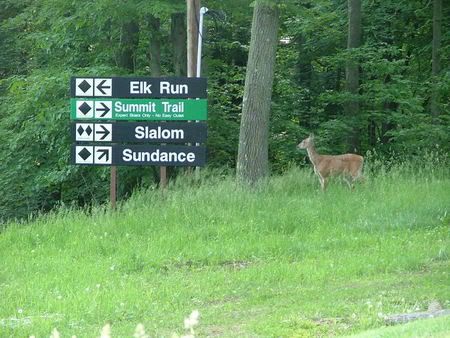
If you think the Eastern coyote is smart you should see this pic of how smart our deer are here in Wisconsin. They have learned to read.

DSCF0411.jpg
 
About the coyote population being low, ask your area biologist! Some places here in the east have populations that match or excede those in the west.Human contact of any kind makes our animals a bit more nocturnal .They pattern humans just like I pattern them. They know what farmer Brown has for breakfast and what time of day. You are entering their living room and trying to figure out where the bedroom is without a blueprint. The key to taking coyote's in the east is learning to read sign and putting together the patterns of movement. Jimmie
 
Jimmie in Ky - I'm sorry, I was speaking from what I know and see here in New England. Probably alot more coyotes in other Eastern states. I hunt Ma., NY, and Maine only, and I would consider hunting for coyotes slow, but steady.

As far as my state Biologist goes, he is very well bookread, and is a nice man. I work next to the Division of Fish and Wildlife, and visit often. But respectfully, he does not have a clue. Acording to him our deer herd is fine, our bobcats are non-existant. Ma. closes bobcat season after 50 cats are shot, and they have NEVER closed it. Yet I myself call 6 to 10 Bobcats a year. Lack of cats? No way, just lack of cat hunters. Deer kill has gone down steadily for the last 10 years in Western Ma., with the Eastern half of the state padding the numbers. Deer herd fine. Nope. Yes, my biologist knows more than I will ever know about almost every animal in New England, but has no idea what it feels like to go from seeing 20 deer a week in archery season to 3. He does not hunt.

My biologist says the states coyote population is 1 coyote for every 2 miles, and that is one estimate I feel is close. But, I wouldn't put that population up against Texas or Nebraska or Colorado or New Mexico, or California, or Utah, or etc.,etc,etc..........

Sorry Jimmie in Ky, just not a bunch of coyotes here in New England, but the ones that are here are fairly easy to kill (until I educate a few). They just require a different approach, or they will seem very smart. Hunt them right, and they die good.

But the reason guys don't kill more around here is not that the coyote is super smart, or noctural, or anything like that. I shoot all my coyotes during the day, as I rarely night hunt. Reason is more don't get shot is too much "Western Technique" used in the Eastern states. Its just not productive around here.

I'm happy you have great hunting in KY, but thats not the only state in the East. I will work my ass off in Ma., and will kill 10 to 15 coyotes a year here in Ma. Lots of coyotes? No.

 
Sleddog, the point I guess I'm trying to make is that there are far more animals out there than most of you think. And I do agree that some of the biologist don't really have a clue as to the populations of predators. The best methods they have for counting predators are hit and miss and do under estimate the actual numbers. I have one of the population studies here done in 98-99.

Lets take your state for instance. Your biologist is basing his answers on someone elses study done at about the saem time as the one I have for a local area. It was done in Cape Cod. With normal hunting pressure and other factors added in you can count on at least a 10 percent increase in population over the year. I personally have seen increases in some areas of 100 percent over four years. Populations doubling in just four years!

With a coyote for every two miles this would translate to a group in 14 square miles.14miles X 640 acres is one heck of a lot of ground to cover!! It's not flat nor is it all row crop or pasture. The group beds in the same general area but are scattered over as much as 2 square miles of the territory they claim. To increase our numbers we have to do our best to figure out which 1280 acres they are in. Even I have to make my best guess as to where they are and only hit the fringes most of the time.

We can all cut down on empty stands by studying topo maps and airial photos. Once you understand where they like to bed and why, you can use these tools along with some footwork to cut those empty stands way down.

By taking 10 to 12 animals in such an area as you live , you are doing fantastic! But I do believe you are under estimating yourself in your abilties and the animals available to you. /ubbthreads/images/graemlins/smile.gif Jimmie
 
My personal opinion on the "smarts" is not that Eastern yotes are any smarter than Western yotes, its just that after watching all of these action packed videos about hunting out west, I have come to the conclusion that I need to hunt certain areas more thoroughly here in West Virginia. I can sit on a ridge-top and call down into a hollow with no luck but then walk around the other side of the hollow on the ridge-top and bring a yote or a fox out of the same hollow I was just calling into. They simply could not hear me. I think its a matter of sound not traveling nearly as far in the east as it does in the west. Trees, brush and especially mountains keep a lot of my calling efforts from being heard. I used to expect any coyote for at least a mile away to hear what I was up to. Out West, you can see a mile away, but that is not nearly the case here.
3 weeks ago I was hunting with a buddy and we decided to set up way farther apart than normal. After 25 minutes I got up and walked the 400 yards or so back over to him and asked him what the hold up was. He was done calling and was ready to pack it up and head to another stand. I never heard a thing. We went back to where I was sitting while he was calling and tried again, revealing 2 grey fox running in in less than a minute. BANG-FLOP! I dont walk nearly as far between stands to predator hunt anymore.
 
I have an opinion on the East vs. West deal. I hear people quite a bit refer to the calling videos and how easy they make it seem. Fact is there aren't many dry stands put on video. No one would watch. We carry cameras to MANY dry stands in order to get the footage for one usable clip. I have over the last three years put quite a bit of footage together for an Eastern video. What you will see on this video is a few coyotes coming in through some trees and getting shot just like the Western filmed videos. The main difference is that the segments will be over in about two to three seconds, and within very close proximity.I will conceede that there are certainly more numbers in the West and that the visability is better. I will also conceede that the ratios of stands per coyote is higher in the West, but these would be blanket statements. I live in Texas. You all are aware that Texas has one of the largest if not the largest coyote densities of any state. Right? You are also aware that Texas is a HUGE state. Right? I could take you to several parts of this state that you would be lucky to call in a coyote in a month of trying. They are just not there in any numbers. I could also take you to a place in Alabama that a buddy of mine hunts and kills 10 a week. He's done it more than once. My point is this, wherever you live chances are you have some huntable number of coyotes. It's just a coyote though, whether he is a big Eastern, or a 20# South western coyote he is still just a coyote, the most adaptable predator ever put on this earth. The only difference in how to call them is to first understand how he is conditioned. In the East they are mostly conditioned to be ALMOST strictly nocturnal to avoid human contact due to the heavy human population. This is not to say you can't call them during the day. I do most of my calling during the day. Remember he is still the same opportunistic coyote that lives out west deep down. What you will have to do is to curb your tactics to fit his conditioning. I hunt in the thick woods of East Texas. It is just exactly like most in the Eastern US. Lots of roads, small farms, and daytime traffic. Get a topo map of East Texas and lay it next to a topo map of where you live anywhere in the East. Lots of people. Coyotes here learn at an early age to avoid human contact or die real fast. They are continuously learning what that takes during general hunting season and by the drive by rednecks and farmers shooting at them year round. Sure we probably have more coyotes here in East Texas than some of you guy's further East, but they are wired the very same as yours. I've been hunting coyotes here for almost thirty years now and can remeber it wasn't to long ago that it was a big deal to see a coyote here. I as you know hunt quite a bit in West Texas and in other states out West. I have also hunted extensively here in East Texas and a few states back East. The basic principles are still the same wherever I hunt East or West. The main difference is I don't expect the Eastern coyotes to come from a mile away so I hunt closer to cover and sometimes in the cover. This requires more ablity as a hunter. As far as calling techniques and responce time, these coyotes, like I said before are the same coyotes as out West. Some will come fast, some will come slow. If they are coming they will come to constant calling or whatever sequence you like. When I'm calling in the thick stuff I like calling off and on though because I can often hear them coming before I see them. I will also make my stands much closer together, sometimes not moving more than a couple hundred yards. My main point is just to say, coyotes are basically the same East and West, but you have to tune your tactics to conform with the different conditioning as well as the different terrain. It's not that its a different coyote but the same coyote under different circumstances. Western callers can get by with making more mistakes because they have a bigger playing field, Eastern callers can make few mistakes because of the closer proximity in which we work with the coyotes, and his conditioning. I have taken enough of your time but would like to say. Calling in the East will never be as productive as it is on large tracts of open ground in the West, but at least you can find a place to hide the truck /ubbthreads/images/graemlins/laugh.gif .

One more thing /ubbthreads/images/graemlins/laugh.gif You will never be a good predator caller, until your a good predator hunter.

Good Hunting

Byron /ubbthreads/images/graemlins/laugh.gif
 
Back
Top