Different COAL on my reloads???

Panyote

New member
I am new to reloading and i am in the process of making my first ladder loads. It is a savage model 11 243. I am using 65 grain vmax bullets with lee pacesetter dies and a lee single stage press. My gun shoots the hornady factory 58 grain vmax extremely well, so i used one of these rounds for my COAL(cartridge overall length).
When i set my bullet seating die my first 3 were all spot on when i measured them, but they really varied after that. Is there something i am doing wrong? Thank you for the help.
 
Measure individual bullets, you will find they vary some so if you measuring to from the base of the case to the tip of the bullet you will find variation. The die doesn't push the bullet in by the tip but by a spot on tapered part of the bullet which is much more consistent than the tip. if your anal about this you can get an adapter from Hornady that clamps on your calipers that measures to the curve on the tip of the bullet. I have one and after measuring a few loaded rounds and finding they are pretty much spot on even if measuring to the tip shows variation. I hardly use it any more.

I have some custom pointed soft point bullets that have the tips mashed down various amounts and show some very substantial COL differences when measured from base to tip and they are spot on with the Hornady adapter. They also shoot very well.

All bullets do not have the same curve in the tip, so learning to adjust bullet depth/distance to the lands is helpful.
 
Last edited:
Hornady comparator. It measures the bullet at the ogive.. That is where the bullet touches the lands in the barrel.. Its nice to have the comparator set and the length gauge and the modified cases for the rifles you are loading... Those will let you know how far your bullet is from touching the lands... More accurate reading than the tip of the bullet as said above..
 
Thank you both! My second question to this topic would be will my accuracy out to 450 or 500 yds be affected by not having the hornady bullet comparator?

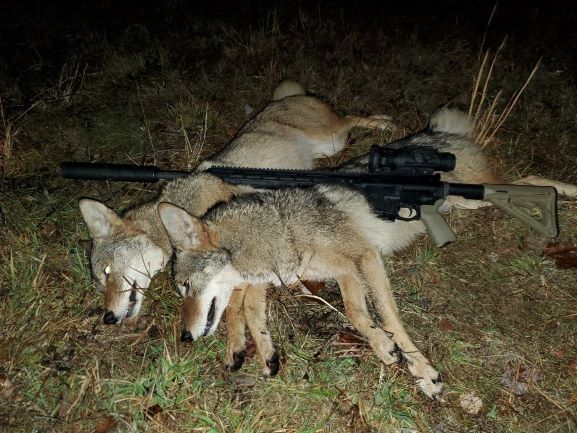
Edited to say i have shot coyotes with the factory 58 grain vmax in this rifle out to 425 yds accurately.
 
Last edited:
No. you can old school it by blacking (I used to use soot from a candle, now a black marking pen) the bullet and setting it back until you are barley touching the lands. The lands will make marks in the blacking when they touch the bullet.. Then you can set it back from the lands what ever distance you want.

Sounds like I'd stay with the 58"s I like them in my 6mm-204, most don't exit until I hit the fringes. The 58 gr V-max and the Nosler 55gr Lead Free are two of my favorite 6mm bullets.

I load 65g V-max for my hunting buddy in his 243 and they are nasty on pelts Hard to believe 7gr's can make hat much difference, I'm only loadiing them to about 3600 in the 6mm-204.
 
Last edited:
You can sort bullets base to ogive, but I think there are enough other factors when shooting factory varmint bullets that it's kinda a waste of time.

Don't worry about it and go shoot. V-Max bullets are virtually insensitive to seating anyway.
 
Get a comparator and be done. It is the only way to get consistent reloads when you switch set ups. For the money I wonder why it took me so long to get a set. You can and will notice accuracy changes between different COAL. I fought it for years. Which id switch dies to load different rifle calibers id always fight trying to get same COAL. Now I have no more issues.
 
Originally Posted By: Smokin250Get a comparator and be done.

Good advice.
thumbup1.gif
 
Contrary to a comment by a previous poster,Vmax bullets have a secant ogive and are VERY sensitive to seating depth. .005" can make a significant change in accuracy. Additionally, I've seen as much as .015" variation in base to ogive length with small caliber Vmax bullets.
 
generally speaking - picking COAL based on what another bullet's COAL is - especially one of a different weight, either lighter OR heavier one - is not a good idea.

according to hornady's 9th
the 58gr vmax should be seated to a COAL of 2.600"
the 87gr vmax should be seated to a COAL of 2.640"


can you give us the full details on the load data you plan to use? Powder/primer/brass/OAL and where you selected your data from?

just rather the great folks here give you as much advise as you can about reloading this bullet in your 243 as safely as possible. especially since you're a beginning reloader.
 
Plant one thank you very much! I am using new winchester brass, sellor &belliot primers, imr 4166, and hornady 65 grain v-max. I am getting my load data from the new hodgden reloading magazine/manual. I am unsure of what oal you are talking about just the brass case length or a loaded round length?
Here are the steps i went through to get to the loaded rounds where i was getting different coal's. Please tell me if i am doing something wrong.

I full length resized my brass in a Lee Pacesetter die on a lee single stage press. I took some of the brass and made sure they would chamber ok in my gun.

I then used calipers to measure the length of my now resized brass. I then trimmed the longer pieces of brass using the Lee Quick trim die and trimmer to get them to 2.045 length. This is what the case length on the instrustions that came with my die set said.

I primed the brass with my Lee hand priming tool. Checking to make sure all primers were not sticking out of the primer pocket and were not crushed in any way.

I then balanced my Lee Safety scale and set to my minimum charge weight of imr 4166 for the 65 grain v-max. It was at 39.4 grains. I used the Lee powder dipper to put the powder on scale first. I then used my powder trickler to reach my weight.

I put my Lee dead length bullet seating die in my press and put a factory hornady 58 grain v-max round into the die and screwed down bullet seating plunger until it was on the bullet. I did this until it was just touching bullet not hard at all.

I put powder in brass and and put it in shell holder with bullet on top and pulled the handle until it stopped on bottom of die.

After i loaded the first three i measured them and they were spot on to the factory 58 grain ammo. They varied after that.
 
This is why you want a comparator. The seating die will not seat the bullet off the tip, it seats off they body of bullet. polymer tip bullets are notorious for giving you different OAL readings. Even my Berger VLD's can. If you use a comparator you are measuring off the O-Give, not tip. Which is the way to get a uniform measurement. if you are measuring off the tip you will chase that length over and over for no reason. While all along you have the same measurement to O-give.
 
first off - let me apologize for getting your bullets you're using mixed up! i must have misread and looked at the COAL for the 87's when you're using the 65's.


in both references i have that shows data for them - the COAL for the 58gr vmax and the 65gr vmax share the same length - Hornady's 9th has then both at 2.600" and lyman's 49th has them both at 2.625". Hodgdon's online data center recommends 2.600" for that bullet

ive just unintentionally proven my "reference published data and not what you read online!" caution
blush.gif


when i refer to COAL - i mean the length of the loaded round - cartridge over all length. also commonly referred to just as OAL.

if i'm discussing brass length - i will say trim length.

-----------------

as for your process as you detailed it in the follow up post - you appear to be on the right track.

however if you're going to use a comparator to measure CBTO (cartridge base to ogive) you'll need to establish the COAL first, and then once you have your COAL baseline, then measure the CBTO to reference for future.

when you're measureing your COAL to get your baseline, dont beat yourself up over 0.001 to 0.003 type varience - as others have noted the tips themselves tend to vary just a bit and can account for this.

once you have a few loaded that are very close to your desired COAL then start to check the CBTO (cartridge base to ogive) with the comparator and see how close that measurement is. You'll usualy find that while COAL will vary, CBTO will usually be consistent.

Once you have your CBTO reference noted for the COAL you desire - make sure you write it down for future reference for repeatability.


if theres' one thing you can do enough of when reloading is keeping track of your data! this will become especially useful down the road as you build up data sets for YOUR firearms. If you're relatively computer savvy i highly recommend setting up a spreadsheet for keeping this info. being able to sort data multiple ways easily to look for correlations is VERY handy - especially once you start adding chronograph data in.


again sorry for my mixup on which bullet you're using.

 
In case I missed it, here's something else to keep in mind. AWS touched on it, earlier. Each bullet type/weight will measure differently from base to ogive. So, if you determine your max cartridge length (bullet seated to the lands), it will apply only to that particular bullet weight/style. If you change bullets, you need to determine the max length, again.


And, as others have said, keep notes.

There are other reloading methods for making precision ammo, but for hunting accuracy, you've got what you need.

Oh, here's a tip for your ladder test if you're not already doing it. Use a colored marker on your bullets. A different color for each load and then shoot them round robin. The bullets will leave a colored hole and shooting round robin will take the bias out.
 
Thank you plant one the trim length makes sense!

Hedge, that is an awesome idea although i don't really have any bias i think. But that would be really neat to try.
I loaded from min to max and wrote in permanent marker the charge weight on each round. That way i can keep track of what is what for group size. I loaded 5 rounds of each charge with a .5 grain jump inbetween each. I think just starting out i need to keep everything seperated. But when i get more expierience i will definetly give the round robin a try.
 
:)We all have a subconsious bias. We see a good group forming and tend to concentrate on that one.

I didn't catch what range you're testing at but, if you're doing a ladder test, you should be at 300 yds or longer. Once you start stretching your load's range, don't look for groups. Look for vertical dispersion. Horizontal dispersion is affected too much by wind. The less vertical you have, the better the load.
My guys will test our loads at 600 and 1000 yds. (that's where the colored bullets help...cuts down chasing back and forth)

Another thing, a good group at 100 yds doesn't always translate to a good one at longer ranges. I've had 1 hole loads at 100 that came apart at 600. When I got the 600 load down to 1 1/2" it shot 3 1/2" at 1000 but about an inch at 100.
 
WOW Hedge, i had no idea that a great group at 100 could not be good at 600! That is extremely interesting! I am going to shoot at a range that i have set up on my half section at my house, i will extend it to 300 yds per your advice. I can't tell you all how much i appreciate your help!
 
Glad to share my experience.
What I said about short range groups compared to long range is just something to keep in mind. If you have a short range group you like, test it at the max range you expect to shoot. It may work just fine. But if it doesn't, it's not unusual and nothing to be upset about.

I don't know if you realize it, but the .243 is a 1000 yd round with the proper load. With a half section, you should be able to set up a nice range.
thumbup.gif

One of the guys I shoot with has a McRee BR10 in .243 we're working up a load for. So far, it's looking good and it's really bucking the wind compared to my .308.
 
Back
Top