Help need with the call I'm making

JimMck

New member
customcall.jpg


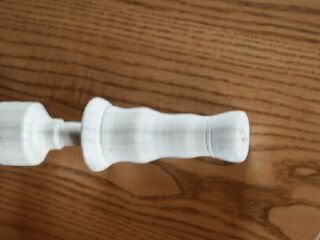
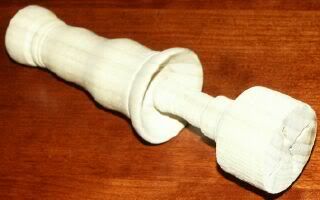
I spun this off the wood lathe in shop class, notice the whole piece you see is not the call, where it gets skinny on the left will be cut off. I am not sure if this will work, but I would like to drop a reed down the middle once I drill a hole threw it. If it won't work, its no big deal, I can try another design. I decided to try something that looked a little different from the ordinary call and made the end larger and more horn like. What kind of reed assembly should I use to finish this call off and where can I get it? I am going to do some more finish sanding and then put a finish coat on the call, where can I get that wax type finish to seal everything in?. This is just pine that the call is made out of. Based on your call making experience, what should I do next?
 
You can go ahead and finish sand the call and add all the detail that you want on it. Then if it was me, I would go ahead and part the call off. Then take it to the drill press and drill my hole in it for the reed sleeve. You can get the reed sleeves and reads (JC Products) at www.allpredatorcalls.com

Then go ahead and set your reed sleeve. Then use a good clear coat finish on the inside and out. You can pick up a good clear coat at lowes. Then its just a matter of puting your JC reed in the sleeve! And you will be ready to go.

Here is a link to a post I put up on how I turn mine:

http://www.predatormastersforums.com/cgi-bin/ultimatebb.cgi?ubb=get_topic;f=8;t=002273


Brent
 
Brent, thanks for the reply. I guess I will have to make a few of these calls becuase you have to buy the reeds in bulk. I popped my primos coon squaller apart and that is a jc reed which looks the same as the ones pictured. Is the 40 pack the best way to go, it appears to be to me.
 
Jim,

First, that's a really nice lookin call. /ubbthreads/images/graemlins/smile.gif What kind of wood is that? (oops, pinewood, I missed that)

NVWalt makes calls using the "cut-off" method, he wrote a great how-to which you can find here.
The biggest difference between Walt's method, and yours, is he "cuts off" the mouthpiece end after he has done the inside of the bell.

As for the JC reeds, AP Jones (of all predator calls) once posted there are around 25 different "wintress" style reeds available through JC, and several more from the Wintress company itself.

Each has slightly different sound and characteristics, even though they all look pretty much the same.

If I were you I'd get the sample pack, there's not as many to buy, and you can figure out which one you like best.
Also that way you'll be able to make yourself a few calls, all with different sound, instead of a whole pile that all sound alike.

One last piece of advise, use the reed sleeves, they will make your life SOOOO much easier.
If you don't use them, sometimes the reed petal will get "snagged" on the grain of the wood inside the call.
Sometimes this just makes the call sound funny, but sometimes it won't make a sound at all, and in the worst case the petal can become damaged to the point of uselessness.

When you use the sleeves, you should install them from the bell end, after you have sealed the inside of the call, (with the wide end of the tapered sleeve towards the bell), and the same for the reed.
This way you can step drill, in from the bell end again, and not end up with a big hole at the mouthpiece end of the call (using the cut-off method you'll have to be very careful not to drill too deep, and lose the step). If this is too cofusing, let me know, I'll whip up a drawing and send it to you.

Have fun, making calls is a great hobby. /ubbthreads/images/graemlins/smile.gif

Krusty

wave1.gif
 
Thanks for the advice Krusty, I will post a pic when I'm done with it. I think I will spin a couple calls before I buy the reeds and see If I can intrest my friends at school in some to help cover the reed cost.

I was wondering if the same thing could be done with plastic, that is turning a call on the lathe. I imagine It could be done and we have several colors to chose from and a good glue that bonds the plastics together well. It would look neat mixing and matchin color combos.
 
Jim,

You're totally welcome, I am glad I could help (without confusing you too much).

Yes, calls can be turned from plastics.
But doing so on the wood lathe might be difficult?

Ryan W, from RAW Custom Calls, makes acrylic predator calls, and they sound (and look) great.
Waterfowl call makers have been using the acrylics for years, because they are so stable, can't be damaged by the weather, and produce incredible sound.
I have never seen a laminated one, but I haven't looked very hard.

Softer plastics like delrin, or nylon might be turnable with hand tools on the wood lathe, but because they lack that "hardness" of acrylics some of the sound quality might be lost.
I believe Mike Cooper has turned some delrin calls, hopefully he'll see this and can add some advice, or comment on the sound quality.

Maybe Ryan can "chime in" here too, and comment on the tooling needed, and/or any special techniques he uses (I know he spends a considerable amount of time polishing the calls after turning).

I love how answers just lead to more questions. /ubbthreads/images/graemlins/laugh.gif And the new answers, more new questions again.
Shows you are thinkin!

Krusty
wave1.gif


P.S. After re-reading Kee's advice I can see the merit in installing the sleeve first, then sealing... if the sealant makes the sleeve too tight, and you force it into the body, the body could split. Even a few thousands worth of sealant could make a big difference, in an already "press fit" installation. If some sealant ended up in the sleeve it is unlikely the reed won't fit, and it might actually help the reed stay in place.
 
Once again, thanks Krusty. I wish that I had a lathe of my own to use, as I am using the one in my high school shop class. Its keeping me content as I am learning something new. I will not be able to spin calls the whole year but I can do a few.
I should probrally post this in the Classified Ads section, but while were talking about it, does anyone have a few jc reeds and reed holders I could buy. I don't have the money to buy the whole 40 pack and 2 packs of the reed sleeves, so if anyone would sell me of each rabbit distress reed and a sleeve to go with it I would appreciate it if you could pm me.
Now, getting back to the post here, that would be great if you other guys could chime in with your experience. I am not working with any acrylic material, is there anywhere I could get some? Thanks for the help, Jim.
 
Jim,
I emailed you. I'd be glad to fix you up with a few reeds & sleeves, and I'll even throw in drilling advice. The sleeve is tapered! Drill a full length hole with a 17/64" bit first. Then drill (from the bell end) with a 9/32" bit, but stop the hole about 3/4" from the mouthpiece end of the call. I then go up to a 11/32" bit and drill to 1 1/4" from the mouthpiece. This gives a shoulder to stop the reed sleeve at when you insert it, and leaves it about 1/4" from the mouthpiece.
I have also used delrin for a predator call. It turns well with sharp tools, and gives off some pretty long & numerous shavings. I didn't polish it too much, as I was making it for myself to use. It sounds good, but it is a little deader sounding than wood. I switched to a .025 loud voice reed to get a sound I like with it. It's tough, durable, and weatherproof, so it gets carried along on most of my hunts whether I'm specifically after predators or not. Never hurts to have a call handy /ubbthreads/images/graemlins/wink.gif
 
JimMcK,
As far as turning acrylic goes, it is a lot of work and really messy but I will tell you what I do. Here are some rules to remember when using acrylic: Use very sharp tools and drill bits. Use some sort of lubricant when drilling out your blank (I use transmission fluid in a little squirt bottle) and back you bit out often to clear out shavings. Also, turn the blank at a real slow speed when drilling out the blank. When turning the outside profile, don't try to take too much off at one time or you will start melting the acrylic. As far as finishing goes, I start by wet sanding (I just spray the sandpaper or steel wool with WD-40) with a 240,then with 320, 400, 600 grit sandpaper. Make sure your sandpaper is always wet with lubricant or you will melt the acrylic. Then go over with #0000 Extra-Fine Steel Wool. Again, keep this wet with lubricant. Next, I use HUT Ultra Gloss Plastic Polish on a shop towel and buff out as many of the tiny scratches as possible. I then go to a micro-mesh sanding kit which ranges in grit from 1500-12,000. I do not use any lubricant on this step and is "dry" sanded. Start with the 1500 grit and gradually work my way up to the 12,000 grit(9 different grits). That is about it. Let me know if you have any more questions.
 
Hi all, I though Krustys answer was typo, but Wabi seems to be saying same thing-drill from bell end, - however I always drilled and set reed holder from the mouth piece end. Works for me, also if you ever make calls without the reed holder you must use tapered hole bored from mouth piece end. Tapered holes like Circe, Weems, ect all used seems like more work and sometimes wore so much reed would push through, but I tend to think sound was purer without metal reed holder to possible viberate ! I'm thinking along those lines when I go back to turning.
Richard Grantham
 
Thanks for all the replies guys. I only have 45 minutes to work on the call each day becuase that is how long the shop class period is at my school. I will not get back to doing any work on the call until monday.

Today I cut a grove for where I will attach the lanyard towards the mouthpiece. I also shaped the inside of the bell end much more. Then I did some fine sanding, the lightest paper I had was 220 but I'm happy enough with the results. I then turned the sandpaper on its back side and used it to buff the call and shine it up a bit. Lastly, I took some minwax wax and did a finish with that. I guess I could buff the wax then on Monday. Monday, I am planned on getting the drilling done. Speaking with my shop class teacher, he said I shold just drill it on the wood lathe, so I guess thats what I am going to do. I just re-read Wabi's post and that may not work though. I the call will be pivoting off the excess wood which is on the bell end of the call. I guess I should just put the call in vice grips and drill it with a drill press. I can't wait to finish the call up and try it out. I think I'm going to make some burn marks to enrich where I cut groves in the call. I'll keep you posted with how things are comming along come monday. Jim
customcall2.jpg
 
Jim,
You can drill the first hole from either end. The 17/64 hole would serve as a pilot hole for the rest. The reason I drill the others from the the bell end is to give a "taper" of sorts for the reed sleeve.
I usually turn my calls on a spindle, so actually I drill a 1/4" hole through the blank before I start turning. It's a simple matter to drill the rest of the steps on the drill press then. For your call it may be best to drill the first hole on the lathe to keep everything centered.
 
The call is just about done. I have a few finishing touches I want to do. I put a jc reed in the call just like wabi posted to do and it sounds great. I think I should drill the end of the bell so it takes less air to blow the call and saves my lungs a little lol. Will changing the size of the hole where the bell is affect my calling sound. The hole right now towards the end was bored out by an 11/32 bit. I have some pics, I can get more if you want to see some more. I think the call looks real nice and sounds nicer than most of my open reeds too.

customcall3.jpg

call2.jpg
 
Jim,
I didn't mention drilling the bell in my steps. Several callmakers use a "uni-bit", the step type bit capable of drilling several size holes in thin material. I frequently use the uni-bit, too. I frequently follow the uni-bit drilling with a tapered rotary rasp for smooth sides to the beveled portion.
 
thanks wabi, i just kept going up in size in bits then filed the rough spots out and it sounds awesome. I called what I believe to be a coyote in. I was in the mountains in a tee stand and I heard something but by the time I got postioned and ready with my dumb nightblaster it was gone. I am going to get a light force here soon that should end the problems.
 
Back
Top