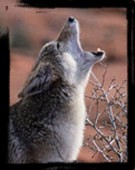

More Black Coyote

Rich in AZ

New member
Hartley H.T. Jackson wrote in 1951 that 750,000 coyotes trapped by Government and co-operative trappers between 1938 and 1945 included 2 albinos. He then stated that he had heard of only one black coyote ever having been reported, that one was trapped in Colorado in the 1920s.

I have not been able to find documented reports of melanism in coyotes within their traditional ranges that did not overlap with redwolf ranges. Black coyotes are also reported in the states that expansionist populations have moved into within the last 35 years.

I have found a surprisingly large volume of predator studies that at least mentioned melanism in these canids.
Gipson, Halloran, Pimlott and Joslin, Freeman, Lawrence and Nowak all addressed this subject in depth.
Gipson et al., 1974 is probably the definitive work on coyote expansion within the southeastern US and their subsequent hybridization with other canids.
Statements from Gipson's dissertations that are significant to this subject include

"Black canids occur over much of the former range of the red wolf..."
"Black pelage, often accompanied by a white pectoral spot and white on the feet, occured among red wolves."Arthur, 1928, Yound and Goldman, 1944, Sealander, 1956, Riley and McBride, 1972
"In 1936 the biologist Black estimated that roughly 25% of the red wolves taken in the Ozarks in the 1930s were black."

Studies by Halloran, 1959 and 1963, and Pimlott and Joslin 1968, all reported black coyotes from or adjacent to, areas known to have been inhabited by melanistic red wolves, an/or dogs in recent times. Black pelage is common among domestic dogs and has been reported in coyote/dog crosses by Gier 1968 and Mengel 1971.
"Forty-three black canids were collected in Arkansas from 1968 through 1971. Twelve were considered to be coyotes, six were coyote X dog hybrids, five were coyote X red wolf hybrids, and one wild dog.
In 1976 Freeman identified twelve black canids collected in Oklahoma as eight coyotes, two coyote X dog hybrids and two coyote X red wolf hybrids.

A phenomenom that biologists call "hybrid swarm" has occurred when coyotes expand into an area that contains numbers of red wolves that are in decline and having difficulty finding a mate of their own species.. This is known to have occurred in Texas on the Edwards Plateau and spread eastward into east Texas and Louisiana.. It is known to have occurred in the Ozarks of Arkansas and spread eastward, into Tennesee and then down into Mississppi and Alabama.
Genes for melanism were probably passed to some hybrid offspring which , in turn, became a part of the gene pool of the present interbreeding genepool.

Oklahoma, Texas, Missouri and Arkansas all report black coyote sightings regularly and these areas are past ranges of the red wolf.

Coyote X dog hybrids and the occassional melanism that would occur is possibly a cause of the reports from northern Iowa, Minnesota and other fringe states that the coyote has expanded into in fairly recent times. The reports of black coyotes in Montana, Washington and Arizona, which are traditional ranges of the coyote are a puzzle.
 
WOW! Nice batch of info Rich. I have suspected coyotes other than their "normal" colors & or physical features. Were not pure coyote.

I ache to bag this big rust colored wooly brute in my area. Would be the Grand Poobah, for sure.

Thanks! for the good read.
 
Great stuff Rich! It all makes sense. I have a question for ya? The coyotes we've taken in California looked just like the AZ dogs except their legs were about 2" longer, no kidding. Ever heard that before?
Pollohombre
 
Rich,
If there are black coyotes in AZ I think it has to be a recent transplant. I started calling one year before they outlawed 1080. We used to go out and call one dog in a day and thought it was great. It was the reason we started duck hunting. We usually could call at least 2 or 3 ducks in a day! Anyway, I sold my pelts to Ron Massey when he lived by Williams Air Force Base. He was a wealth of coyote knowledge for me when I started out. I sold my pelts to him for about 10 years. He would let me look at all the hides he had and I bet I looked at 10,000 at least over that time period. I never saw a blackish colored coyote or an albino. He never spoke about them either. Colors trended red/tan in the desert to grey with black highlights in the high country. There were alot of variations but nothing like what the guys have shown us here. We talked about wieghts too and as far as I can remember there were no 50lbers. taken during that time period.
Pollohombre
 
Last edited:
Thanks for the research Rich.

Very interesting stuff.

It has been theorized for many years that the coyotes while spreading East bred with the remnant Red Wolf population. I can remember when I was a kid (early 70's in East Texas) a friend of mines dad killed a black wolf, he called it. Looked like a wolf to me but all I saw was the pictures. I vividly remember the pictures as my friend had them for years. The black wolf or what ever it was covered most of a tail gate. I would estimate it weighed in the 50# + range. This was the only black one I saw for many years, well except for the occational one I saw in taxidermy shops. In the last ten years I have started to see even more but I explain this with the fact that we simply have more coyotes.

Back in the 70's we didn't have a lot coyotes at all in East Texas. By the mid eighties though I had killed lots of coyotes and had yet to see a black one, or one I felt could be confused as a wolf. One day early in the morning while driving to a job I saw what I have no doubt was mostly wolf. I'll admit that I didn't see him for very long but I was definately convinved it was not a coyote. Now with all this being said our coyotes here in East Texas have always outweighed the West and South Texas coyotes considerably. It is not uncommon at all to kill one bumping the 50# mark and most adult males will weigh in excess of 40#'s.

Hybridization with the red wolf could easily explain the black color phase as well as the larger body size. It could also explain a few other subtle differences in the Easter Texas coyotes compared the West and South Texas variety.

All this should not come as much of a suprise to anyone familiar with coyotes though. The coyotes ability to adapt is well documented.

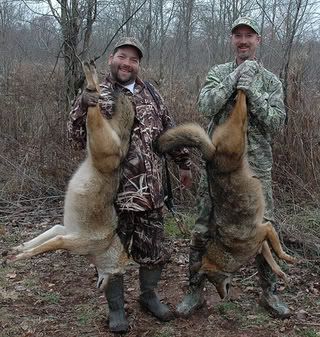
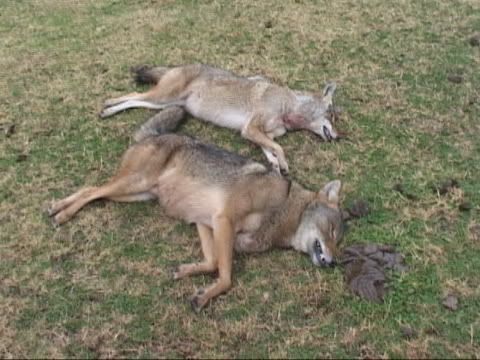
Here is a pair of coyotes Rod Haydel and I shot in Western Louisiana last year. The big male weighed 50 # (certified UPS scales). He is not black but definately much darker than any Western coyote I've ever seen. The size of these coyotes, by the way, is not all that uncommon around here.

rods7.jpg


rodspair.jpg


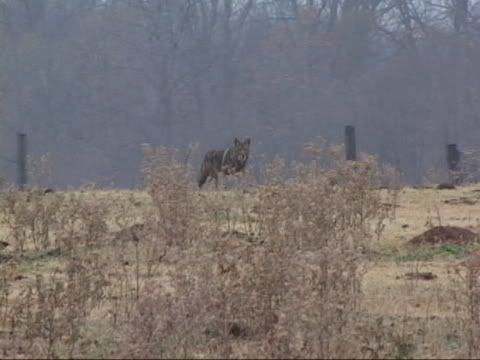
Here is a picture of the male right before he was shot.

rod5.jpg
 
Last edited:
I have yet to see a black yote here in the Mid South, but I have been told that there are few around. We do see a lot of red color faze. I think the red colors are coming from the red wolves that once roamed this area...

We are in the same boat as you are Byron... lots of larger dogs. Most that we kill here are around 40lbs to 45lbs.
 
Man, that is a big ole coyote. Never have or will, see one like that here in southern arizona....unless Byron hauls a crate of breeders this way:)
Ive killed a few coyotes, that have damned near that type of very black guard hairs,along with black painted front legs,on the forward edge, from ankle to bottom of brisket.
Ive never, seen the other black type of coyote in Arizona, would sure love to, but as of yet, nothing like the others in corresponding photos.....truely gorgeous coyotes.
 
I may have seen a black coyote in Colorado. It really looked dark like it had dominant black hairs in it's pelt, but wasn't solid black. I have been keeping my eyes open for the old boy. He gave us the slip, the one day we spotted him.
 
Vic,

I need your adress..... we sell'm buy the pound. /ubbthreads/images/graemlins/wink.gif

I kill quiet a few like you described with the black on the forward edge of their legs and very dark guard hairs. We aslo kill alot of dark red colored coyotes. Red Wolf some might say, but they look just like coyotes to me. Heck even the Red Wolf pictures on the Red Wolf websites look like coyotes to me. Maybe a Red Wolf is just a big red (or black)coyote?

If you notice the female in the picture above she is about as pale as you can expect to kill around here. Most are darker. Even killed one last year that was almost orange (this orange one is on my volume 3 video, head shot coming straight on at about 15-20 yards, cool footage). There is a black one on volume 2 and two or three black ones on volume 3.

Happy 4th, /ubbthreads/images/graemlins/ooo.gif

Byron /ubbthreads/images/graemlins/grin.gif
 
Here is a picture of one we caught with a lot of black on him.We guessed the weight at close to 50# You can see the tail is all black.We call and trap a lot of dark color coyotes.Most all the older males are heavy coyotes. [image]
lastscan.jpg
[/image]
 
About 6-7 years ago I spotted a black coyote just a shade darker than the one pictured above. It was crossing the road in Lake Elsinore, CA. It's the only one I've ever seen. I tried calling it back for another look, but no luck. This was in "town", so there's a chance it was a coydog.
 
Byron, until the advent of genetic testing just recently the redwolf was thought to be a cross between timber wolves and coyotes by many biologists including the noted wolf researcher David Mech. You have an interesting mix in east Texas. C.latrans frustror is considered to be the largest of the "western" coyotes, the biologist Bailey initially classified it as a wolf in 1885. And then the red wolves and red wolf hybrids really add some spice to your mix. Very interesting animals in your neck of the woods.

Yotetote, what a beautiful animal. C.latrans var. has been recognized by taxonomists as the twentieth sub-species of canis latrans. Before genetic testing it was referred to as the New England canid or New England phenotype and there were many different theories as to it's origin. Genetic testing has now established that the "wolf" looking eastern coyotes have varying degrees of canis lycaon dna that they picked up from encounters with the Algonquin wolves in Quebec. They have identified three distinct coyote types in Pa. and N.Y. I could never understand how anyone could not look at the photos that you guys post and not recognize the wolf influence in those animals. Every dog fancier can look at a cur and recognize the breed of the parents. Wolf influence is just as recognizable. Shawna Nelson is the Mexican Wolf reintroduction project coordinator for the AZ.F&G. At her information booths she displays close up photos of the wolves next to photos of coyotes so that the public can learn to tell the difference between the two canids. Her photos of the Mexican Wolf look exactly like the photo that you posted and like the numerous other photos that have been posted by other North Eastern callers.
 
Something else to consider. I asked in the original post in the other thread what the eye color of your black coyotes were. The reason for that is because the biologists who have done extensive research in canid hybridization, Silver and Silver, Gipson et al specifically, have stated that coyotes, wolves and their hybrids all have golden or amber colored eyes. Dogs and Coyote X dog hybrids usually have brown eyes, occasionally greenish colored.
 
More good info, can't get enough.

Reflecting back on the big ole boy I meet @ the road, Winter snowfly circa;1981. Seemed his eyes may have been "Brown". Otherwise, I most likely would've remembered. He was all Golden from past his nose to the tip of his tail. Estimated him, pushing 60lbs.

I got a real close look @ his features, as he brushed my front bumper. I kept thinking, what is that? As that was my 1st ever sighting of a coyote-X.

Don't recall, if I posted this or not. But that same Winter. Unknown to me, my Dad rolled an idential large Golden male coyote-X [paired with a female coyote]. Around 5 miles East of where this one was. That one took a 22-250 broadside in the chest, he rolled & kept going.
 
Rich AZ,I never paid much attention to eye color,thanks for the info.From here on in,i will take pictures of the coyotes and on the back i will write down there "eye color." It will be interesting to see what i come up with.
 
Dennis, I run into "pockets" of dark coyotes here. The agouti bands on the guard hairs are much broader than normal and and add considerably more black to the coloration of the animal. Normal white, yellow and ochre coloration on throat, belly and legs. Although they are not "black" coyotes they are significantly different from the normal coyotes that their bloodlines are suspect. I wish I knew.
 
Back
Top