I want a higher base mag than the hogster 35 I have. Most of my shots seem to be a minimum of 150 yards with a few lucky ones around 100. Does anyone here have a rico mk1 384? I couldnt find anything on here but there is a lot of positive reviews out there for this scope. I like the onboard battery and focus knob compared to the bering. It sounds like you have to buy a better mount for it right away though so that gets you to almost super yoter price. What are your thoughts? How do the specs compare between these two? Can anyone figure out fov in feet @100 yds?



You are using an out of date browser. It may not display this or other websites correctly.
You should upgrade or use an alternative browser.
You should upgrade or use an alternative browser.
Thinking about a new scope. Iray Rico 384 vs super yoter?
- Thread starter Oakhill
- Start date
WestTX 25/06
New member
I don’t have answers, but just wanted to say I am also trying to decide between the two for the upcoming coyote season to replace my Flir pts536. Here are the pros and cons I’ve been wrestling with. Would love some help from folks with real world experience. For reference, I hunt mostly open West Texas low humidity country from a high rack. Prior kills run from 400 yards to right next to the truck. I really hate missing, thus the POI comments below and the reason I’ve stuck with my Flir for so long.
Iray pros:
1) Has the rail on the left side so I can mount my radius rangefinder and see it with my off scope eye.
2) Supposedly good image quality for a 384. Supposed to have great black hot image.
3) 4x base mag great for longer shots.
4) currently in stock
5) factory mount is apparently good for a bolt gun, which I hunt with most of the time.
6) battery is supposed to be great
Iray cons:
1) Made in China
2) looks like the Chinese copy/pasted a Pulsar Trail (I’ve had enough poi shift issues with my trail xp50 to sour me on this).
3). 4x base mag is a little much when they get in tight.
Yoter pros:
1). Better resolution
2). Ranging lines feature might allow me to sell my radius, lowering my all in cost.
3). Never heard of poi shift issues with bearing products
4). Extremely fine zeroing adjustments.
5). 3x base mag might be better for most shots
Yoter cons:
1) unsure of when I can actually get it in my hands
2). Factory mount most likely won’t work well with bolt gun. (Can you special order a mount that sets further back like you can with the super hogster?)
3). I heard the Iray 640 model had a poor black hot image, and I think the Yoter uses the same core, so possibly the same story.
Iray pros:
1) Has the rail on the left side so I can mount my radius rangefinder and see it with my off scope eye.
2) Supposedly good image quality for a 384. Supposed to have great black hot image.
3) 4x base mag great for longer shots.
4) currently in stock
5) factory mount is apparently good for a bolt gun, which I hunt with most of the time.
6) battery is supposed to be great
Iray cons:
1) Made in China
2) looks like the Chinese copy/pasted a Pulsar Trail (I’ve had enough poi shift issues with my trail xp50 to sour me on this).
3). 4x base mag is a little much when they get in tight.
Yoter pros:
1). Better resolution
2). Ranging lines feature might allow me to sell my radius, lowering my all in cost.
3). Never heard of poi shift issues with bearing products
4). Extremely fine zeroing adjustments.
5). 3x base mag might be better for most shots
Yoter cons:
1) unsure of when I can actually get it in my hands
2). Factory mount most likely won’t work well with bolt gun. (Can you special order a mount that sets further back like you can with the super hogster?)
3). I heard the Iray 640 model had a poor black hot image, and I think the Yoter uses the same core, so possibly the same story.

Kirsch
Active member
Originally Posted By: WestTX 25/06I don’t have answers, but just wanted to say I am also trying to decide between the two for the upcoming coyote season to replace my Flir pts536.
Flir: The Flir image on the PTS536 wasn't very good. However, it was a very accurate scope. The biggest issue besides Flir abandoning the civilian market is the 4.5° FOV was really tight on it.
iRay: On the iRay, I would look really close on the height of the scope to make sure you can mount a radius on the side. It might easily, but something to check.
As for black hot, I believe white-hot is the stronger palette on all thermals using iRay sensors including Super Hogsters, Super Yoter as well as the Ricos. It isn't bad on any of them, I just don't feel it shows as much detail as white hot.
6-hours for a proprietary scope battery isn't that great. If I read it correctly, $169 for an additional pack. Ouch. If I am running off a pack, I want to make sure it will last me a full night in sub-zero temps. It doesn't look like it would, but TX and ND can be very different.
I was very leary of iRay when it was made in China, imported in and had no service. However, if iRayUSA will be servicing after warranty, that helps, but I do not know this but just assuming they will be.
Super Hogster: The Super Hogster is still the best "bang for your buck" in my opinion. It is $800 less expensive than the iRay 384. It is a proven scope, assembled and serviced by a US company. It has 3° bigger FOV than your PTS536 and a 1.3 ° bigger FOV than the iRay 384.
Super Yoter: If you have the money, the Super Yoter is going to be an awesome scope. You are correct, availability is going to be an issue. However, when stacked up against the Rico 640, it is $1,400 less expensive and comes with a LaRue mount. The only thing the Rico 640 really has that I can see that some would say is better is the battery. However, a $169 proprietary battery to me isn't better, when I can get replacement batteries for a TRB for instance for $20 or $30. As you mentioned, the Yoter will have the Range Marks feature which is new Bering technology.
For both the Super Hogster and Super Yoter, if you want to make sure you can get them far enough back, purchase an extended riser like the LaRue QD extended riser so you don't have to worry about a Special Order, and it won't hurt the resale if you ever want to sell the scope.
I think all 4 would work. If you want to brainstorm some more on this, send me a PM, with your phone number and we can talk over each of thoughts in more-depth if you like.
Flir: The Flir image on the PTS536 wasn't very good. However, it was a very accurate scope. The biggest issue besides Flir abandoning the civilian market is the 4.5° FOV was really tight on it.
iRay: On the iRay, I would look really close on the height of the scope to make sure you can mount a radius on the side. It might easily, but something to check.
As for black hot, I believe white-hot is the stronger palette on all thermals using iRay sensors including Super Hogsters, Super Yoter as well as the Ricos. It isn't bad on any of them, I just don't feel it shows as much detail as white hot.
6-hours for a proprietary scope battery isn't that great. If I read it correctly, $169 for an additional pack. Ouch. If I am running off a pack, I want to make sure it will last me a full night in sub-zero temps. It doesn't look like it would, but TX and ND can be very different.
I was very leary of iRay when it was made in China, imported in and had no service. However, if iRayUSA will be servicing after warranty, that helps, but I do not know this but just assuming they will be.
Super Hogster: The Super Hogster is still the best "bang for your buck" in my opinion. It is $800 less expensive than the iRay 384. It is a proven scope, assembled and serviced by a US company. It has 3° bigger FOV than your PTS536 and a 1.3 ° bigger FOV than the iRay 384.
Super Yoter: If you have the money, the Super Yoter is going to be an awesome scope. You are correct, availability is going to be an issue. However, when stacked up against the Rico 640, it is $1,400 less expensive and comes with a LaRue mount. The only thing the Rico 640 really has that I can see that some would say is better is the battery. However, a $169 proprietary battery to me isn't better, when I can get replacement batteries for a TRB for instance for $20 or $30. As you mentioned, the Yoter will have the Range Marks feature which is new Bering technology.
For both the Super Hogster and Super Yoter, if you want to make sure you can get them far enough back, purchase an extended riser like the LaRue QD extended riser so you don't have to worry about a Special Order, and it won't hurt the resale if you ever want to sell the scope.
I think all 4 would work. If you want to brainstorm some more on this, send me a PM, with your phone number and we can talk over each of thoughts in more-depth if you like.
Kirsch
Active member
Originally Posted By: OakhillI want a higher base mag than the hogster 35 I have. Most of my shots seem to be a minimum of 150 yards with a few lucky ones around 100. Does anyone here have a rico mk1 384? I couldnt find anything on here but there is a lot of positive reviews out there for this scope. I like the onboard battery and focus knob compared to the bering. It sounds like you have to buy a better mount for it right away though so that gets you to almost super yoter price. What are your thoughts? How do the specs compare between these two? Can anyone figure out fov in feet @100 yds? The Rico 384 will not compare image-wise to a Super Yoter just as the Super Yoter has a much stronger image than the Super Hogster. That doesn't mean you need a 640 resolution scope to harvest coyotes.
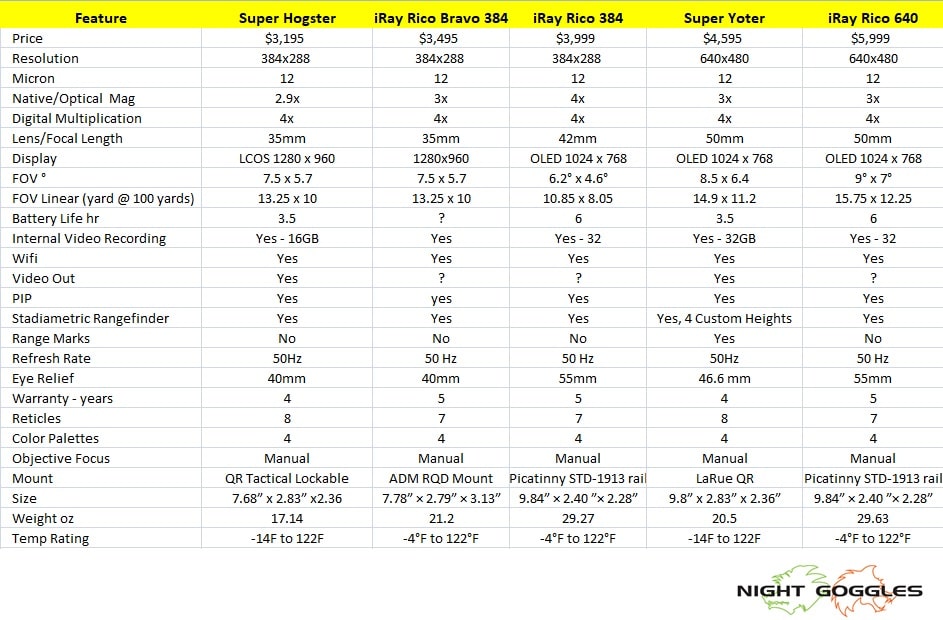
I created the chart so you could see most of the specs side by side. I included the FOV in yards so just take times 3 if you want to get to feet. You mentioned the Focus knob on the Super Hogster and Super Yoter. You simply need an $8-$20 focus extender and the problem goes away on the Hogsters and then it is actually better because it is easier to operate with gloves on. Feel free to send me a PM with your phone number if you want to talk about the different models.
I created the chart so you could see most of the specs side by side. I included the FOV in yards so just take times 3 if you want to get to feet. You mentioned the Focus knob on the Super Hogster and Super Yoter. You simply need an $8-$20 focus extender and the problem goes away on the Hogsters and then it is actually better because it is easier to operate with gloves on. Feel free to send me a PM with your phone number if you want to talk about the different models.

I can't comment on the Iray because I have never seen one or know anyone I trust that owns one. I can comment on the Super Hogster because I own one, actually had two but sold one to get money for a Super Yoter.
The Super Hogster is VERY proven, and proven by guys like myself that hunts hard, all night long in extremely cold temperatures. My Super Hogster NEVER had a zero shift and no issues. If your comparing 384 resolution scopes I would look no further than the Super Hogster. If you have the money for a $4600 scope than run the Super Yoter.
I have made MANY 300 plus yard shots with the Super Hogster and the Super Yoter will be even better because of the better image. I am on the pre-order list for the Super Yoter so I'll say more about the beginning of October...
The Super Hogster is VERY proven, and proven by guys like myself that hunts hard, all night long in extremely cold temperatures. My Super Hogster NEVER had a zero shift and no issues. If your comparing 384 resolution scopes I would look no further than the Super Hogster. If you have the money for a $4600 scope than run the Super Yoter.
I have made MANY 300 plus yard shots with the Super Hogster and the Super Yoter will be even better because of the better image. I am on the pre-order list for the Super Yoter so I'll say more about the beginning of October...
Kirsch
Active member
Originally Posted By: Kino MI can't comment on the Iray because I have never seen one or know anyone I trust that owns one. I can comment on the Super Hogster because I own one, actually had two but sold one to get money for a Super Yoter.
The Super Hogster is VERY proven, and proven by guys like myself that hunts hard, all night long in extremely cold temperatures. My Super Hogster NEVER had a zero shift and no issues. If your comparing 384 resolution scopes I would look no further than the Super Hogster. If you have the money for a $4600 scope than run the Super Yoter.
I have made MANY 300 plus yard shots with the Super Hogster and the Super Yoter will be even better because of the better image. I am on the pre-order list for the Super Yoter so I'll say more about the beginning of October... Kino said it much better in a lot fewer words. Agree 100%
The Super Hogster is VERY proven, and proven by guys like myself that hunts hard, all night long in extremely cold temperatures. My Super Hogster NEVER had a zero shift and no issues. If your comparing 384 resolution scopes I would look no further than the Super Hogster. If you have the money for a $4600 scope than run the Super Yoter.
I have made MANY 300 plus yard shots with the Super Hogster and the Super Yoter will be even better because of the better image. I am on the pre-order list for the Super Yoter so I'll say more about the beginning of October... Kino said it much better in a lot fewer words. Agree 100%
Thanks for putting that table together Kirsch. It's nice to be able to see the numbers side by side. I do have a throw lever on my hogster, I just liked the focus on top of the trail better.
Westtx, I know what you mean about the trail shift. I have one that I love everything about except it wont hold zero. It does make me wonder about the rico being new if there will be any problems. I would think with an all metal housing it would not shift like the trail. That also adds one to the con list though, over 29 ozs seems heavy especially compared to the Berings.
Westtx, I know what you mean about the trail shift. I have one that I love everything about except it wont hold zero. It does make me wonder about the rico being new if there will be any problems. I would think with an all metal housing it would not shift like the trail. That also adds one to the con list though, over 29 ozs seems heavy especially compared to the Berings.
Might want to look at the bottom end of the temperature range also. 10 degree cushion with the SY if your not afraid to go out when it's a little cool out. I know Kirsch is probably testing the bottom end at times and I have in Iowa when it gets down there as long as the breeze is very low.
I dont like that -4 rating for the ricos, I do hunt down to -10 or more if its not very windy. When the hogsters first came out I saw a spec sheet with them only rated to -4 and that was one reason I picked the trail over a hogster as that was rated -13. Shortly after that they changed it to -14. I wonder if the same thing will happen with the rico as well when they get more of them out there or do more testing.
I guess im leaning more towards a super yoter anyway, I just want to buy something that I will be happy with for more than one season, hopefully many!
I guess im leaning more towards a super yoter anyway, I just want to buy something that I will be happy with for more than one season, hopefully many!
On the new facebook account that Kirsch created for Nigth Goggles friends .... I wrote that the Pulsar Italia dealer made me try all the best Pulsar thermals. I was able to compare the thermal view of a hill (about 6 miles away, with a hot light on the top and a radio antenna a little below) using: 1) my new Thermion 2 XP50; 2) Thermion 2 XQ50; 3) Accolade 2 lrf XP50 Pro; 4) Helion 2 XP50 Pro. It looked good with all devices, but I could only see the antenna with my Thermion 2 XP50. By placing the digital zoom at 3.5X (minimum magnification of the Thermion 2 XQ50 ...) on all devices, the image of my Thermion 2 XP50 was even slightly better than all the others. I was really a little surprised ... but then, thinking about the 50 mm effective diameter lens and the NETD
Last edited:
Kirsch
Active member
Ernest, I know Pulsar is really pushing the NETD value. I do believe it can make a difference, and I believe you when you say it appears to in comparing various Pulsar products, However, I believe a lot of it is for marketing. I recently spoke to someone who was hunting in high humidity and light fog for coyotes. One hunter had the Super Hogster and the other the new Thermion 2 XP 50. They could not positively ID the coyotes with the XP but the SH with a worse mK rating had no problems as well as costing $2K less. This is only one situation, but I have been told by many the iRay sensors still are the best in tough conditions. I say this because maintaining a good image in bad weather conditions is supposed to be one of the big NETD advantages Pulsar keeps saying.
As for detection ranges there are two big issues. First some are based on man-sized targets, some on vehicles, and some on hogs so they are hard to compare. Next, many companies use optimal conditions, while companies like Bering Optics use the worst possible conditions to under-promise and over-deliver. This is an American slang term that means to promise less and deliver more. A prime example is I used a Helion XP 38 as a scanner for a long time. It was rated at 1350 yards detection. My hunting partner used a Hogster 35 rated at 800 for hogs and 600 for coyotes which I know is way low. He consistently could detect coyotes at further ranges with the Hogster 35 in comparison to my Helion XP which was rated at around double the detection distance. What I’m trying to say is there isn’t a good standard and it is very subjective.
As for 640 x 512, Boris from Bering and I talked about this for the Yoter as well, as the sensor really is 640 x 512 in the Yoter. However, Boris asked me to list it as 640x480 due to the visible pixels shown to the end user. It has something to do with the sensor detecting all 512 pixels, but the user doesn't see the top 16 and bottom 16 pixels. I may not be saying this correct, but his point is to the end-user they won't be able to tell the difference if it is 640x480 or 640x512. Since the Rico 640 and Yoter have the same sensor, I listed them both at 640x480.
There are other things I would love to add such as accuracy, image quality, durability but again these are all subjective components so I tried to keep those things off the list. I almost took off temp ratings as well as they aren’t always accurate. The Phenom is only rated for 4F and I used it at -25F numerous times last year but it again goes to Bering making sure no one can ever say, you promised me a specification higher than they can deliver.
The list wasn’t meant to be a list of every scope or as you said I would have listed Pulsars, Nvision, etc and more of every brand. I had the Bering table, and since the question was on the Rico, I added those two units.
As for detection ranges there are two big issues. First some are based on man-sized targets, some on vehicles, and some on hogs so they are hard to compare. Next, many companies use optimal conditions, while companies like Bering Optics use the worst possible conditions to under-promise and over-deliver. This is an American slang term that means to promise less and deliver more. A prime example is I used a Helion XP 38 as a scanner for a long time. It was rated at 1350 yards detection. My hunting partner used a Hogster 35 rated at 800 for hogs and 600 for coyotes which I know is way low. He consistently could detect coyotes at further ranges with the Hogster 35 in comparison to my Helion XP which was rated at around double the detection distance. What I’m trying to say is there isn’t a good standard and it is very subjective.
As for 640 x 512, Boris from Bering and I talked about this for the Yoter as well, as the sensor really is 640 x 512 in the Yoter. However, Boris asked me to list it as 640x480 due to the visible pixels shown to the end user. It has something to do with the sensor detecting all 512 pixels, but the user doesn't see the top 16 and bottom 16 pixels. I may not be saying this correct, but his point is to the end-user they won't be able to tell the difference if it is 640x480 or 640x512. Since the Rico 640 and Yoter have the same sensor, I listed them both at 640x480.
There are other things I would love to add such as accuracy, image quality, durability but again these are all subjective components so I tried to keep those things off the list. I almost took off temp ratings as well as they aren’t always accurate. The Phenom is only rated for 4F and I used it at -25F numerous times last year but it again goes to Bering making sure no one can ever say, you promised me a specification higher than they can deliver.
The list wasn’t meant to be a list of every scope or as you said I would have listed Pulsars, Nvision, etc and more of every brand. I had the Bering table, and since the question was on the Rico, I added those two units.
The numbers of the mathematical calculation in general are always important and tell us that, with the same focal length (50 mm), a sensor with a pixel pitch of 12 micron (vs 17 micron) gives a better image. In fact SY and Rico 640 have ID=(50x50x100)/(12x12)=1736 pixel/square yard. Instead the Thermion 2 XP50 has ID=(50x50x100)/(17x17)=865 pixels/square yard.
So I think the SY and Rico 640 actually allow you to see the details better in long range.
The Estonia dealer offered me to buy Infiray Rico RH50 (640) for € 4020. But he couldn't give me the technical details. There are 2 models for sale in Europe ... one with NETD
So I think the SY and Rico 640 actually allow you to see the details better in long range.
The Estonia dealer offered me to buy Infiray Rico RH50 (640) for € 4020. But he couldn't give me the technical details. There are 2 models for sale in Europe ... one with NETD
Last edited:

skinney
Director
Originally Posted By: OakhillI dont like that -4 rating for the ricos, I do hunt down to -10 or more if its not very windy. When the hogsters first came out I saw a spec sheet with them only rated to -4 and that was one reason I picked the trail over a hogster as that was rated -13. Shortly after that they changed it to -14. I wonder if the same thing will happen with the rico as well when they get more of them out there or do more testing.
I guess im leaning more towards a super yoter anyway, I just want to buy something that I will be happy with for more than one season, hopefully many!
The Rico's will not go down in -10... We ran them last year on a night that was -28 not factoring any windchill, exposure was 45 minutes. We also ran them on numerous -15 degree nights with hours of exposure consecutively, with zero issues.
I would highly, highly consider looking into the new Alpha model that is 640, but if your budget is limited their new Bravo model that's 384 has some very very awesome upgrades.
I guess im leaning more towards a super yoter anyway, I just want to buy something that I will be happy with for more than one season, hopefully many!
The Rico's will not go down in -10... We ran them last year on a night that was -28 not factoring any windchill, exposure was 45 minutes. We also ran them on numerous -15 degree nights with hours of exposure consecutively, with zero issues.
I would highly, highly consider looking into the new Alpha model that is 640, but if your budget is limited their new Bravo model that's 384 has some very very awesome upgrades.
Originally Posted By: skinneyOriginally Posted By: OakhillI dont like that -4 rating for the ricos, I do hunt down to -10 or more if its not very windy. When the hogsters first came out I saw a spec sheet with them only rated to -4 and that was one reason I picked the trail over a hogster as that was rated -13. Shortly after that they changed it to -14. I wonder if the same thing will happen with the rico as well when they get more of them out there or do more testing.
I guess im leaning more towards a super yoter anyway, I just want to buy something that I will be happy with for more than one season, hopefully many!
The Rico's will not go down in -10... We ran them last year on a night that was -28 not factoring any windchill, exposure was 45 minutes. We also ran them on numerous -15 degree nights with hours of exposure consecutively, with zero issues.
I would highly, highly consider looking into the new Alpha model that is 640, but if your budget is limited their new Bravo model that's 384 has some very very awesome upgrades.
Glad you chimed in as I've looked at the specs online and I just can't see the price difference, especially since they are running the exact same processor. Can you point out some of the advantages of those VS. the Super Hogster and Super Yoter? I did notice a 5year warranty vs. Bering 4year.
Your videos really showcase how nice the image is on the Rico. I wished there was more footage of the new Yoter in cool less humid temps.
I guess im leaning more towards a super yoter anyway, I just want to buy something that I will be happy with for more than one season, hopefully many!
The Rico's will not go down in -10... We ran them last year on a night that was -28 not factoring any windchill, exposure was 45 minutes. We also ran them on numerous -15 degree nights with hours of exposure consecutively, with zero issues.
I would highly, highly consider looking into the new Alpha model that is 640, but if your budget is limited their new Bravo model that's 384 has some very very awesome upgrades.
Glad you chimed in as I've looked at the specs online and I just can't see the price difference, especially since they are running the exact same processor. Can you point out some of the advantages of those VS. the Super Hogster and Super Yoter? I did notice a 5year warranty vs. Bering 4year.
Your videos really showcase how nice the image is on the Rico. I wished there was more footage of the new Yoter in cool less humid temps.
Last edited:
skinney
Director
Originally Posted By: Kino M
Glad you chimed in as I've looked at the specs online and I just can't see the price difference, especially since they are running the exact same processor. Can you point out some of the advantages of those VS. the Super Hogster and Super Yoter? I did notice a 5year warranty vs. Bering 4year.
Your videos really showcase how nice the image is on the Rico. I wished there was more footage of the new Yoter in cool less humid temps.
I have no idea what the hogster or yoter are offered with, or what their field performance is, therefor I can't point out any advantages of one over the other. Other than a few hundred dead coyotes to solidify my personal confidence in certain units. I do know the Alpha and Bravo's upgrades are going to be worth looking into IMHO. An ADM RQD mount, along with a mount that worked very well for us on our custom bolt rifles regarding sight height and proper eye relief. An upgraded housing, MOC connector, and more depending on which model you get. I've also heard there are more upgrades coming in the near future. Great things from N-Vision as well, haven't heard much from Trijicon.
Regarding the Tatical pic rail on the left side the MK1's offer, yes you can easily run the Radius. We've been doing some local damage control raids for Fall Calvers, hold the range button for a couple secs and she's continuously giving you feedback the duration of the set. Another possible advantage the Rico's may offer is their ability to be upgradeable, and add an LFR that will give you realtime readings through the OLED via the optional upgrade program that will be offered very soon.


Glad you chimed in as I've looked at the specs online and I just can't see the price difference, especially since they are running the exact same processor. Can you point out some of the advantages of those VS. the Super Hogster and Super Yoter? I did notice a 5year warranty vs. Bering 4year.
Your videos really showcase how nice the image is on the Rico. I wished there was more footage of the new Yoter in cool less humid temps.
I have no idea what the hogster or yoter are offered with, or what their field performance is, therefor I can't point out any advantages of one over the other. Other than a few hundred dead coyotes to solidify my personal confidence in certain units. I do know the Alpha and Bravo's upgrades are going to be worth looking into IMHO. An ADM RQD mount, along with a mount that worked very well for us on our custom bolt rifles regarding sight height and proper eye relief. An upgraded housing, MOC connector, and more depending on which model you get. I've also heard there are more upgrades coming in the near future. Great things from N-Vision as well, haven't heard much from Trijicon.
Regarding the Tatical pic rail on the left side the MK1's offer, yes you can easily run the Radius. We've been doing some local damage control raids for Fall Calvers, hold the range button for a couple secs and she's continuously giving you feedback the duration of the set. Another possible advantage the Rico's may offer is their ability to be upgradeable, and add an LFR that will give you realtime readings through the OLED via the optional upgrade program that will be offered very soon.
Kirsch
Active member
In all fairness, I changed the table listed earlier to include the Bravo 384. The questions included talk of the iRay battery pack so I assumed it wasn't the Bravo being discussed. As Skinney doesn't have first-hand knowledge on the Bering side, I don't have it on the iRay side. Skinney, thanks for the follow up on the Radius mounted to the side.
Kino, as for the Yoter video, please keep in mind this is all pre-production stuff I am doing. There are a few hog hunting videos on Youtube with another tester. I intentionally record videos with medium to high humidity. When marketing videos are shot in AZ for instance in low humidity, it can make thermals look really good, but it doesn't translate to a large portion of users. Also, the videos recorded on Bering thermals are never going to be over-the-top fantastic due to compression used.
Kino, as for the Yoter video, please keep in mind this is all pre-production stuff I am doing. There are a few hog hunting videos on Youtube with another tester. I intentionally record videos with medium to high humidity. When marketing videos are shot in AZ for instance in low humidity, it can make thermals look really good, but it doesn't translate to a large portion of users. Also, the videos recorded on Bering thermals are never going to be over-the-top fantastic due to compression used.
Skinney ... really very nice this setting ... it all seems compact. I ask you ... can a rubber bellows be attached to the eyepiece to make it easier to see and safer for the eye when shooting?
Today I called the Infiray dealer ... he told me that a local hunter (full of money ...) bought both the Thermion 2 XP50 and the Rico RH50 (640). The hunter tried them, said they are great, but the Rico RH50 looks slightly better than the Thermion 2 XP50 ....
Today I called the Infiray dealer ... he told me that a local hunter (full of money ...) bought both the Thermion 2 XP50 and the Rico RH50 (640). The hunter tried them, said they are great, but the Rico RH50 looks slightly better than the Thermion 2 XP50 ....
Last edited: