What happened to all the jacks?

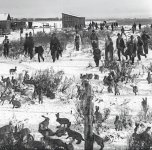
I lived between Moorhead and Detroit Lakes in the 70s, we had some jacks around, not like the pictures in the museum but enough that I could pop one off the deck out in my alfalfa field now and then. Up there pheasants were marginal, severe winters with deep snow and no place to get to out of it made survival hard.
I live 50 miles north of Morehead. Back in the 70's you would see hundreds of them. Disease, coyotes, fox, owls, eagles, farm chemicals, 50ft field cultivators all have contributed to their downfall. They were the best self propelled targets on earth and it was a blast shooting them. Now I see more deer than rabbits, I don't shoot them anymore and slow down or stop rather hitting one with my vehicle.
 
Same here in eastern ND. When I was a kid in the mid 50’s almost everybody had cattle so almost everybody had alfalfa fields. They were an absolute magnet for jacks. A lot of our country roads were just two tracks on almost every section line. Had a 52 Chev pickup with a spotlight. Dad would drive down these roads, shining the light from side to side while I stood in the box resting over the top of the cab with a model 37, 12 gauge, didn’t hit that many bouncing down these rough roads. Didn’t have coyotes back then but jacks and fox went together. When jacks over populate about every 8-10 years they would die out and recover in about 3 years. The ditches on the graded roads would fill up with snow and the jacks would burrow in that snow, shot many in their holes. Haven’t seen a jack like that in probably 30 years. Ain’t what it used to be
 
I suspect there isn't just one answer. And that the reasons are somewhat localized - there may be a different combination of causes in some places than others.

The factors I believe I have witnessed in my local areas would include, disease, drought, fire/habitat degradation and not least - development. Just over all loss of habitat. I don't believe predation has been a factor at all in my area. Just the opposite, lack of jacks has been one of the factors in a dramatic decrease in coyote numbers.

There were studies done on jacks back in the 70's when they were thick and considered a real problem for cattlemen. One of the more interesting ones I read, involved radio collared jacks and tracking their movements, over several years. It was found that for this particular population, at that particular point in time, they were actually quite migratory. In late winter they would travel as far as 25 miles from all around to gather in one spot and stay there for a couple of months. Dispersing again in the spring. Several theories as to why, including a huge orgy/sex/mating gathering, safety in numbers, etc. When jacks gather in dense numbers in deep snow they pound out trails that allow them to run top speed zigging and zagging through the brush. I've witnessed that myself hundreds of times. I have also witnessed jacks in deep snow without pounded down trails get picked off easy peasey by coyotes.

But, anyway... We call these late winter yarding areas the winter orgy grounds. If you know where they are, you can get into incredible numbers at that time of year. Even within the last couple of years, a couple of these spots have still had pretty good numbers at that time of year. I think it was two years ago we shot about fifty each in one day. In Utah.

I personally know of two of these traditional winter orgy spots that have been destroyed by development. It's just one factor among many, but I believe it's an under appreciated factor. At least in my area.

- DAA

 
I wouldn't rule out disease as a major factor. I didn't hardly see any rabbits at all, cottontails or jackrabbits either one for a few years. I also heard reports of rabbits testing positive for Tularemia in Oklahoma. So that could have been why. I didn't shoot any rabbits for quite a while.
 
I lived between Moorhead and Detroit Lakes in the 70s, we had some jacks around, not like the pictures in the museum but enough that I could pop one off the deck out in my alfalfa field now and then. Up there pheasants were marginal, severe winters with deep snow and no place to get to out of it made survival hard.
I grew up in Moorhead. Mid 70s_ mid 80s, the jackrabbit #s were insane.
Dad used to drop my brother and I off in Georgetown in the morning and we'd walk cross country to our uncles about 7 miles away. We each had .22s Winchester semi autos. Several times, we'd get to my uncles empty of rounds.
We would each have a brick (500) when we started. Man, those were fun times!

Now it kinda rare to see one.
 
In 1969 when I was first married. Jackrabbits paid for a lot of groceries & heat bills. There were a fur buyers in Sioux Falls that sold the hides to overseas buyers & ground the carcasses for mink food. They were paying 50 cents each for them & occasionally $1.00!
I bought my 1st center fire (222) for long range kills.
 
I grew up in Moorhead. Mid 70s_ mid 80s, the jackrabbit #s were insane.
Dad used to drop my brother and I off in Georgetown in the morning and we'd walk cross country to our uncles about 7 miles away. We each had .22s Winchester semi autos. Several times, we'd get to my uncles empty of rounds.
We would each have a brick (500) when we started. Man, those were fun times!

Now it kinda rare to see one.
So, there is the answer for that area, Borkon and family killed 'em all!:LOL:
 
Back
Top