

You are using an out of date browser. It may not display this or other websites correctly.
You should upgrade or use an alternative browser.
You should upgrade or use an alternative browser.
Your persoanl Strategies in calling Bobcats
- Thread starter CWeeks
- Start date
Byron South
New member
Lots of good advise.
I've called cats from the harwoods and pine thickets of the east to the mountains and even in the deserts of the southwest. Many people call bobcats while out with intentions of calling coyotes and do quiet well. When this happens to me I take it as a bonus. However sometimes I want to target specifically bobcats and I do set up a little differently and look for different terrain. Bobcats as a rule (pretty good rule) prefer the thicker stuff. Their tactics in the way they aproach a call is also generally different than a coyote's. A coyote will often rush a call or may circle to the downwind. Bobcats will sometimes come pretty fast to a call but will slow way down once they get close and put a stalk on the call. This is where different tactis on your part will pay off.
Bobcats will come a good ways to a call but not near as likely as a coyote so set up close to good cover.
Bobcats as a rule don't like to cross a lot of open ground. If your wanting to call cats give him some cover to use for the stalk but not enough that you can't see him do it. Tall grass or low brush is a no no unless you have some good elevation to see down into it.
Electronic calls are not a must but I will garantee you will see and kill more cats with a remote controlled e-caller. Remember the cat will be stalking the caller. If the caller is you then the cat will often have cover between you and him. If the caller is a remote e-caller then the cat will not be putting the slow stalk on you but the call. This will up the odds of you seeong the cats considerably.
Constant sounds (I use almost exclusively constant sounds even while calling coyotes). Constant sounds will often time keep the cats attention and keep him coming. Cats since of smell is not good so he relies heavily on being able to hear his prey. Once he is close enough he will also depend on his excelent eyesight. This is where decoys come in. Anyone seriously considering calling bobcats need a decoy. A simple feather on a string will work but I like the commercial decoys a little better as they are not reliant on the wind.
I hear it all the time that cats take a long time to come to the call. While this may be so I believe its over stated. I believe most cats come fairly quick to the call just the set ups some guys use force the cats to slow down or hang up making it seem that it took them a whle to get there. Cats typically don't stalk the call from 500 yards out. they close the intial distance pretty quick. It's the last 100 or so yards where they slow down to a crawl. If you set up properly, give them some stalking cover and use a remote e-caller and a decoy your odds will go up dramatically.
I honestly believe that guys that are seeing cats after an hour on stand probably had the cat closer for lots longer than he thought. If you want to sit on stand for that long be my guest as you can certainly call cats at those extended times. For me though my stands last no longer than thirty minutes.
When I break a stand in good cat country I don't just get up and leave either. I slowly stand, look around, take a step, look around and so on. Many times a slinky cat will be there that you never saw. I can't tell you how many cats I've caught hunching down trying to hide with this tactic.
Sounds to use. I tend to use the basic rabbits, jacks and cottontails. I like the busier sounds as a rule, but I like them for coyotes as well. I like to get the excitement level up and create a sence of urgency with my sounds. I've called them with fawn in distress on lots of occasions too. Bobcat in heat sounds work very well at times and I've often used them to get a hung up bobcat to untrack. Rodent sounds are also very good. Don't be afraid of using different sounds but I would hesitate to switch to ofetn when trying to call cats. They can be finicky and sometimes reluctant to come. You may not no one is coming and by switching sounds you could get him to put the breaks on.
Last but not least. Don't get in a hurry, especially once you see the cats responding to your call. they will not spook from the caller like a coyote will, but any false move from you will surely be detected by him and could force him to retreat. Let him come, take your time, and take him when he is close.
OK, one more thing.... When you do shoot him and he goes down like a sack of taters don't assume he is dead. Cats are mostly muscle and are not impressed with hydrostatic shock. I've seen lots of dead bobcats regain their composure after a few moments and get away. Some were never found and some were found only after lots of down time looking.
Good Luck on the bobcats. Let us know how your hunt goes with Paul.
Good Hunting, Have Fun, Be Safe and God Bless,
Byron
I've called cats from the harwoods and pine thickets of the east to the mountains and even in the deserts of the southwest. Many people call bobcats while out with intentions of calling coyotes and do quiet well. When this happens to me I take it as a bonus. However sometimes I want to target specifically bobcats and I do set up a little differently and look for different terrain. Bobcats as a rule (pretty good rule) prefer the thicker stuff. Their tactics in the way they aproach a call is also generally different than a coyote's. A coyote will often rush a call or may circle to the downwind. Bobcats will sometimes come pretty fast to a call but will slow way down once they get close and put a stalk on the call. This is where different tactis on your part will pay off.
Bobcats will come a good ways to a call but not near as likely as a coyote so set up close to good cover.
Bobcats as a rule don't like to cross a lot of open ground. If your wanting to call cats give him some cover to use for the stalk but not enough that you can't see him do it. Tall grass or low brush is a no no unless you have some good elevation to see down into it.
Electronic calls are not a must but I will garantee you will see and kill more cats with a remote controlled e-caller. Remember the cat will be stalking the caller. If the caller is you then the cat will often have cover between you and him. If the caller is a remote e-caller then the cat will not be putting the slow stalk on you but the call. This will up the odds of you seeong the cats considerably.
Constant sounds (I use almost exclusively constant sounds even while calling coyotes). Constant sounds will often time keep the cats attention and keep him coming. Cats since of smell is not good so he relies heavily on being able to hear his prey. Once he is close enough he will also depend on his excelent eyesight. This is where decoys come in. Anyone seriously considering calling bobcats need a decoy. A simple feather on a string will work but I like the commercial decoys a little better as they are not reliant on the wind.
I hear it all the time that cats take a long time to come to the call. While this may be so I believe its over stated. I believe most cats come fairly quick to the call just the set ups some guys use force the cats to slow down or hang up making it seem that it took them a whle to get there. Cats typically don't stalk the call from 500 yards out. they close the intial distance pretty quick. It's the last 100 or so yards where they slow down to a crawl. If you set up properly, give them some stalking cover and use a remote e-caller and a decoy your odds will go up dramatically.
I honestly believe that guys that are seeing cats after an hour on stand probably had the cat closer for lots longer than he thought. If you want to sit on stand for that long be my guest as you can certainly call cats at those extended times. For me though my stands last no longer than thirty minutes.
When I break a stand in good cat country I don't just get up and leave either. I slowly stand, look around, take a step, look around and so on. Many times a slinky cat will be there that you never saw. I can't tell you how many cats I've caught hunching down trying to hide with this tactic.
Sounds to use. I tend to use the basic rabbits, jacks and cottontails. I like the busier sounds as a rule, but I like them for coyotes as well. I like to get the excitement level up and create a sence of urgency with my sounds. I've called them with fawn in distress on lots of occasions too. Bobcat in heat sounds work very well at times and I've often used them to get a hung up bobcat to untrack. Rodent sounds are also very good. Don't be afraid of using different sounds but I would hesitate to switch to ofetn when trying to call cats. They can be finicky and sometimes reluctant to come. You may not no one is coming and by switching sounds you could get him to put the breaks on.
Last but not least. Don't get in a hurry, especially once you see the cats responding to your call. they will not spook from the caller like a coyote will, but any false move from you will surely be detected by him and could force him to retreat. Let him come, take your time, and take him when he is close.
OK, one more thing.... When you do shoot him and he goes down like a sack of taters don't assume he is dead. Cats are mostly muscle and are not impressed with hydrostatic shock. I've seen lots of dead bobcats regain their composure after a few moments and get away. Some were never found and some were found only after lots of down time looking.
Good Luck on the bobcats. Let us know how your hunt goes with Paul.
Good Hunting, Have Fun, Be Safe and God Bless,
Byron
Predator Paul
New member
Quote:
Many people call bobcats while out with intentions of calling coyotes and do quiet well. When this happens to me I take it as a bonus. However sometimes I want to target specifically bobcats and I do set up a little differently and look for different terrain. Bobcats as a rule (pretty good rule) prefer the thicker stuff. Their tactics in the way they aproach a call is also generally different than a coyote's.
Bryon has a great point that I didn't make in my post. When I go for cats, I go for cats. I take a different rifle and I go to different spots than I would for coyotes. Funny thing is, I have only called cats when I have been out calling FOR cats. I have called lots of coyotes calling for cats, but never called a cat when calling for coyotes. /ubbthreads/images/graemlins/confused1.gif It wasn't until I targeted these shy little critters that I became successful.
So, the moral is, it is different, at least here at a mile or more high
Many people call bobcats while out with intentions of calling coyotes and do quiet well. When this happens to me I take it as a bonus. However sometimes I want to target specifically bobcats and I do set up a little differently and look for different terrain. Bobcats as a rule (pretty good rule) prefer the thicker stuff. Their tactics in the way they aproach a call is also generally different than a coyote's.
Bryon has a great point that I didn't make in my post. When I go for cats, I go for cats. I take a different rifle and I go to different spots than I would for coyotes. Funny thing is, I have only called cats when I have been out calling FOR cats. I have called lots of coyotes calling for cats, but never called a cat when calling for coyotes. /ubbthreads/images/graemlins/confused1.gif It wasn't until I targeted these shy little critters that I became successful.
So, the moral is, it is different, at least here at a mile or more high
Wiow! Excellent post, Byron. Dittos my experience, and adds some. I have anecdotes of nearly all of Byron's tips, especially that cats often run till they are just outside of where they can be seen, then they stop or slow down and sneak.
I sometimes set up to see and shoot the cat BEFORE he gets close enough to go into hide and sneak mode. Much easier to see and shoot him.
Have only called three coyotes to specific cat stands that I recall over 20 years. Got a few more bobcats to coyote stands in So. Cal.
Ditto to electronic calls and decoy. I would never have bought an electronic call for coyotes, and got mine specifically for cats. (And would use it for cat-sneaky blacktail bucks if it was legal.)
I sometimes set up to see and shoot the cat BEFORE he gets close enough to go into hide and sneak mode. Much easier to see and shoot him.
Have only called three coyotes to specific cat stands that I recall over 20 years. Got a few more bobcats to coyote stands in So. Cal.
Ditto to electronic calls and decoy. I would never have bought an electronic call for coyotes, and got mine specifically for cats. (And would use it for cat-sneaky blacktail bucks if it was legal.)
CWeeks
New member
Byron,
Thanks for the post that was a very helpful post. And I am fortunate to go with such a good guy and someone who has called cats before in Paul. I can't wait to get out and try to get one in and even see it would be really cool.
Do you use many woodpecker or bird sounds Byron? Also what decoys do you use? I have a jack in the box do you feel like it will work?
Thanks for the post that was a very helpful post. And I am fortunate to go with such a good guy and someone who has called cats before in Paul. I can't wait to get out and try to get one in and even see it would be really cool.
Do you use many woodpecker or bird sounds Byron? Also what decoys do you use? I have a jack in the box do you feel like it will work?
Byron South
New member
Thanks guys but all were good post.
Any distress sounds will work but I like the busier more urgent sounds. I've called lots of bobcats with bird sounds but to be honest it's hard to beat the old tried and true rabbit sounds.
I've used lots of different decoys and they all work. I'm currently using the jack in the box from FOXPRO. The toper I like on it is the little rabbit. It has some white on it and I believe it stands out more. What I like about the JITB is I can turn it off and on from the remote. When calling coyotes I ususally keep it off until I get one hung up looking for movement. In more open country though I leave it running. For cats I would leave it running as well. The JITB also has a little squeaker made into it that is cool. It can be used alone as a call and decoy once the cat is close.
Paul obvoiusly knows his stuff and is familiar with the cats in the area as well as what habitat to concentrate on. Hunting with him will surely be a great way to learn a trick or two.
One more thing on cats that I'm sure you've already heard but it is so true. Most guys have no idea how many cats they call in and never see. Cats generally slink in and when you do see them they seem to miracuously appear from thin air. Fact is, this is by design. Cats most of the time slink in using the cover. It is very tough to spot a cat when he is playing peek-a-boo with you from the cover. While coyote hunting you usually see the entire coyote coming in at a good pace. Not so with cats. In most good cat habitat you will only see samll parts of him and he usually is moving very stealthy and methodical. Their natural camoflage and slow fluid movements combine to help him do his job. I heard for years that cats are easier to call at night but I'm not sure I buy that. I believe this stems from the fact that they are just easier seen at night. Its hard for a cat to hide those big glowing eyes from the light at night. I believe they are just as receptive to the call at any time. During daylight though they are sometimes very difficult to see and often see you first. Sitting motionless and wearing good camoflage is a must if you want to call and kill many cats. As mentioned by others in this thread cats will spot any movement and lock onto it fast. Don't move until you go to shoot and then just move slow, and deliberate and get it done.
Good Hunting,
Byron
Any distress sounds will work but I like the busier more urgent sounds. I've called lots of bobcats with bird sounds but to be honest it's hard to beat the old tried and true rabbit sounds.
I've used lots of different decoys and they all work. I'm currently using the jack in the box from FOXPRO. The toper I like on it is the little rabbit. It has some white on it and I believe it stands out more. What I like about the JITB is I can turn it off and on from the remote. When calling coyotes I ususally keep it off until I get one hung up looking for movement. In more open country though I leave it running. For cats I would leave it running as well. The JITB also has a little squeaker made into it that is cool. It can be used alone as a call and decoy once the cat is close.
Paul obvoiusly knows his stuff and is familiar with the cats in the area as well as what habitat to concentrate on. Hunting with him will surely be a great way to learn a trick or two.
One more thing on cats that I'm sure you've already heard but it is so true. Most guys have no idea how many cats they call in and never see. Cats generally slink in and when you do see them they seem to miracuously appear from thin air. Fact is, this is by design. Cats most of the time slink in using the cover. It is very tough to spot a cat when he is playing peek-a-boo with you from the cover. While coyote hunting you usually see the entire coyote coming in at a good pace. Not so with cats. In most good cat habitat you will only see samll parts of him and he usually is moving very stealthy and methodical. Their natural camoflage and slow fluid movements combine to help him do his job. I heard for years that cats are easier to call at night but I'm not sure I buy that. I believe this stems from the fact that they are just easier seen at night. Its hard for a cat to hide those big glowing eyes from the light at night. I believe they are just as receptive to the call at any time. During daylight though they are sometimes very difficult to see and often see you first. Sitting motionless and wearing good camoflage is a must if you want to call and kill many cats. As mentioned by others in this thread cats will spot any movement and lock onto it fast. Don't move until you go to shoot and then just move slow, and deliberate and get it done.
Good Hunting,
Byron
First I dont bother with worrying about the wind/direction.
I try to sit as far away from the caller as possible and elevated if possible.
I try to get off the flat land and into the mountains/hills.
Look for heavy cover.
Hunt at night with red filter.
Sit really still and watch for movment, I have had them hang up and sit and look with my only clue the flip of an ear or very slight movment. Ive called in some thick stuff where visability is less than 20feet. Never give up and stop trying new areas and ideas. If in doubt leave the rifle in the car and call at night with spotlight to get idea of what animals are out there. Bobcats will frequent areas where food is, bowls in the mountains, sage brush for rabbits, trees for squirrels. In one area every cat we have gotten just about has had squirrel in their stomachs. A decoy will not hurt even if its not moving, but movment is better. Whirling woodpecker or stuffed rabbit fur.
Lastly dont rush a shot cats normally give more than one opportunity so stay still and pick your shots. Also clear the ground a little around you for your bipod when you sit down.
I try to sit as far away from the caller as possible and elevated if possible.
I try to get off the flat land and into the mountains/hills.
Look for heavy cover.
Hunt at night with red filter.
Sit really still and watch for movment, I have had them hang up and sit and look with my only clue the flip of an ear or very slight movment. Ive called in some thick stuff where visability is less than 20feet. Never give up and stop trying new areas and ideas. If in doubt leave the rifle in the car and call at night with spotlight to get idea of what animals are out there. Bobcats will frequent areas where food is, bowls in the mountains, sage brush for rabbits, trees for squirrels. In one area every cat we have gotten just about has had squirrel in their stomachs. A decoy will not hurt even if its not moving, but movment is better. Whirling woodpecker or stuffed rabbit fur.
Lastly dont rush a shot cats normally give more than one opportunity so stay still and pick your shots. Also clear the ground a little around you for your bipod when you sit down.
Colorado Pete
New member
Carl, I see from your other posts you've been busy and successful!
Go with Paul, sit still, listen and learn. He'll learn ya a lot. ;-) Post pics after!
Paul, we never did get out over the last two winters like I wanted to, I'll have to give you a buzz soon. I'm thinking the north side of the Arkansas throughout the gorge area, from Rt. 9 out almost to Salida.
Good luck fellas!
Go with Paul, sit still, listen and learn. He'll learn ya a lot. ;-) Post pics after!
Paul, we never did get out over the last two winters like I wanted to, I'll have to give you a buzz soon. I'm thinking the north side of the Arkansas throughout the gorge area, from Rt. 9 out almost to Salida.
Good luck fellas!
Predator Paul
New member
Pete!
Nice to hear from you. Yes, yes, it's been too long. I miss having you edumacate me on all the prehistoric stuff too. I have actually passed a few thing along to other hunters that have been with me. (If you don’t mind) That, and you have traveled every two track road in the entire state and can describe each and every turn. /ubbthreads/images/graemlins/smile.gif
How's the pistol tourneys going? Still shooting?
Colder than a well diggers rear end here right now. It's 3:45 AM and I'm drinking coffee getting ready to head out and wack something.
The area you are talking about I have been through. But not really hunted it. Great cat country, a little tight, but some good openings for calling. Lets do it.
Paul
Quote:
Paul, we never did get out over the last two winters like I wanted to, I'll have to give you a buzz soon. I'm thinking the north side of the Arkansas throughout the gorge area, from Rt. 9 out almost to Salida.
Good luck fellas!
Nice to hear from you. Yes, yes, it's been too long. I miss having you edumacate me on all the prehistoric stuff too. I have actually passed a few thing along to other hunters that have been with me. (If you don’t mind) That, and you have traveled every two track road in the entire state and can describe each and every turn. /ubbthreads/images/graemlins/smile.gif
How's the pistol tourneys going? Still shooting?
Colder than a well diggers rear end here right now. It's 3:45 AM and I'm drinking coffee getting ready to head out and wack something.
The area you are talking about I have been through. But not really hunted it. Great cat country, a little tight, but some good openings for calling. Lets do it.
Paul
Quote:
Paul, we never did get out over the last two winters like I wanted to, I'll have to give you a buzz soon. I'm thinking the north side of the Arkansas throughout the gorge area, from Rt. 9 out almost to Salida.
Good luck fellas!
davr
New member
Quote:
I would not use any coyote/pup distress if you really want a kitty.
Twice yesterday around the 15 minute mark, I let loose with a death cry/pup distress and sure as heck a kitty was coming into the snowshoe hare/lighting jack and got spooked and turned around to leave.
Funny, the cat my son just took a few weeks back came in to just that sound, coyote pup distress. Played rabbit sounds for the first 10 minutes, and was 3 or 4 minutes into coyote pup distress when he came trotting up out of the wash. After my son put him down, it shocked me a bit that he came into a coyote distress vocal, but then I thought "heck, why not, what bobcat wouldn't mind a little coyote pup on the menu?".
I would not use any coyote/pup distress if you really want a kitty.
Twice yesterday around the 15 minute mark, I let loose with a death cry/pup distress and sure as heck a kitty was coming into the snowshoe hare/lighting jack and got spooked and turned around to leave.
Funny, the cat my son just took a few weeks back came in to just that sound, coyote pup distress. Played rabbit sounds for the first 10 minutes, and was 3 or 4 minutes into coyote pup distress when he came trotting up out of the wash. After my son put him down, it shocked me a bit that he came into a coyote distress vocal, but then I thought "heck, why not, what bobcat wouldn't mind a little coyote pup on the menu?".
IdahoSawtooth
Member
CWeeks I have only shot 2 cats here in SE Idaho. The first one I cut the tracks in fresh snow and followed them for a ways till I found a likley looking spot then called for about 3 or 4 minutes and the cat was there right in front of me out of no where. Probably just a lucky guess on that one and she happened to be close. The second we caught sneaking out on a 30 minute set. I imagin it came in unnoticed and then left and we were lucky enough to spot it. Both these cats were in the hills east of Idaho Falls. They say that the lava flows around here has one of the highest populations of cats in this part of the state, and I believe it judging by the number of tracks I have seen out there. I have trapped a few there but have never been able to call one in, at least that I have seen. There is alot of cover there for them to sneak around in.
CWeeks
New member
I have a really good friend who lives in Idaho Falls and his father in law owns a ranch in those hills to the east up by the windmills. We have seen Lion and Bobcat tracks. we have only called in yotes up there though. He told us we could shoot a Bobcat if we wanted but he didn't want us shooting to many of them. He likes having them around.
IdahoSawtooth
Member
Their last name wouldn't be Elkington would it because they told me the same thing.
CAT DADDY COLD
New member
Hunt where the cats are. Here is a pic ofmy calling partners okie limit of 20 before I piled my meger 13 to them on sale day last year.
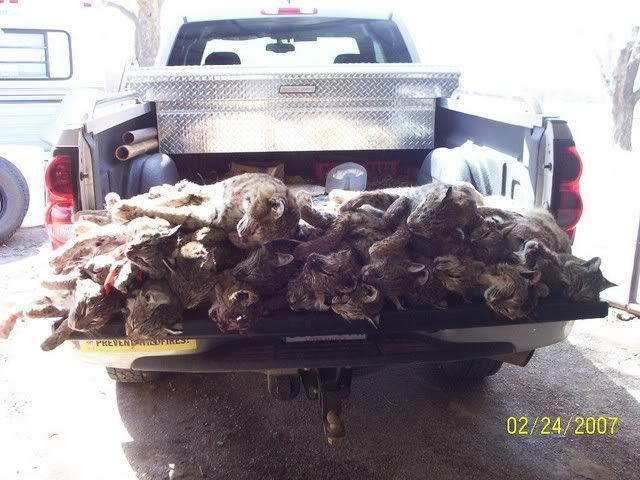
Here is a pic of our best cat day last Dec.
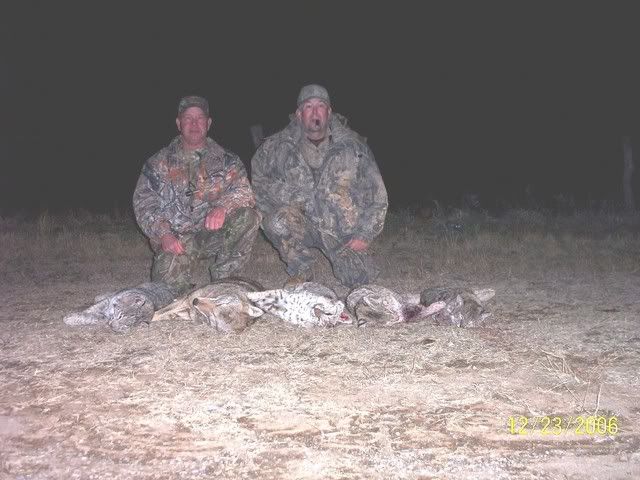
Most of our cats come within 15 minutes, some run in like a coyote. Sometimes they belly sneek in. Sometimes you just see half a cats head peeking thru the weeds.
Sometimes you don't see them until they get to the decoy.
Look your area over and get it in your head. Then as you slowly scan, be looking for a piece of cat that was not there before.
I like to set up close to a thicket and call them to the edge. Lots of times they come to the edge and just sit down.....easy 50 yards shot.
Good luck with your quest. Kelly
Here is a pic of our best cat day last Dec.
Most of our cats come within 15 minutes, some run in like a coyote. Sometimes they belly sneek in. Sometimes you just see half a cats head peeking thru the weeds.
Sometimes you don't see them until they get to the decoy.
Look your area over and get it in your head. Then as you slowly scan, be looking for a piece of cat that was not there before.
I like to set up close to a thicket and call them to the edge. Lots of times they come to the edge and just sit down.....easy 50 yards shot.
Good luck with your quest. Kelly
gonzaga
New member
Man this is a great thread. I learned alot from everybody. I am wanting to take some pictures of some areas and see what you guys think. I understand the concept that they like thick stuff. I had heard also that they preferred areas with lots of rocks on it. We have a bunch of cedars and scrub oak and some thick thorn bushes. I have one spot that I found where a turkey had been eaten for lunch. It is pretty thick and there are some small opeinings too, so I will be heading that way next time I am in the canyon. Thanks to all of you.
gonzaga
gonzaga
Predator Paul
New member
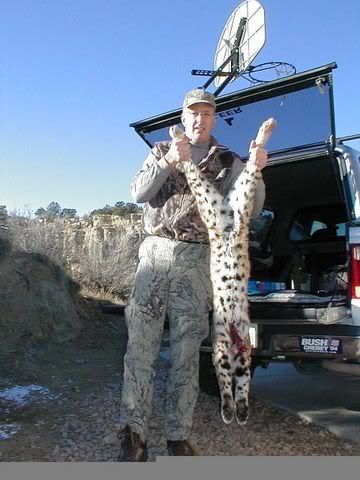
Look at the country behind the hoop! They love that stuff.......PLAYER!
/ubbthreads/images/graemlins/smile.gif
Quote:
Hey, if you would stop playing basketball on stand and call cats right away it might not take so long.. /ubbthreads/images/graemlins/confused1.gif /ubbthreads/images/graemlins/laugh.gif /ubbthreads/images/graemlins/smile.gif
/ubbthreads/images/graemlins/smile.gif
Quote:
Hey, if you would stop playing basketball on stand and call cats right away it might not take so long.. /ubbthreads/images/graemlins/confused1.gif /ubbthreads/images/graemlins/laugh.gif /ubbthreads/images/graemlins/smile.gif
Predator Paul
New member
That's a lot of [beeep] for a tailgate party. Next time, call a couple friends!!
/ubbthreads/images/graemlins/smile.gif
Quote:
/ubbthreads/images/graemlins/smile.gif
Quote:
CWeeks
New member
CAT DADDY,
Holy crap that is a lot of cats on the tail gate. That is awesome.
IdahoSawtooth,
That would be the Elkington crew. Do you know them personally? His son in law Dave his daughter are really great friends of mine. They are great people. Have you been up hunting on their ranch? They are a little finiky about who they let up there ate times.
Holy crap that is a lot of cats on the tail gate. That is awesome.
IdahoSawtooth,
That would be the Elkington crew. Do you know them personally? His son in law Dave his daughter are really great friends of mine. They are great people. Have you been up hunting on their ranch? They are a little finiky about who they let up there ate times.