Bullet revolutions per 100 yards

I pointed this stuff out because I thought it was interesting. I did not intend to upset people about these articles and if I did I'm sorry.
 
Originally Posted By: CatShooterWhen traveling sideways, the air under it will come in contact with the "under belly" of the bullet, and the rotation will cause air to be pulled from the right side over to the left side (looking from the rear) - (it is the same as the forces that cause curve balls in baseball) - the result is that the bullet is pulled to the right - not much at first, but an increasing amount as it travels down range - some "theorists" say 20" to 40" at 1,000 yds, but these green children have never shot at 1,000 yards. The real amount is a few inches... most of the time, an error that is lost in the "noise" of shooting errors.

What the theorists are forgetting when they talk about bullets sitting on a cushion of air that makes a bullet "spin drift" 20-40" at 1,000yrds is that the cushion of air is being shed behind the bullet, rather than being able to establish a force beneath the bullet.

Theoretical physists can do a lot of experiments that would PROVE a bullet SHOULD drift 20-40" over 1,000yrds, and for a static rotating shaft, I'd tend to agree, HOWEVER, as an engineer versed in fluid mechanics/dynamics, I can tell you that what we see in real life is easily supported, and disproves the 20-40" prediction. In laymans terms, the spin of the bullet is spitting the cushion of air beneath the bullet out from beneath itself, much like a truck spinning his tires on a welcome mat.

 
Originally Posted By: Jabey9210we have found that when he builds some people guns they tell him that their groups are smaller at 200 yrds than they are at 100 yrds. I read an article a long time ago I have no idea where but it stated to turn your scope down half the power that you normally have it on while shooting 200 yrds when shooting 100yrds and because you are essentially making the same shot because the target is the same size in your scope your groups will shrink at the closer distance. This is what I read and we've tried it and it truely does work. Don't knock til you've tried it.

What you're experiencing is a "new shooter" problem, not anything magical about scopes or bullets finding their way back to center at longer ranges.

I had a similar experience when I was shooting competitive smallbore. I had a 20x scope shooting at 50yrds indoor, scored very well, but hit a glass ceiling. Some of the older shooters on my club suggested I try their open sighted rifles for a few weeks.

Somehow I shot better scores WITHOUT a scope than I did shooting with a 20x! This puzzled me for about a year until I started instructing a woman's riflery class and realized what was REALLY different.

The better you can see your target, the more you'll notice your own movement, and the more you will try to muscle your rifle around, causing inconsistent pressures against your rifle, and delivering inconsistent shots. The better practiced you are with your rifle, and the more you practice using your natural point of aim, the less dramatic that effect will be. It's VERY hard (especially for men) to resist the urge to PUSH their crosshairs onto target. At 200yrds, you can't notice your small bobbles and slight movements as well, and you can't notice as easily that your crosshairs are 1/8" off center, so you don't push as hard on your rifle.

If a shooter uses the proper natural point of aim techniques, he'll be able to maximize his accuracy, and WILL NOT shoot better at 200 than 100, regardless of his scope magnification.
 
You do see this deflection at 500yrds, but it's non-linear. The bullet's deceleration isn't linear, therefore the forces acting on the bullet don't change linearly.

If a bullet "spin drifts" 5" at 1000yrds, I'd venture that it only drifts about 1" at 500yrds (proportionately LESS than half of it's 1000yrd drift), which most shooters would attribute to their own misjudgement of the wind, or any of 100 other factors, rather than singling out spin drift.
 
Originally Posted By: Varminterror

"If a bullet "spin drifts" 5" at 1000yrds, I'd venture that it only drifts about 1" at 500yrds... "


Not even.

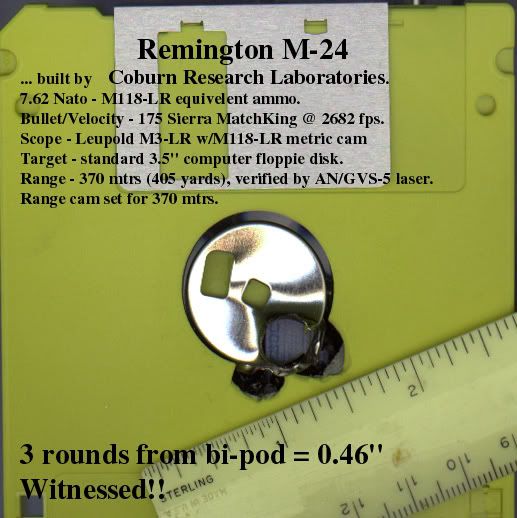
I zeroed the rifle at 100 and dialed the elevation for 405 yards and shot the group with a dead on hold.
There was about 1/4" of "drift".

The rifle was fitted with a bunch of bubble levels and was dead flat.

M24Rifle046inchgroup-300.jpg
 
Originally Posted By: CatShooterOriginally Posted By: Varminterror

"If a bullet "spin drifts" 5" at 1000yrds, I'd venture that it only drifts about 1" at 500yrds... "


Not even.

I zeroed the rifle at 100 and dialed the elevation for 405 yards and shot the group with a dead on hold.
There was about 1/4" of "drift".

The rifle was fitted with a bunch of bubble levels and was dead flat.

M24Rifle046inchgroup-300.jpg


How much for the rifle?

 
Wow, Cat, that was one helluva great demonstration of shooting! Thanks for the physics refresher too, I appreciate it. Like I said, I was not trying to be difficult, I was trying to learn, and you did just fine! Thanks again!

Ridgeline, PLEASE DO continue to post those articles, I for one enjoy the education and the conversation they generate! We can all learn some things from them!
 
Originally Posted By: Ridgeline17Originally Posted By: CatShooterOriginally Posted By: Varminterror

"If a bullet "spin drifts" 5" at 1000yrds, I'd venture that it only drifts about 1" at 500yrds... "


Not even.

I zeroed the rifle at 100 and dialed the elevation for 405 yards and shot the group with a dead on hold.
There was about 1/4" of "drift".

The rifle was fitted with a bunch of bubble levels and was dead flat.

M24Rifle046inchgroup-300.jpg


How much for the rifle?


I was offered $3,500 for it (less scope), it at the range the day I shot the group.

I still have it - and I built a 300 Win Mag twin.

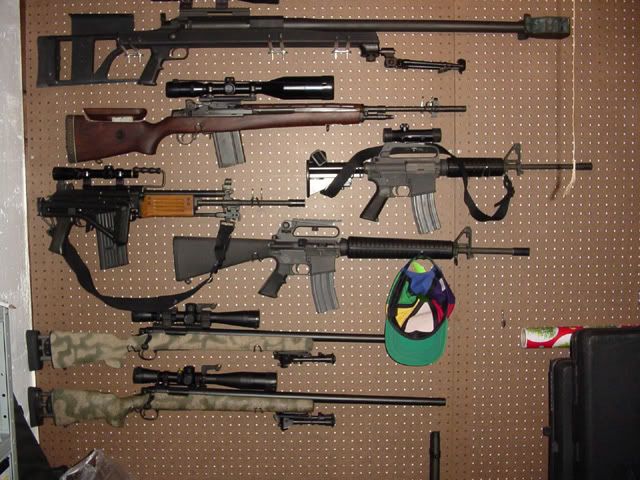
They are the two rifles in "Sand & Spinach" camo on the bottom of the rack.

Insidethedoor-640.jpg


.
 
Not a physics major and didnt stay at holiday inn but this stuff is fascinating. If I could have made sense of the math I'd have killed a dozen years in grad school doing a phd in physics. I understand what Cat is saying, at least at a rudimentary level, but Brian Litz articles got me thinking. If a barrel is poorly crowned such that a bullet experiences a perturbation that changes its angle of attack, vertically, horizontally, or both as it leaves the barrel it will point in an ever so slightly different direction from its direction of travel as it exits the muzzle.

http://bryanlitz.bravehost.com/EpSwerv.html


Is this possible? Litz seems to think so. If this happens, the aerodynamic load on the side of the bullet should, it seems, nudge the bullet in the direction in which it is pointed at the instant it exits the muzzle. However, rather than taking off in a new direction, the rotation of the bullet translates this perturbation into a "wobble" that leads to a trajectory resembling a poorly thrown football or a corkscrew as Lifz/McCoy describe it. What is the final effect? ??? If the wobble is big enough I'd think it would lead to a broader dispersion of points of impact. If you happened to have bullets traveling at very near the same velocity they may all impact at the same point in their corkscrew flight path hitting very near each other on the target. If some are faster or slower they may hit at a different angular point on the path thus hitting a different location. This is probably hopelessly simple minded, but it really is interesting. Thanks for listening.
 
Last edited:
The wobble would translate from the direction of the lands. And if you go to the Redfield site there is a video in slow motion of them testing the Accurange reticle, firing from 100-500 yds. In the video you can actually see some of this wobble in the vapor trail.
 
What the theorists are forgetting when they talk about bullets sitting on a cushion of air that makes a bullet "spin drift" 20-40" at 1,000yrds is that the cushion of air is being shed behind the bullet, rather than being able to establish a force beneath the bullet.

So they actually believe that the bullet is riding on the air like a hydrofoil craft (believe that is the type of craft I'm thinking of)?
 
Originally Posted By: Ricky BobbyNo one has mentioned if we're talking about clockwise or counter-clockwise revolutions ... just wanting to clarify

Clock wise (viewed from the rear)
 
I "think" it's more like the interaction of a spinning baseball with the air it goes through. Backspin imparts an upward force, topspin a downward force and sidespin a lateral force (the direction depends on the direction of the spin). Combine front or back with side and you can make a baseball or soccerball do wondrous things.
 
Last edited:
Originally Posted By: Ridgeline17The wobble would translate from the direction of the lands. And if you go to the Redfield site there is a video in slow motion of them testing the Accurange reticle, firing from 100-500 yds. In the video you can actually see some of this wobble in the vapor trail.


The vapor trail does not show wobble - it is showing the turbulence of air once the bullet has passed. Think of the smoke trails of rockets a few seconds after the rocket has passed - the trail is not straight, it is wobbley. When you see something with bullets, it is very important to make sure that you understand what you are seeing - other wise, new "wives tales" are created.

The mass of a bullet cannot wobble while it travels - the gyroscopic momentum will not allow that kind of motion.

IF, a crown is bad (very very rare) and it launches a bullet off the axis, then THAT is the direction of the bullet, and there is nothing that can be done, nor is there any difference in it's path. It will behave like any other bullet shot in any other direction.


.
 
Back
Top