

You are using an out of date browser. It may not display this or other websites correctly.
You should upgrade or use an alternative browser.
You should upgrade or use an alternative browser.
So you think you can shoot????
- Thread starter Gerhard
- Start date
JoeF, Thank you.
Kirby, thanks for the diagram! That really shows how you do that.
This maybe needs a thread of its own, but here's another wrinkle on locating distant game. I use a compass a lot. One time when a partner wounded a big 4x4 mule deer across a narrow, deep canyon, the buck made it over the far ridge. It was nearly 1000 feet down and back up again, in a burn that looked the same on the whole canyon side, with a mile long ridge above it with no timber or distinguishing marks. Just low even scrub brush, no saddles, bluffs, or humps on the ridge.
I took a compass reading on where the buck crossed the far ridge without taking my eyes off of the spot or moving. If we went straight to it following the compass line, it was going to be a LONG miserable climb down and up. I am lazy about such climbs. Hmmm... Keeping my eyes on the spot where the buck crossed the ridge, by moving 30 feet to one side I could line up the only thing I was sure I could see and identify from the other ridge, a single standing burned snag. So now the compass heading, set on the base plate, went from me straight through the snag to where the buck crossed the ridge.
With that info, we could pocket the compass and easily go around the level contour of the mountain. Once out on the ridge we took a reverse compass reading on the snag, 180 degrees from the reading where we started. I didn't even arithmetic out a reverse heading, just turned the compass around so the south needle read north on the dial, and stopped when it lined up on the snag. Bingo. We were six feet from the buck's tracks and blood trail.
If a wounded animal crosses any line, such as a trail, edge of woods, road, fence, etc. you can use a compass to pick up his trail at that point. Take a compass bearing on the spot where he crossed the line, then mark the spot where you're standing if needed with a cap, etc. (I've used Safeway white plastic shopping bags) so you can see back to it when you get there. Then pocket the compass, walk the easiest way to the line, and go along it till you line up your reverse heading on the spot you marked. Where the compass line crosses the physical linnear feature on the ground, be it fence, edge of clearcut, whatever, that's the spot where you saw the animal. Good way to pick up a trail or a downed animal across a lake, swamp, etc.
Liquid filled compasses with a base plate, about $10, do fine for this kind of work and the needle is steady without the jiggle.
Kirby, thanks for the diagram! That really shows how you do that.
This maybe needs a thread of its own, but here's another wrinkle on locating distant game. I use a compass a lot. One time when a partner wounded a big 4x4 mule deer across a narrow, deep canyon, the buck made it over the far ridge. It was nearly 1000 feet down and back up again, in a burn that looked the same on the whole canyon side, with a mile long ridge above it with no timber or distinguishing marks. Just low even scrub brush, no saddles, bluffs, or humps on the ridge.
I took a compass reading on where the buck crossed the far ridge without taking my eyes off of the spot or moving. If we went straight to it following the compass line, it was going to be a LONG miserable climb down and up. I am lazy about such climbs. Hmmm... Keeping my eyes on the spot where the buck crossed the ridge, by moving 30 feet to one side I could line up the only thing I was sure I could see and identify from the other ridge, a single standing burned snag. So now the compass heading, set on the base plate, went from me straight through the snag to where the buck crossed the ridge.
With that info, we could pocket the compass and easily go around the level contour of the mountain. Once out on the ridge we took a reverse compass reading on the snag, 180 degrees from the reading where we started. I didn't even arithmetic out a reverse heading, just turned the compass around so the south needle read north on the dial, and stopped when it lined up on the snag. Bingo. We were six feet from the buck's tracks and blood trail.
If a wounded animal crosses any line, such as a trail, edge of woods, road, fence, etc. you can use a compass to pick up his trail at that point. Take a compass bearing on the spot where he crossed the line, then mark the spot where you're standing if needed with a cap, etc. (I've used Safeway white plastic shopping bags) so you can see back to it when you get there. Then pocket the compass, walk the easiest way to the line, and go along it till you line up your reverse heading on the spot you marked. Where the compass line crosses the physical linnear feature on the ground, be it fence, edge of clearcut, whatever, that's the spot where you saw the animal. Good way to pick up a trail or a downed animal across a lake, swamp, etc.
Liquid filled compasses with a base plate, about $10, do fine for this kind of work and the needle is steady without the jiggle.
Last edited:
NM Leon
New member
Triangulation is great, but for long range big game shooting it's completely unnecessary. /ubbthreads/images/graemlins/confused.gif
You had a spotter when you shot who was of course looking right at the animal. He's still looking right at the animal (or where he was/fell) when you go to find him, and he's directing you to that point. /ubbthreads/images/graemlins/shocked.gif
I generally hunt alone for long range coyotes, but I don't need a spotter to find the animal/location because I've already been there setting up my e-caller. /ubbthreads/images/graemlins/smiliesmack.gif
Calculating the effects of wind (and mirage) is extremely difficult, almost an art. When the heat is causing more than the faintest mirage, and/or the wind is more than the faintest breath and/or variable, the formula I use is the same one that everybody else uses. I hunt short range stands. /ubbthreads/images/graemlins/grin.gif
You had a spotter when you shot who was of course looking right at the animal. He's still looking right at the animal (or where he was/fell) when you go to find him, and he's directing you to that point. /ubbthreads/images/graemlins/shocked.gif
I generally hunt alone for long range coyotes, but I don't need a spotter to find the animal/location because I've already been there setting up my e-caller. /ubbthreads/images/graemlins/smiliesmack.gif
Calculating the effects of wind (and mirage) is extremely difficult, almost an art. When the heat is causing more than the faintest mirage, and/or the wind is more than the faintest breath and/or variable, the formula I use is the same one that everybody else uses. I hunt short range stands. /ubbthreads/images/graemlins/grin.gif
10-4 JoeF.
I brought up "triangulating" so other members may learn how to use it as a tool. For figuring out where their animal was standing/bedded, prior/during a long shot.
I hunt almost exclusively by myself. So it comes in very handy w/o a spotter.
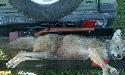
Snow cover; When I miss or have a blood trial. Both visuals are often found where[focal area] the coyote once was. Which in turn, I'm able to pick up the track & direction of the wounded coyote. Not to mention where my missed bullet hit.
I brought up "triangulating" so other members may learn how to use it as a tool. For figuring out where their animal was standing/bedded, prior/during a long shot.
I hunt almost exclusively by myself. So it comes in very handy w/o a spotter.
Snow cover; When I miss or have a blood trial. Both visuals are often found where[focal area] the coyote once was. Which in turn, I'm able to pick up the track & direction of the wounded coyote. Not to mention where my missed bullet hit.